From Requirement to TestFlight: How an AI Frontend Development Engine Closes the Delivery Gap
Enterprise teams do not lack ideas. Instead, they lack a fast, governed path from a written requirement to a working, testable build. Scaffolding, environment setup, stakeholder previews, and mobile signing routinely stretch a simple request into weeks of coordination overhead. This case study traces that exact path through an AI frontend development engine, following one…
Enterprise teams do not lack ideas. Instead, they lack a fast, governed path from a written requirement to a working, testable build. Scaffolding, environment setup, stakeholder previews, and mobile signing routinely stretch a simple request into weeks of coordination overhead.
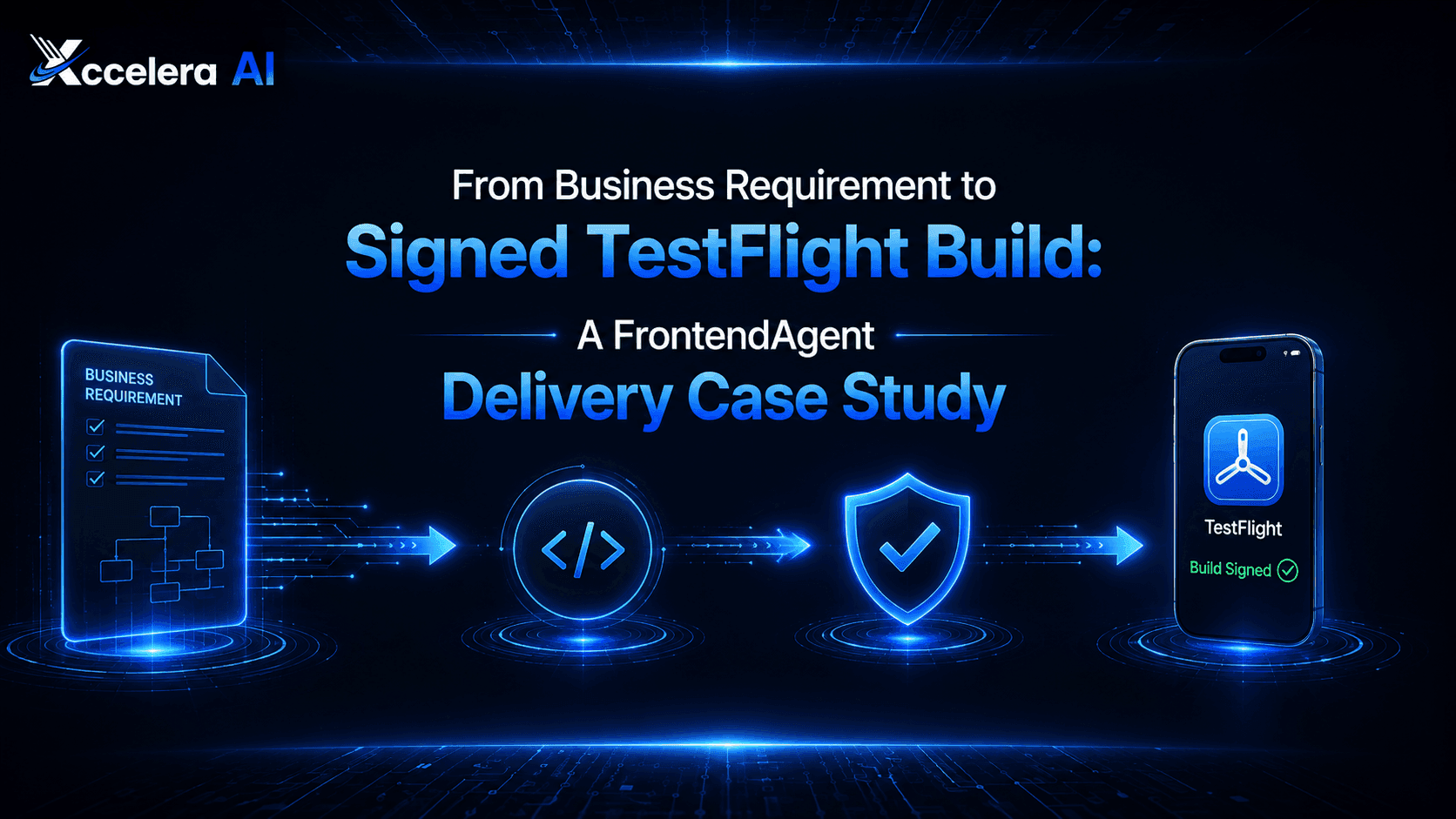
This case study traces that exact path through an AI frontend development engine, following one requirement from plain-English description to a signed, distributable TestFlight build. It measures the delivery-time and cost outcomes that bottom-funnel enterprise buyers, the founders, directors, and CTOs closest to a signing decision, actually evaluate before committing a budget.
The Hidden Cost of Slow Enterprise App Delivery
Every enterprise frontend project starts the same way. A stakeholder writes a requirement, an engineering team estimates scaffolding time, and a release date gets promised before a line of code exists. That promise rarely survives contact with reality.
A 2026 industry assessment found that median lead time to production across large enterprises still sits at 30 to 45 days, even with AI tools accelerating individual coding tasks. According to DORA’s own lead time definition, even elite performers measure lead time from commit to production in hours, not weeks, which makes the enterprise-wide 30-to-45-day figure a clear signal of surrounding process drag, not coding speed.
Large organizations continue to face delays concentrated in testing, security, compliance, governance, and release management, even where AI has sped up the coding step itself. The bottleneck was never typing speed. Instead, it was everything surrounding the code: routing setup, environment configuration, live preview access, and the mobile build chain.
From Business Requirement to Working Build: Closing the Delivery Gap
The gap between “we approved the requirement” and “stakeholders can click through a real build” is where most delivery timelines quietly collapse. A requirement gets handed off, an engineer opens a terminal, and days pass before anyone outside engineering sees a running screen.
Enterprises now expect that gap to close in hours, not sprints. Broader agentic AI research backs this shift in expectation. Organizations report meaningful time gains across the entire development lifecycle, not just initial code output, with roughly equal productivity gains showing up in generation, documentation, review, and planning work alike.
That distribution matters. It means the fastest gains do not come from writing code faster in isolation. Instead, they come from removing every handoff between “requirement written” and “build reviewable.”
As a result, buyers increasingly judge frontend tooling by one question. How fast does a plain-English requirement become a reviewable, running application, and how safely can that application change afterward without a full rebuild cycle?
AI Frontend Development Engine: Turning Requirements Into Shipped Code
An AI frontend development engine changes the starting point of every project. Instead of a blank repository, a written requirement, optionally paired with Figma frames, becomes the input to a governed generation pipeline.
The system selects a target framework, React, Angular, or Expo/React Native, and generates a full project structure, complete with routing, components, and styling. An automated judge-and-fix-pass loop validates the output before anything reaches a human reviewer, closing the quality gap that ad hoc AI code assistants routinely leave open.
This differs sharply from prompt-based coding tools. The market itself reflects that distinction. Enterprise buyers are no longer comparing raw generation quality alone; instead, they increasingly weigh a vendor’s ability to coordinate complete workflows end to end. The enterprise AI coding agent market reached an estimated $9.8 billion to $11.0 billion annualized as of April 2026, a signal that governed, workflow-level platforms are pulling budget away from narrower point tools.
Inside the Pipeline: Requirement to TestFlight Build Timeline
The full delivery sequence runs as one continuous, auditable job, rather than a chain of disconnected tools.
| Stage | What Happens | Typical Manual Equivalent |
|---|---|---|
| Requirement intake | Plain-English spec plus optional Figma frames | Discovery workshops, days |
| Code generation | Full project scaffold generated per target framework | Manual scaffolding, hours to days |
| Validation | Automated judge and fix-pass loop | Manual code review cycles |
| Live preview | Detached dev server with public tunnel | Manual deploy, port-forwarding |
| Modification | Git-committed change with accept or rollback | Ad hoc edits, no clean undo |
| Native build | Signed Android APK or App Store-signed iOS IPA | Local Mac, certificates, manual signing |
| Distribution | Upload to TestFlight or equivalent | Manual App Store Connect handling |
The mobile build stage historically causes the worst delays. Manual iOS signing setup alone typically consumes 4 to 8 hours of initial engineering time before a single build ships, according to current CI/CD guidance, and that estimate assumes an already-configured Apple Developer account.
An AI frontend development engine collapses that stage instead. It pushes the generated project to a certificate-managed pipeline, runs a remote macOS build, signs through an established Fastlane and Match process, and uploads directly to TestFlight, producing a real, installable build rather than a simulator screenshot.
Two readiness checks run before any preview or build reaches a stakeholder. One confirms the application bundle itself is responding, and a second confirms the public preview URL is reachable, so nobody clicks a broken link during a live demo. That same discipline carries through to native builds. The pipeline polls the remote build job on a fixed interval until the signed artifact is ready, storing the result against the original job so engineering leadership can trace a shipped build back to the exact requirement that triggered it.
Delivery-Time and Cost Metrics Enterprise Buyers Actually Track
Bottom-funnel buyers do not evaluate frontend tooling on feature lists. Instead, they evaluate it on the same delivery metrics their engineering leadership already reports to the board.
- Lead time from commit to a reviewable, running build
- Time from requirement approval to first stakeholder-visible preview
- Rollback safety during iteration, measured by how cleanly a rejected change reverts
- Cost per shipped feature, inclusive of scaffolding, review, and mobile signing overhead
- Native build turnaround, from code freeze to a signed, distributable artifact
Elite engineering organizations increasingly track lead time and deployment frequency together, treating speed and stability as a single system rather than a trade-off. That framing matters for procurement conversations.
A platform that only speeds up code generation but leaves preview access, rollback, and mobile signing manual has not actually closed the delivery gap. It has just moved the bottleneck downstream.
Engineering Velocity Without Sacrificing Quality or Compliance
Speed without governance creates its own liability, and enterprise security teams have taken notice. Veracode’s 2026 GenAI Code Security Report, which tested more than 100 AI models, found that roughly 44 percent of AI code generation tasks introduced a risky security vulnerability, with average security pass rates barely improving year over year.
That finding makes an unreviewed, ungoverned generation pipeline a nonstarter for regulated buyers. A governed AI frontend development engine addresses this directly through structural controls, rather than trust alone: JWT-based ownership chains restricting access per user and project, mandatory malicious-code scanning on any imported repository before modification runs against it, and a git-backed workflow where every change commits a pre-change state first.
Rejecting a change means a hard reset to exactly what worked before, never a partial or unclear undo.
“The teams that ship fastest are not writing less code. They are generating, previewing, and safely iterating on it in one continuous loop.”
That loop, paired with enforced rollback and import scanning, is what allows velocity gains to survive a compliance review, rather than getting reversed by one.
Xccelera’s Approach to Agentic Frontend Delivery
Xccelera built its AI Frontend Development Engine to close the exact gap this case study measures: requirement to signed, distributable build, inside one governed pipeline.
Generation, live preview, git-backed rollback, and real mobile signing run as a single auditable job, rather than five disconnected tools stitched together by an engineering team under deadline pressure.
For enterprise buyers, that translates directly into the delivery-time and cost metrics leadership already reports upward. Teams evaluating this category can review the full architecture, supported platforms, and use cases directly at xccelera.ai before scoping a pilot.