ISO 42001 and Enterprise AI: What Certification Actually Requires
Enterprise AI buyers now ask for proof of governance before they sign anything, not just model performance. ISO 42001 certification requirements give organizations a structured way to answer that demand. This piece breaks down the AIMS structure, Annex A controls, certification costs, EU AI Act alignment, and the governance infrastructure that turns certification into an…
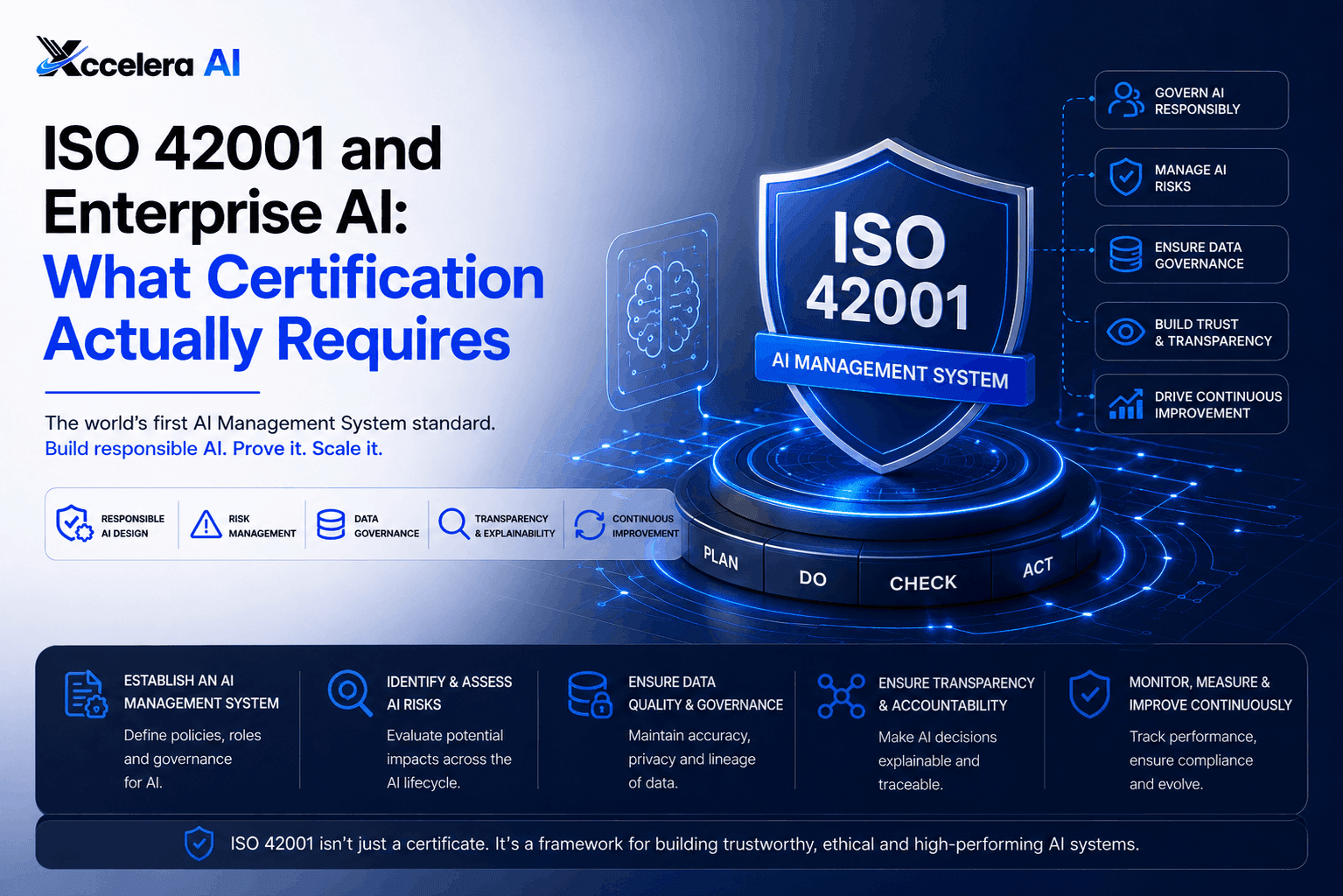
Enterprise AI buyers now ask for proof of governance before they sign anything, not just model performance. ISO 42001 certification requirements give organizations a structured way to answer that demand.
This piece breaks down the AIMS structure, Annex A controls, certification costs, EU AI Act alignment, and the governance infrastructure that turns certification into an operational reality procurement teams can trust.
ISO 42001 Certification Requirements Enterprise AI Buyers Are Now Demanding
Procurement teams stopped asking whether an AI vendor’s model performs well. Instead, they now ask whether the system can be audited. By mid-2026, roughly 40 percent of enterprise AI vendor RFPs in the EU and about 25 percent in North America include a direct question about ISO 42001 status, with parity to ISO 27001 expected within two years.
That shift changes what “AI-ready” means for a vendor. A model that performs well but cannot produce a documented risk register, an impact assessment, or an audit trail no longer clears procurement review at large accounts.
ISO 42001 certification requirements exist precisely to close that gap, giving buyers a third-party verified answer instead of a marketing claim. The standard itself is younger than most of the AI systems it now governs, having launched in October 2023. Yet it has moved from a niche credential to a default procurement checkbox in under three years.
Organizations that treat certification as a compliance afterthought consistently discover it faster, and cheaper, to build the governance first and assemble the paperwork second.
Inside the Structure of an ISO 42001 AI Management System
An Artificial Intelligence Management System, or AIMS, is the operational backbone ISO 42001 certifies against. BSI, one of the first bodies accredited to certify against the standard, describes a certified AIMS as strengthening controls over quality, security, and transparency.
Why Structure Matters More Than Intent
An AIMS is not a policy document sitting in a shared drive. Instead, it is a live system of risk registers, ownership assignments, and monitoring routines that auditors can walk through at any point in the year.
Accreditation as a Trust Signal
Because certification bodies themselves carry accreditation, the credibility of a certificate depends partly on who issued it. That is why enterprise buyers increasingly check the certifying body alongside the certificate itself. Multiple accreditations, such as UKAS and ANAB alongside national bodies, signal that a certifier meets consistent international standards.
Core Clauses Every AI Management System Must Satisfy for Certification
ISO 42001 follows the same High-Level Structure used by ISO 27001 and ISO 9001. This is part of why organizations already holding one of those standards move faster. The standard draws its AI terminology from ISO/IEC 22989, making it applicable across machine learning, large language models, and autonomous systems alike.
Scope and Roles Come First
Clause 4 requires organizations to define AIMS scope and identify AI-specific roles, including provider, deployer, and user. A single company can hold more than one role depending on the system.
Leadership Accountability Runs Through Every Clause
Clause 5 demands documented top management commitment to an AI policy, not a signature on a template. Clauses 6 through 8 then carry that commitment into planning, resourcing, and operational execution, requiring objectives that are measurable rather than aspirational.
Auditors treat leadership sign-off as a genuine governance test. Superficial commitment without operational follow-through is a common point of audit failure.
Annex A Controls and Technical Safeguards Auditors Look For
Annex A translates clause-level requirements into concrete technical and operational controls. As A-LIGN’s breakdown of the standard’s annexes explains, an AIMS converts scattered model validations into an enterprise-wide governance fabric, rather than isolated one-off checks.
- Risk assessment and treatment plans tied to specific AI systems, not generic enterprise risk
- Data governance controls covering provenance, quality, and bias testing
- Human oversight mechanisms at defined decision points in the AI lifecycle
- Supplier and third-party AI governance for embedded or purchased models
- Incident response procedures specific to AI failure modes
- Continuous monitoring of AI lifecycle controls after deployment, not only before it
Auditors expect evidence these controls operate continuously, not documentation produced only ahead of a scheduled visit.
ISO 42001 Versus ISO 27001 and the NIST AI Risk Management Framework
Enterprise teams frequently confuse these three frameworks. A direct comparison helps clarify where each one fits and why teams often pursue more than one at once.
| Framework | Certifiable | Primary Focus | Relationship to ISO 42001 |
|---|---|---|---|
| ISO 42001 | Yes, third-party audit | AI governance and lifecycle management | The standard itself |
| ISO 27001 | Yes, third-party audit | Information security management | Shared structure cuts ISO 42001 effort by roughly a third to a half |
| NIST AI RMF | No, voluntary | AI risk best practices (Govern, Map, Measure, Manage) | Feeds directly into an ISO 42001 audit |
As Konfirmity notes, the NIST framework is a voluntary, non-certifiable US approach, while ISO 42001 is the international standard organizations can be independently certified against. The two are complementary rather than competing. Holding ISO 27001 does not exempt a company from ISO 42001 audit requirements, but it does meaningfully shorten the runway.
Certification Timeline and Audit Stages From Readiness to Sign-Off
Most certification programs follow a phased path rather than a single audit event:
- Governance mapping establishes system ownership and identifies gaps, prioritizing high-risk systems first
- Control implementation turns documented policy into operational reality
- Internal audit and readiness requires remediating non-conformities and preparing management review documentation
- External certification audit, conducted by an accredited third-party body, formally verifies the AIMS
Skipping straight to documentation without operational controls is the single most common reason organizations fail their first audit attempt. The certificate itself remains valid for three years, with annual surveillance audits and a full recertification cycle afterward.
Certification Cost Drivers Across Company Size and AI System Scope
Certification cost scales with headcount, AI system count, and governance maturity, not with ambition alone.
What Growth-Stage Companies Typically Pay
Organizations in the 50 to 200 employee range typically invest between $85,000 and $150,000 for a first ISO 42001 certification. This often supports EU expansion or growing enterprise customer requirements.
Why Larger Programs Cost More
Mid-market and larger enterprises managing dozens of AI systems across multiple business units routinely see first-year totals climb well beyond that range. External consulting and cross-functional program management add up quickly. Most organizations budget two to three times the audit fee itself for implementation work, and certification timelines commonly span four to twelve months regardless of company size.
EU AI Act Alignment and the Regulatory Pressure Behind Certification
Regulatory timing has shifted in ways enterprise teams need to track closely. On June 16, 2026, the European Parliament approved amendments pushing most high-risk AI obligations to December 2027 and August 2028. However, Article 50 transparency duties, including chatbot disclosure and deepfake labeling, were not delayed and still took effect August 2, 2026.
That distinction matters. Teams that assumed the entire AI Act timeline slipped are wrong about the parts that hit first, and general-purpose AI enforcement powers activated the same day.
ISO 42001 governance work remains the fastest credible way to demonstrate EU AI Act compliance readiness, since the certification’s risk assessment, impact assessment, and human oversight requirements map directly onto Act obligations.
Governance Infrastructure That Turns Certification Into an Achievable Goal
Certification does not fail because organizations lack ambition. Instead, it fails because governance gets bolted on after AI systems are already in production, usually after the systems have already touched customer data or influenced a business decision.
Governance by Design, Not Governance Bolted On
This is where the AI Agent Lifecycle Management Platform changes the equation. Role-based access controls, human-in-the-loop approval gates, full version history, and complete audit trails are not add-on features. They are structural defaults built into every agent the platform generates.
This means the evidence an ISO 42001 audit demands already exists as a byproduct of how agents get built, not as separate paperwork assembled afterward.
Cost Visibility Feeds Directly Into Risk Documentation
Every deployment carries a documented cost estimate covering expected spend and compute requirements before approval, giving risk owners financial context alongside technical risk. Because generated agents ship with security guardrails already embedded at the code level, teams spend audit preparation time verifying controls instead of retrofitting them under deadline pressure.
Building an Audit-Ready AI Agent Program for the Long Term With Xccelera
The gap between organizations moving toward certification and organizations still exposed remains wide. As of April 2026, 78 percent of organizations had not taken meaningful steps toward AI Act compliance, and more than half lacked even a basic AI system inventory.
That gap is the opportunity for enterprises willing to build governance into their AI agent programs from day one, rather than retrofitting it under deadline pressure. An audit-ready program starts with an accurate inventory of every AI system in production. It extends through documented risk assessment tied to each system, and depends on infrastructure that generates AIMS certification evidence continuously rather than on demand.
Enterprises that build agent programs on platforms with governance embedded at the code level are not just preparing for one certification. They are building the operational habit ISO 42001, the EU AI Act, and whatever regulation follows will all eventually require. The organizations that treat governance as infrastructure now will spend 2027 winning enterprise deals on trust, while competitors are still assembling their first risk register.
Xccelera builds the governance infrastructure enterprise AI programs need to move from exposed to audit-ready. Certification pressure will only grow as procurement teams standardize ISO 42001 into vendor questionnaires and regulators phase in stricter obligations.
The AI Agent Lifecycle Management Platform embeds role-based access, human-in-the-loop approval gates, full version history, and complete audit trails into every agent it generates by default. This turns ISO 42001 readiness into a byproduct of how agents get built, rather than a separate compliance project.
Enterprises that govern by design today avoid the retrofit scramble later. Learn more at xccelera.ai.


