Multi-Agent Orchestration: How Enterprises Coordinate Workflows Without Losing Control
Enterprise teams are moving past single AI agents into coordinated agent teams that plan, act, and hand off work across live systems. Multi-agent orchestration promises speed and scale. However, most deployments stall on governance, cost visibility, and audit trails, rather than raw capability. Agent coordination without a control layer produces stacked errors and unclear accountability.…
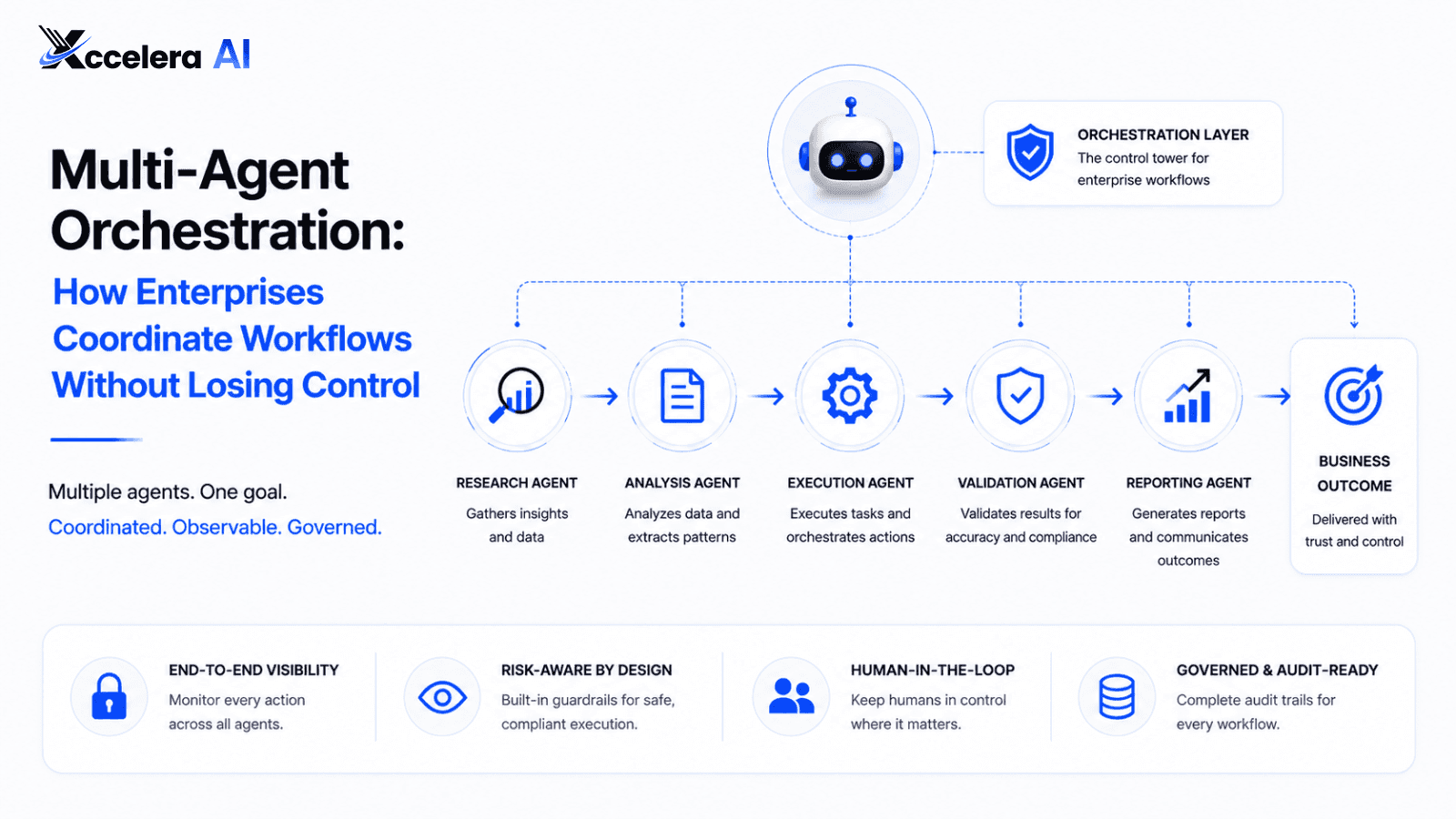
Enterprise teams are moving past single AI agents into coordinated agent teams that plan, act, and hand off work across live systems. Multi-agent orchestration promises speed and scale.
However, most deployments stall on governance, cost visibility, and audit trails, rather than raw capability. Agent coordination without a control layer produces stacked errors and unclear accountability. Nobody can trace back to a decision.
Enterprises that treat orchestration as an infrastructure problem, not a framework choice, build agent teams that scale safely and deliver measurable business outcomes.
Multi-Agent Orchestration Enters the Enterprise Roadmap
A single AI agent answering support tickets is a tool. Five agents researching, deciding, drafting, and acting across production systems is something else entirely.
That shift changes what enterprise leadership needs to worry about. Multi-agent orchestration has moved from an engineering experiment to a board-level planning topic in 2026, as coordinated agent teams start touching customer data, financial decisions, and regulated workflows.
Why This Shift Matters Now
Enterprise operating models built on real-time data, connected agents, and hybrid governance are becoming the default architecture rather than the exception. Leadership teams that once asked whether to adopt one agent now ask how to coordinate dozens of them without losing visibility into what each one did and why.
The Gap Between Ambition and Execution
Most enterprises that start with a single agent plan to orchestrate multiple agents within two years. Far fewer actually complete that transition successfully.
The gap exists because orchestrating agents is a coordination and governance problem first, and a technical integration problem second. Gartner projects that 40 percent of enterprise applications will embed task-specific agents by the end of 2026, up from less than 5 percent in 2025. Enterprises that treat this shift purely as engineering work tend to stall.
The Coordination Problem Behind Distributed AI Agents
Coordinating five autonomous agents is nothing like running five scripts in sequence. Each agent reasons, plans, and calls tools independently, which means small errors compound instead of canceling out.
A manager agent that delegates to specialist agents can lose track of which agent made which decision, especially across long-running tasks. Recent benchmarking work shows that planning and coordination, not language understanding, separate agents that perform well from agents that collapse under real workloads.
Where Handoffs Break Down
Handoffs between agents create the most fragile points in any coordinated system. An agent that passes incomplete context to the next agent in the chain sets off a chain reaction of small mistakes.
Those mistakes rarely surface immediately. Instead, they show up days later as a customer complaint or a compliance flag that nobody can trace back to its origin.
Long-Horizon Tasks Strain Memory and State
Agents also struggle to hold coherent states across long-horizon tasks that span multiple sessions or systems. A coordination layer that cannot preserve process context, user permissions, and operational guardrails across that timeline puts the entire workflow at risk, regardless of how capable each individual agent is.
Governance Gaps That Break Multi-Agent Deployments at Scale
Analyst interest in multi-agent systems has climbed sharply since 2024. Gartner reports a 1,445 percent surge in multi-agent inquiries between Q1 2024 and Q2 2025 alone. That growth curve outpaces the governance tooling most teams have in place.
Enterprises deploying coordinated agents into healthcare, legal, and financial workflows are discovering that capability without oversight creates new categories of risk, rather than eliminating old ones.
Accountability Disappears Without Clear Ownership
When a coordinating agent manages several specialist agents, responsibility for any single decision can become diffuse. If no one can say definitively which agent approved a transaction or drafted a clause, the organization loses the audit trail regulators and customers both expect. That diffusion of accountability is a governance failure, not a technology failure.
Cost Runs Ahead of Visibility
Inference bills from coordinated agent systems can spiral quickly once agents start calling other agents as tools. Without per-agent cost tracking, finance teams find out about runaway spend only after the invoice arrives, long after the misconfigured workflow triggered it.
Control Layers Enterprises Need for Coordinated Agent Execution
Enterprises that succeed with coordinated agents build a control layer above the orchestration framework itself, rather than assuming the framework will provide it. That layer typically includes:
- Role-based access control that restricts which agents can touch which systems and data
- Human approval gates at decision points that carry financial or regulatory weight
- Per-request and per-day cost budgets enforced automatically, not reviewed after the fact
- Full version history and audit trails for every agent action taken in production
- Guardrails against prompt injection, data leakage, and off-topic agent behavior
Governance Has to Be Built In, Not Bolted On
Enterprises that add these controls after a coordinated system reaches production spend far more time retrofitting than they would have spent building governance in from the start. Teams that embed approval gates, RBAC, and audit trails into the agent lifecycle from day one avoid that retrofit entirely.
Multi-Agent Frameworks Versus Enterprise-Grade Orchestration Systems
Several open frameworks now lead multi-agent development, each with a different coordination model. None of them fully solves the governance, cost enforcement, or audit layer enterprises need once agents move into production.
| Framework Type | Coordination Model | Enterprise Governance Coverage |
|---|---|---|
| Graph-based orchestration | Deterministic, node-to-node execution | Requires external governance tooling |
| Role-based agent crews | Specialist agents assigned fixed roles | Limited built-in cost and access controls |
| Conversational multi-agent loops | Agents converse to reach a decision | Weak audit trail without added instrumentation |
| Hierarchical agent trees | Manager agent delegates to sub-agents | Depends on platform-level RBAC and approvals |
The Framework Choice Is Not the Governance Answer
Choosing a framework answers how agents talk to each other. It does not answer who approved a given action, what it cost, or whether the agent stayed inside its defined domain. IBM’s overview of AI orchestration similarly frames orchestration as bridging integration, automation, and management, not any single tool.
Enterprises that confuse framework selection with governance strategy end up building the control layer twice: once informally during a crisis, and once properly afterward.
Lifecycle Management as the Foundation for Reliable Coordination
Coordinated agent systems only stay trustworthy if every agent inside them is governed from the moment it is created, not just at the moment it is deployed. That means version control on every agent change, cost estimates before a workflow goes live, and role-based permissions that separate who can build, approve, and observe.
An agent lifecycle management approach treats governance as a property of how agents are created, updated, and retired, not a separate compliance exercise layered on top.
Brownfield Coordination Matters More Than Greenfield Demos
Most enterprise coordination problems involve agents that need to work inside existing codebases and systems, not a fresh architecture built from scratch. A lifecycle approach that respects existing conventions lets coordinated agent teams scale without forcing a rebuild of every system they touch.
Xccelera and the Path to Controlled Agentic Scale
Xccelera builds the AI Agent Lifecycle Management Platform that gives enterprises the governance, version control, and cost visibility multi-agent orchestration requires from day one.
Every agent created through it carries role-based access, human approval gates, and full audit trails by design, not as an afterthought.
For enterprises ready to coordinate agent teams without losing control, xccelera.ai is the place to start that conversation.


