Human-in-the-Loop vs Fully Autonomous: Choosing the Right Workflow Model
Autonomy is no longer a single setting that enterprises simply flip on or off. It now works like a dial, and where a company sets that dial determines whether AI agents build trust or create liability. The debate over human-in-the-loop versus fully autonomous workflows has moved past theory. It now shapes budget meetings, procurement reviews,…
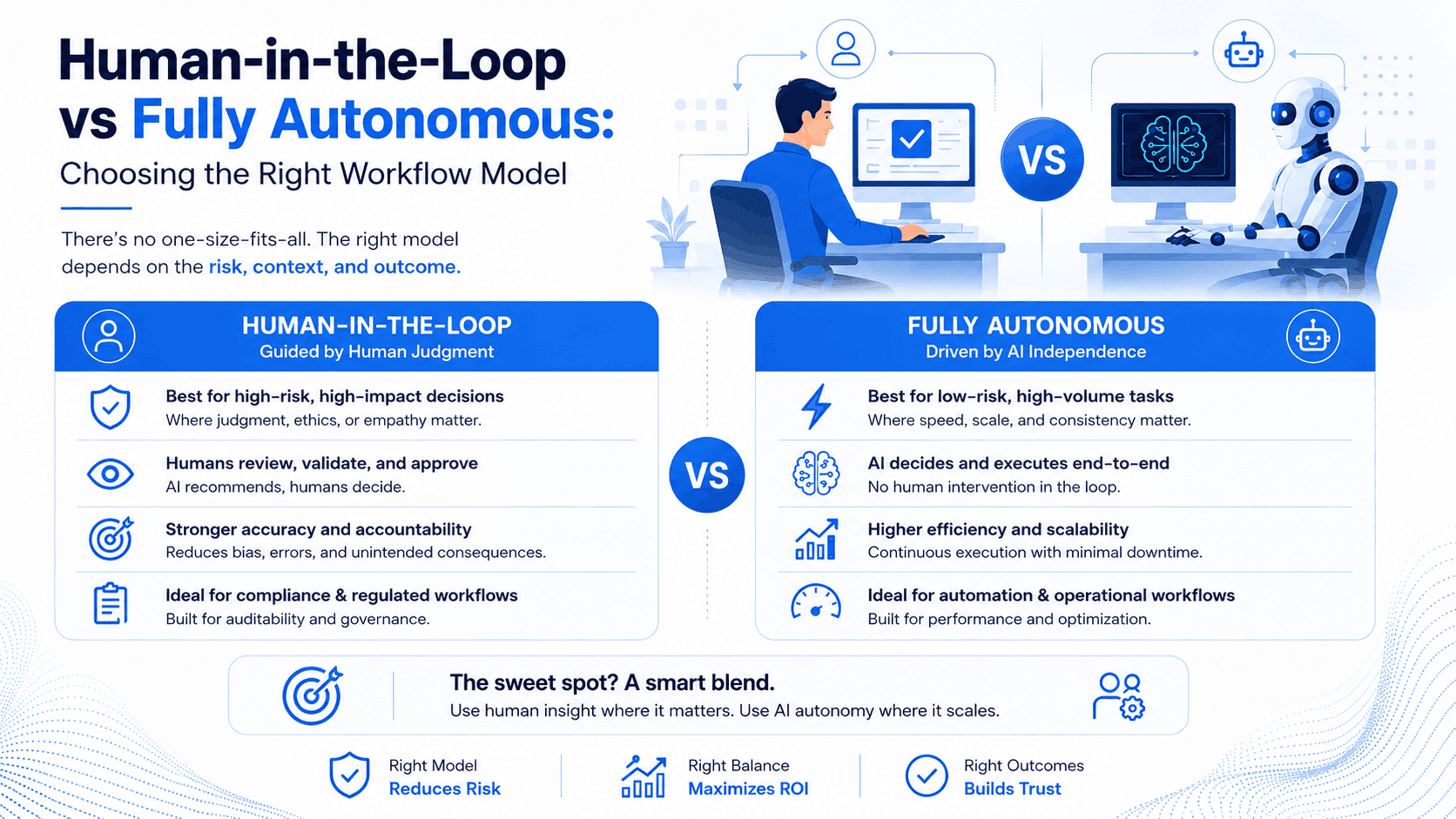
Autonomy is no longer a single setting that enterprises simply flip on or off. It now works like a dial, and where a company sets that dial determines whether AI agents build trust or create liability.
The debate over human-in-the-loop versus fully autonomous workflows has moved past theory. It now shapes budget meetings, procurement reviews, and board-level risk conversations, because the wrong autonomy model can turn a productivity win into a compliance incident overnight.
Enterprises that get this decision right don’t necessarily run the most advanced models. Instead, they hold the clearest map of where human judgment still belongs and how quickly an agent should act once that judgment is no longer required at every step.
Why Enterprises Are Rethinking Autonomy Levels in AI Workflows
Adoption has outpaced governance across most enterprise programs, and that gap is exactly where the choice between tighter oversight and broader independence starts to matter.
Task-specific agents are moving from isolated pilots into systems that touch payments, customer records, and regulated processes. Consequently, leadership must define autonomy boundaries instead of assuming default settings will hold once real workloads arrive.
The Shift From Pilots to Production
Once real data and real consequences enter the picture, enterprise leaders quickly notice that agents behave differently in production.
A workflow that looks flawless in a sandbox can surface edge cases within days of going live, and those edge cases are precisely where autonomy decisions get tested.
As a result, enterprises that treated autonomy as a technical afterthought are now retrofitting oversight into systems that were never designed for it. This retrofit costs far more in engineering hours and executive attention than building checkpoints in from the outset.
Meanwhile, procurement teams have started asking vendors direct questions about where a system pauses for approval, not just what it can technically do alone. This shift in questioning reflects how much operational maturity this space has gained in a short window, a trend McKinsey’s research on agentic AI governance also confirms.
What Human-in-the-Loop Actually Means in Production Systems
Teams frequently reduce human oversight in AI agents to a vague promise of a person watching a dashboard. However, production systems require something more precise: defined checkpoints where execution pauses until a qualified human approves the next step before anything irreversible happens downstream.
Approval Gates Versus Passive Monitoring
There is a meaningful difference between a system that waits for explicit sign-off and one that simply lets a human observe after the fact.
The first model suits irreversible or high-stakes actions such as financial disbursements or access changes to sensitive systems. Here, a pause of a few seconds costs nothing compared to the damage an unauthorized action could cause.
The second model, sometimes called passive supervision, fits medium-risk situations where speed matters and teams can correct mistakes after detection without lasting harm.
Confusing these two models inside a single workflow is one of the most common governance gaps enterprise teams create without realizing it. Unfortunately, it tends to surface only after an incident forces a retrospective review, and EU AI Act Article 14 already treats this distinction as a compliance requirement for high-risk systems.
Where Fully Autonomous Execution Delivers Real Operational Value
Autonomous AI workflow models earn their keep in high-volume, low-ambiguity tasks where waiting for a human introduces more risk than it removes. In these environments, speed becomes the operational advantage rather than a shortcut around accountability, so the economics shift decisively toward independent execution.
Matching Autonomy to Task Volume and Reversibility
The strongest fully autonomous deployments share two traits:
- High transaction volume across repetitive, well-defined tasks
- Low consequence per error, so mistakes stay cheap to reverse
Routine ticket triage, inventory monitoring, and repetitive data reconciliation fit this profile well. A single mistake is cheap to reverse, yet expensive to review manually at the scale enterprises now operate.
By contrast, pushing autonomy into irreversible or emotionally sensitive decisions tends to erode the trust that made rapid adoption possible in the first place. That is why the most successful deployments draw a hard line between routine execution and judgment calls that carry lasting consequences for customers or regulators. Gartner similarly warns that uniform governance across mismatched autonomy levels drives enterprise agent failures.
The Risk Calculus Behind the Human-in-the-Loop vs Fully Autonomous Decision
Workflow automation risk management isn’t a single formula that applies evenly across departments. Instead, it compares four practical factors:
- Reversibility of the action
- Regulatory exposure tied to the decision
- Error tolerance within the workflow
- Cost of human review relative to the cost of an agent’s mistake
Reading the Four-Factor Risk Framework
Once teams lay those four factors side by side, a clear pattern emerges across regulated industries. A misrouted internal ticket costs little to fix, so heavier autonomy is often defensible and even preferred for the speed it delivers.
A misapplied lending decision or an unauthorized data access event, however, carries legal and reputational exposure that no efficiency gain offsets. That is precisely why clear escalation thresholds exist: to catch these cases before they execute rather than after damage is already done, an approach the NIST AI Risk Management Framework formally recommends.
Enterprise AI governance models increasingly formalize this calculus into written policy rather than leaving it to individual engineering teams. This formalization is now becoming a baseline expectation from boards and compliance officers alike, not a differentiator reserved for the most cautious organizations.
Building a Hybrid Framework That Scales With Trust
Autonomous agent orchestration rarely stays fixed at one setting for the life of a workflow. Instead, the organizations that capture the most value treat autonomy as adjustable, expanding an agent’s independence only after it earns measurable trust through observed performance over time.
Earning Autonomy Through Demonstrated Reliability
Mature hybrid frameworks start every new workflow with tighter human-in-the-loop AI systems oversight, then loosen the checkpoints as confidence data accumulates from real production runs, an approach Oracle also outlines for agentic AI systems.
Confidence scoring, audit trails, and time-boxed approval windows give teams a defensible record of why an agent’s autonomy expanded. This record matters as much to internal risk committees as it does to external regulators reviewing the same decisions later.
This graduated approach turns the human-in-the-loop versus fully autonomous question from a one-time architectural decision into an ongoing, performance-based practice. It mirrors how enterprises already manage human employees, who earn expanded responsibility over time rather than receiving unlimited authority on day one.
Xccelera’s Approach to Balanced Autonomy in Agentic Workflows
Xccelera builds this dial directly into its AI agent orchestration platform, giving enterprises a structured way to resolve autonomy questions without rebuilding governance from scratch for every new use case.
The platform lets teams define escalation thresholds, approval checkpoints, and confidence-based autonomy expansion at the workflow level. As a result, agents earn independence the same way a new hire earns responsibility on a team, all backed by the identity and access controls that keep escalation paths auditable.
Enterprises using Xccelera’s orchestration layer have reported measurable gains, including up to 40 percent improvements in workforce productivity, up to 35 percent reductions in operating costs, and deployment timelines under seven weeks from concept to live production.
For teams that want expert guidance while defining these thresholds, Xccelera’s AI agent consulting practice can help map risk factors to the right autonomy level for each workflow.
Explore the platform to see how balanced autonomy translates into operational outcomes rather than theoretical governance, and how a workflow can move from cautious oversight to earned independence without a single rebuild along the way.


