Workflow Automation Across the SDLC: Where Enterprises Are Starting in 2026
Software delivery timelines are colliding with a wall of manual coordination, and engineering leaders are running out of headcount to throw at the problem. Agentic AI SDLC automation is changing that equation. It moves software development lifecycles from human-paced review cycles into continuous, agent-led execution. Enterprises are starting their rollouts in specific, bounded stages through…
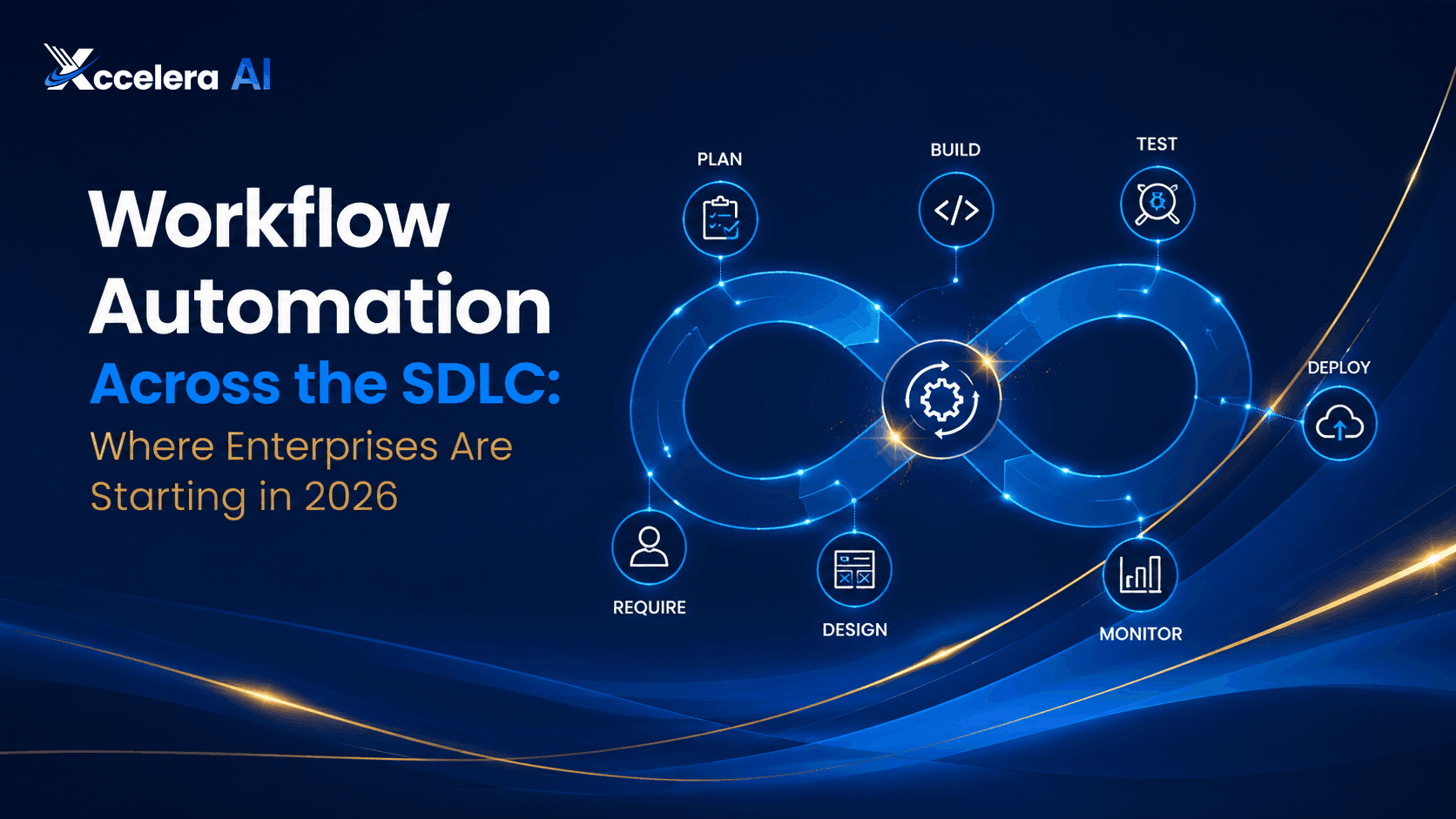
Software delivery timelines are colliding with a wall of manual coordination, and engineering leaders are running out of headcount to throw at the problem. Agentic AI SDLC automation is changing that equation.
It moves software development lifecycles from human-paced review cycles into continuous, agent-led execution. Enterprises are starting their rollouts in specific, bounded stages through 2026. The capabilities that separate a working deployment from a stalled pilot come down to context, governance, and measurable outcomes.
Planning, development, testing, and release each demand different levels of autonomy. The gap between a scaled program and a stalled experiment sits in how deliberately leadership designs for accountability from day one.
The SDLC Bottleneck Enterprises Can No Longer Ignore in 2026
Engineering leaders spent the last two years buying AI coding assistants. Most got faster first drafts and the same slow path to production. The bottleneck was never writing code.
It was everything around it: ticket triage, code review, test coverage, deployment approval, and incident response. Each of those steps still runs on human coordination, and human coordination does not scale at the pace AI-generated code now arrives.
Forrester’s State of Agentic Software Development report notes that isolated individual productivity gains are no longer enough. Autonomous agents are now expected to collaborate across the entire lifecycle, toward true end-to-end automation.
Enterprises stuck in legacy request-and-response workflows cannot bolt agentic AI onto a review process built for a slower, human-only cadence and expect different results. The enterprise software development lifecycle has to be redesigned around continuous, accountable execution, not retrofitted with a faster assistant.
That redesign is where agentic AI SDLC automation earns its place on the leadership agenda in 2026, not as an experiment but as an operating model decision.
Agentic AI SDLC Automation: The Shift From Assistance to Execution
From Copilots to Coworkers
For most of the last three years, AI in software development meant autocomplete. A developer typed, the model suggested, and a human accepted or rejected the suggestion line by line. That pattern is giving way to something structurally different.
CIO’s coverage of 2026 engineering workflows describes this as agentic AI absorbing work at every stage of the lifecycle. Agents now analyze feasibility during planning, implement features during build, expand test coverage during validation, and surface risk during review.
Execution Layers, Not Just Tools
This is the core distinction behind agentic AI SDLC automation. A tool waits for a prompt. An execution layer interprets a goal, plans the steps, uses the tools it needs, and escalates to a human only when judgment or accountability requires it.
Enterprises that treat this shift as a bigger set of point solutions tend to stall. The ones that treat it as a new operating layer for the entire software lifecycle tend to compound the gains quarter over quarter.
Where Enterprises Are Starting Their SDLC Automation Journey
Enterprise adoption of AI-driven software delivery rarely starts with the whole lifecycle at once. Instead, it starts with the highest-volume, most expensive stretch of the pipeline: the distance between a ticket and a merged pull request.
A typical starting pattern looks like this. An agent reads a ticket or design note, identifies the relevant files, drafts an implementation, opens a pull request with a written description, runs tests, and leaves the merge decision to a human reviewer.
A second common starting point sits in incident response. When an alert fires, an agent gathers context, queries logs, retrieves related deploys and incidents, drafts a triage summary, and pages the on-call engineer with a structured briefing already assembled.
Neither starting point replaces engineering judgment. Both remove the manual assembly work that used to consume the first twenty minutes of every incident or every ticket pickup. Enterprises that succeed share a pattern in how they sequence adoption: they pick one bounded stage, instrument it with clear success metrics, and expand only once output holds up under real production load.
Core Capabilities Behind Autonomous SDLC Agents
Dropping a coding agent into an existing workflow does not create an agentic SDLC on its own. Enterprise-grade autonomous SDLC agents depend on four capabilities working together.
Context Across Systems
An agent needs the organization’s full operating picture, not a single repository. That means code, tickets, documentation, monitoring systems, and infrastructure context feeding into a shared operational memory, rather than isolated tool calls.
Agentic Workflow Orchestration
Specialized agents need a coordination layer that routes tasks, resolves conflicts, and tracks shared state across a multi-agent system. Without orchestration, parallel agents duplicate effort or contradict each other’s output.
AI Code Review Automation
A two-layer review process separates mechanical checks from judgment calls. Agent review automation handles style consistency, pattern compliance, security scanning, and test coverage verification. Human reviewers then focus on architectural fit and business logic.
Explainable, Auditable Action
Every agent decision needs a traceable path: what it changed, why it changed it, and how to roll it back. This is the difference between AI agent lifecycle management done deliberately and a fleet of agents nobody can account for.
Governance and Oversight in an Agent-Led Software Lifecycle
Faster code generation creates a new bottleneck if governance does not scale alongside it. DORA’s research on AI-assisted development calls this the verification tax. The time an enterprise saves writing code gets re-spent auditing it, and that tax grows fast once agents produce code in larger batches at higher speed.
Quality gates absorb that pressure in a well-run agentic SDLC. A quality gate is the automated review layer that checks agent-generated code before it merges, applying codebase-specific standards and security validation at the same speed the agents generate output.
Left unaddressed, the verification tax quietly cancels out the time an enterprise thought it was saving. Governance in this context is not a brake on velocity — it is what makes velocity sustainable. Boards and audit committees are already asking engineering leaders how autonomous agent activity gets reviewed.
Measuring ROI From AI Agent Lifecycle Management
The financial case for agentic AI SDLC automation is no longer theoretical. McKinsey research on enterprise technology spending shows AI-driven modernization delivering outsized EBITDA gains when paired with disciplined engineering investment, rather than AI alone.
Three metrics matter more than raw activity counts:
- Cycle time from ticket creation to production deployment, tracked end to end rather than per stage
- Change failure rate on agent-touched pull requests compared with the existing baseline
- Reviewer hours reclaimed per sprint, since that time gets redirected toward architecture and design work
Acceptance rate, the most commonly cited vanity metric, tells leadership almost nothing about whether AI-driven software delivery is actually compounding value over time. The programs that stall are usually the ones reporting activity, rather than outcomes finance and the board actually recognize as value.
Comparing Automation Approaches Across the Software Lifecycle
Not every automation approach delivers the same outcome. Enterprises evaluating options in 2026 are finding real differences in how each one handles context, oversight, and scale.
| Automation Approach | Scope of Autonomy | Human Role | Best Fit |
|---|---|---|---|
| Rule-based scripting | Fixed, predefined tasks | Full manual oversight | Repetitive, low-variance steps |
| Copilot-style assistants | Suggests, does not execute | Accepts or rejects every suggestion | Individual developer productivity |
| Single-purpose DevOps AI agents | Executes one bounded task | Reviews output before merge | Point automation, testing or triage |
| AI agent lifecycle management platforms | Plans, executes, and escalates across the SDLC | Sets boundaries, reviews escalations | Enterprise-scale, multi-stage automation |
The pattern across enterprise deployments is consistent. Point solutions produce isolated wins that plateau quickly. Platforms built around AI agent lifecycle management sustain gains because they orchestrate agents across planning, development, testing, and deployment.
Building an Enterprise-Ready Agentic SDLC With Xccelera
Xccelera approaches agentic AI SDLC automation as an operating model, not a point tool. Its AI Agent Lifecycle Management Platform gives engineering leaders a single control layer for planning, execution, review, and rollback across the full software lifecycle, with explainable actions and audit trails built in from the start.
For enterprises ready to move past pilot stalls, xccelera.ai outlines how the platform fits into existing engineering governance.