Every Engineering Org Runs AI Now. Almost None Can Say Where They Actually Stand.
Every engineering organization now runs at least one AI-assisted workflow. Yet most cannot say where they actually stand on the agentic SDLC maturity model. Some teams treat AI as an autocomplete layer bolted onto existing habits. Others have built governed agent networks that plan, code, test, and deploy with minimal human intervention. The gap between…
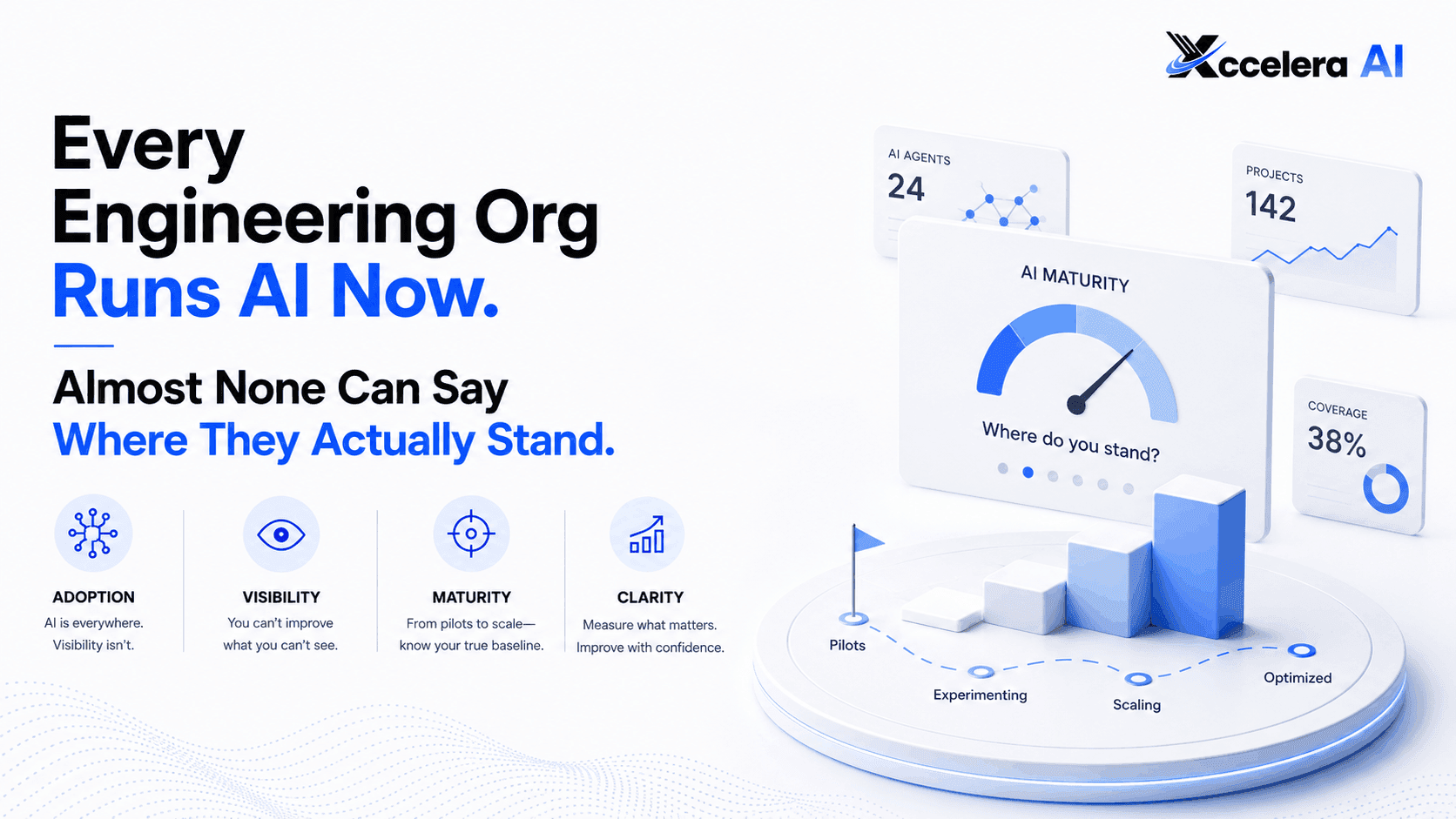
Every engineering organization now runs at least one AI-assisted workflow. Yet most cannot say where they actually stand on the agentic SDLC maturity model.
Some teams treat AI as an autocomplete layer bolted onto existing habits. Others have built governed agent networks that plan, code, test, and deploy with minimal human intervention.
The gap between these two positions determines cost efficiency, delivery speed, and risk exposure over the next several budget cycles.
Leaders who can’t place their organization on a defined maturity curve tend to overinvest in tooling while underinvesting in governance — or the reverse. This piece maps the stages, the signals that indicate stalled progress, and what it actually takes to advance.
Defining the Agentic SDLC Maturity Model
An agentic SDLC maturity model measures how deeply autonomous agents are embedded across planning, coding, testing, and deployment.
It does not measure how many AI tools a team has purchased.
Maturity depends on orchestration, governance, and measurable outcomes — not tool count. Recent documentation describes coordinated multi-agent pipelines translating requirements into code, quality checks, and deployment as connected stages, not isolated point solutions.
Independent research places less than half of enterprises at a mid-tier maturity stage, with the rest stuck earlier or unable to exit pilot status.
A workable model needs distinct stages and a governance checkpoint at each transition. Running an assessment against these criteria — not a tool inventory — is what actually locates an organization on the curve.
The Four Stages of Agentic SDLC Maturity
Stage One: Manual Development With Isolated AI Assistance
Individual engineers use AI coding assistants inside their own editor, with no shared context across the team.
- No orchestration layer connects planning, coding, and testing activities
- Prompt quality depends entirely on the individual engineer’s skill
- Output review happens manually, line by line, with no automated gate
- Adoption is inconsistent across teams, even inside the same department
Value is real at the individual level but invisible at the organizational level. Most enterprise engineering orgs still sit here, whatever their internal AI narrative claims.
Stage Two: Coordinated AI Agents Inside Individual Workflows
At Stage Two, individual workflows gain their own dedicated agent rather than a shared assistant. A code review agent flags security gaps and test coverage holes before a human reviewer opens the pull request. A triage agent classifies incoming tickets and routes them by severity.
These agents operate inside a bounded task, not across the full delivery lifecycle. Teams report measurable time savings on the specific workflow the agent covers — but the gains stay siloed. One team’s agent tooling rarely transfers cleanly to another team’s stack, and there’s still no shared state connecting requirements to code to deployment.
Stage Three: Cross-Functional Agent Orchestration Across the SDLC
Coordination at this stage needs shared state, handoff protocols, and policy checks that simple tool deployment cannot provide.
This is where the agentic SDLC stops being a collection of point tools and becomes a pipeline.
A planning agent converts specifications into structured requirements. A coding agent implements that plan. A quality agent assesses the output before a deployment agent ships it. Each agent hands context to the next rather than starting cold.
This is also the stage where engineering leadership starts asking governance questions in earnest — because agents are now touching production-adjacent systems as a coordinated unit, not isolated experiments.
Stage Four: Autonomous Agent Networks With Governance Guardrails
Stage Four organizations run agent networks that operate with defined autonomy inside explicit boundaries:
- Human approval gates sit at defined decision points, not on every action
- Full audit trails exist for every agent action across the pipeline
- Role-based access controls govern which agents can touch which systems
- Cost budgets and rate limits are enforced automatically, not reviewed after the fact
- Agents self-heal from common failure patterns without waking an on-call engineer
Very few organizations run a genuinely autonomous software delivery lifecycle today — and most that claim to are actually further back.
The Clearest Signal of Stalled Maturity
Stalling rarely looks like failure. It looks like a plateau that leadership mistakes for steady state.
Teams keep running the same pilot for two or three quarters without expanding scope. Agent usage concentrates among a handful of enthusiastic engineers while the rest of the team opts out quietly. Metrics stay anecdotal — built from screenshots and Slack praise rather than tracked throughput or defect data.
A March 2026 survey of 650 enterprise technology leaders found that 78 percent had at least one agent pilot running, yet only 14% had successfully scaled an agent to organization-wide operational use.
That gap between pilot activity and scaled deployment is the clearest single signal of stalled agentic AI engineering maturity.
Governance Requirements at Each Maturity Stage
AI agent governance in software development scales with autonomy, not with headcount or budget:
- Stage One needs a usage policy and basic data handling rules — nothing heavier
- Stage Two needs human-in-the-loop approval workflows and logging on agent output
- Stage Three needs cross-agent audit trails and a defined escalation path
- Stage Four needs continuous, telemetry-driven oversight rather than periodic manual review
Every stage needs a documented owner accountable for agent behavior in production. Skipping a tier to chase autonomy is the most common root cause of failed deployments reaching board-level scrutiny.
Cost, Risk, and ROI Benchmarks Across Maturity Levels
| Maturity Stage | Cost Pattern | Primary Risk | ROI Signal |
|---|---|---|---|
| Stage One | Per seat, low predictability | Shadow AI, output quality | Individual time savings |
| Stage Two | Per workflow, moderate visibility | Siloed tooling, integration debt | Workflow throughput gains |
| Stage Three | Platform level, budgeted | Cross-agent coordination failures | Org-wide cycle time drop |
| Stage Four | Governed, forecastable | Autonomy outpacing oversight | Sustained margin gains |
Cost and risk move together across maturity levels. Agent-driven workflows at scale show cost reductions between 20% and 40%, concentrated at Stage Three and above.
Common Pitfalls Blocking Engineering Orgs From Advancing
- Treating a successful demo as proof the workflow is production-ready
- Deploying agents on curated, clean data that doesn’t exist at production volume
- Measuring agent success against technical benchmarks instead of business outcome metrics
- Building on a single-vendor architecture that creates lock-in at the scaling stage
- Letting executive sponsorship evaporate once the initial pilot demo has landed
- Deferring identity, permissions, and auditability until the pilot hits a hard wall
The same March 2026 survey attributes 89% of scaling failures to five recurring gaps: legacy integration complexity, inconsistent output quality at volume, absent monitoring tooling, unclear ownership, and insufficient domain training data. These gaps compound each other — ownership gaps leave monitoring gaps unfilled, which lets quality problems stay invisible until they reach customers.
Building an Advancement Roadmap for Higher Maturity
Most maturity frameworks tell organizations where they are but not what to do next.
A usable roadmap pairs each stage with specific investments, not a generic call to modernize:
- Stage 1 → 2: Pick two or three high-volume workflows and give each a dedicated agent with logging built in from day one
- Stage 2 → 3: Build the shared state layer that lets agents hand off context instead of restarting cold
- Stage 3 → 4: Shift governance from periodic review to continuous, telemetry-driven oversight
Each transition needs a named owner, a defined success metric, and a hard governance gate.
Xccelera’s Agent Lifecycle Platform and the Path to Full Maturity
Advancing the agentic SDLC maturity model inside a real engineering organization depends on infrastructure built for governed autonomy from the start, not bolted on after a pilot succeeds.
Xccelera’s AI Agent Lifecycle Management Platform gives engineering leaders a structured path through exactly the stages this piece has outlined — role-based access controls, human-in-the-loop approval gates, full audit trails, cost visibility before deployment, and native support across multiple LLM providers so no single vendor creates lock-in at the scaling stage.
Brownfield integration means existing codebases don’t need a rebuild to participate. For organizations ready to move past isolated pilots toward governed, auditable, organization-wide agent delivery, this is where that path starts.
Discussion: Which stage is your org actually at — not where the internal narrative says, but where the governance and audit trail evidence would actually place you?
If you’re mapping your own org’s position on the agentic SDLC curve, subscribe for more maturity benchmarks, governance frameworks, and field notes on what separates real scaled deployment from pilot theater.