Xccelera Voice Agent: Turning Conversations Into Autonomous Workflows
AI Voice Agent Autonomous Workflows are shaping the next phase of customer service. By 2026, nearly 80% of businesses plan to integrate AI-driven voice solutions into their customer service operations, reflecting a rapid shift toward conversational automation. At the same time, organizations deploying voice AI are already seeing measurable impact, including reductions in call handling…
AI Voice Agent Autonomous Workflows are shaping the next phase of customer service. By 2026, nearly 80% of businesses plan to integrate AI-driven voice solutions into their customer service operations, reflecting a rapid shift toward conversational automation. At the same time, organizations deploying voice AI are already seeing measurable impact, including reductions in call handling time and improvements in service efficiency.
Yet despite this momentum, many companies still rely on traditional IVR systems and rule-based chatbots that struggle to deliver natural, responsive interactions. These systems often trap users in rigid menus, fail to understand intent, and remain disconnected from real business workflows.
Voice AI agents are emerging as the next evolution of enterprise automation. Instead of simply answering questions, these systems can understand requests, respond dynamically, and trigger actions across operational systems in real time.
Xccelera Voice Agent is designed to enable this transition, transforming everyday conversations into autonomous workflows that allow businesses to automate interactions while maintaining natural, human-like engagement.
Why Businesses Are Moving Toward Voice AI Agents
Traditional automation systems were designed to handle structured interactions, not real conversations. IVR menus guide users through predefined options, while rule-based chatbots respond only to programmed queries. As a result, many automated interactions still feel rigid and time-consuming.
These limitations become more visible as businesses scale. Support teams continue to handle large volumes of repetitive requests such as service inquiries, appointment confirmations, and basic troubleshooting. Instead of improving efficiency, traditional automation often shifts the workload rather than reducing it.
Voice AI agents address this gap by enabling systems to understand spoken language and respond dynamically. Instead of forcing users through scripted pathways, these agents interpret intent and provide immediate assistance through natural conversation.
For businesses, this shift offers two key advantages. It improves the customer experience while also enabling organizations to automate high volumes of routine interactions, allowing human teams to focus on more complex tasks.
What Is the Xccelera AI Voice Agent
The Xccelera AI Voice Agent is designed to move beyond traditional voice bots by combining conversational intelligence with operational automation. Instead of simply responding to queries, the system understands user intent and can trigger actions across business workflows in real time.
At its core, the voice agent functions as an intelligent conversational layer that interacts with users through natural speech. When a request is received, the system interprets the intent behind the conversation and determines the appropriate response or action.
This capability allows the voice agent to do more than provide information. It can assist customers, automate routine interactions, and initiate processes that would normally require manual intervention.
By combining conversational AI with task execution, the Xccelera Voice Agent acts as a digital workforce layer that helps businesses handle large volumes of interactions while maintaining responsive and natural communication.
Core Capabilities of the Xccelera AI Voice Agent
The Xccelera AI Voice Agent operates on a three-stage conversational framework designed to transform spoken interactions into real operational outcomes. Instead of functioning like traditional voice systems that rely on rigid scripts, the platform processes conversations through a Listen, Understand, and Act workflow that connects user requests directly to business operations.
Listen
The first stage of the interaction begins with capturing the user’s voice input in real time. The system processes spoken language with high-accuracy speech recognition, enabling the agent to detect words, tone, and conversational signals during live interactions. This capability allows the voice agent to handle natural conversations rather than forcing users to follow predefined menu structures.
Understand
Once the voice input is captured, the agent analyzes the meaning behind the request. Instead of relying only on keyword matching, the system evaluates intent and conversational context to determine what the user actually needs. This layer enables the voice agent to interpret requests accurately even when users phrase them differently.
Act
After identifying the user’s intent, the voice agent executes the appropriate action. The system can retrieve information, trigger workflows, update records, or connect with business applications to complete tasks in real time. By linking conversation directly to operational processes, the platform allows businesses to turn customer interactions into automated outcomes.
Through this Listen, Understand, and Act framework, the Xccelera Voice Agent enables organizations to move beyond static voice automation and build conversational systems capable of assisting users and executing business tasks at scale.
How Xccelera AI Voice Agent Works
The Xccelera AI Voice Agent processes every interaction through an intelligent real-time pipeline that converts conversations into automated business actions. Instead of relying on scripted responses, the platform interprets user requests and connects them directly with operational systems.
User Speaks via Phone or Web
The interaction begins when a user communicates with the system through a phone call or web interface. The platform captures the audio input through its omnichannel infrastructure, ensuring high-fidelity voice data is received for processing.
Speech Converted to Text
Once the voice input is captured, the system converts speech into text using Whisper-class automatic speech recognition (ASR) technology. This process occurs in milliseconds, allowing the platform to analyze the conversation without noticeable delay.
AI Understands Intent and Context
After transcription, the request is processed by the conversational intelligence layer powered by PersonaPlex. This framework enables the system to interpret the meaning of the conversation, extract the required information, and determine the user’s intent with greater contextual awareness. By maintaining structured dialogue patterns, PersonaPlex allows the voice agent to respond in a more natural and consistent conversational manner.
Business Logic Is Triggered
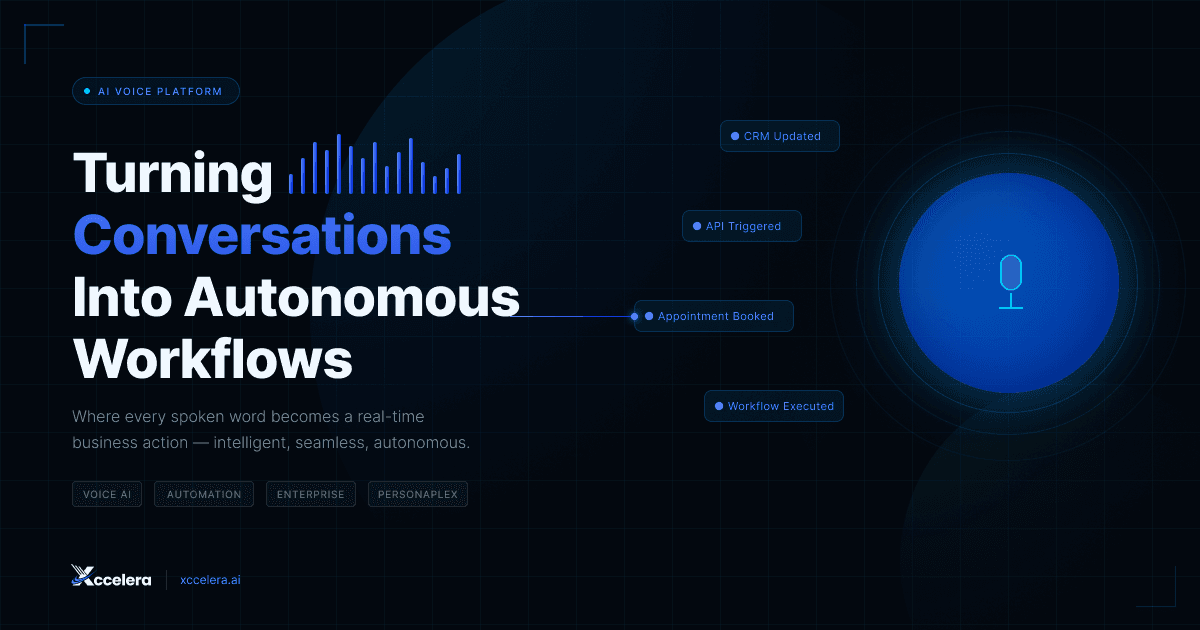
Once the intent is identified, the platform activates the required business logic. This may involve API calls, database queries, or interactions with booking engines and internal enterprise applications to perform the requested action.
Agent Responds in Natural Voice
After the action is processed, the system generates a conversational response. Neural text-to-speech technology converts the response into natural voice output so the interaction feels fluid and human-like.
Systems Updated Automatically
Finally, the platform synchronizes the results across connected systems. CRM platforms, calendars, and support tools are updated automatically, ensuring that the interaction is recorded and operational processes remain aligned.
Through this real-time interaction pipeline, the Xccelera Voice Agent transforms conversations into automated workflows while maintaining natural, human-like engagement.
Where Businesses Can Deploy Xccelera AI Voice Agents
The Xccelera AI Voice Agent can be deployed across several business functions where organizations manage frequent voice interactions. By automating these conversations, businesses can respond faster, reduce manual workload, and maintain consistent service experiences across customer and operational workflows.
Customer Support and Issue Handling
The voice agent can assist customers with support requests, answer common questions, and guide users through issue resolution processes. This helps organizations manage high volumes of support interactions while maintaining faster response times.
Sales Qualification and Follow-ups
Businesses can use the voice agent to engage with potential customers, ask qualifying questions, and collect relevant details during initial conversations. The system can also conduct follow-up calls to nurture leads and maintain ongoing communication.
Appointment Scheduling
The agent can manage scheduling interactions by checking availability, confirming bookings, and updating appointments during live conversations. This allows customers to arrange services quickly without manual coordination.
IT and Helpdesk Automation
Voice agents can assist employees or customers with technical support requests. The system can capture issue details, provide initial guidance, and route requests to the appropriate teams or systems when necessary.
Order and Service Updates
Organizations can use the voice agent to provide updates related to orders, deliveries, or service requests. Customers can receive real-time information about the status of their requests without needing to contact support teams directly.
Feedback and Surveys
After service interactions, the voice agent can automatically collect customer feedback or conduct surveys. This enables businesses to gather insights and improve service quality while maintaining continuous engagement with customers.
Outbound Calls and Alerts
The platform can also perform outbound interactions such as sending reminders, alerts, or important notifications. These automated calls help businesses communicate critical information to customers quickly and consistently.
Through these use cases, the Xccelera Voice Agent allows organizations to automate a wide range of conversational interactions while improving operational efficiency and service responsiveness.
Xccelera Builds the Future of Voice-Driven AI Workflows
Voice is rapidly becoming one of the most natural ways for people to interact with technology. As organizations continue to adopt AI-driven systems, conversational interfaces are evolving from simple automation tools into intelligent systems capable of assisting users and executing tasks in real time.
Traditional automation platforms were designed to answer questions or route requests. However, modern businesses require systems that can go beyond responding and actively participate in operational processes. Voice agents are beginning to fill this gap by connecting conversations directly with enterprise workflows.
The Xccelera Voice Agent reflects this shift toward a more intelligent form of automation. By combining conversational AI with operational integrations, the platform enables businesses to handle interactions while simultaneously triggering actions across their digital infrastructure. Conversations are no longer isolated events but part of a broader workflow that supports business operations.
Technologies such as PersonaPlex further strengthen this capability by enabling voice agents to maintain consistent conversational behavior and context during interactions. This allows organizations to deploy AI-driven systems that can interact more naturally with users while maintaining structured dialogue patterns.
As conversational AI continues to mature, voice will increasingly become a primary interface through which users interact with enterprise systems. Businesses that adopt voice-driven automation early will be better positioned to scale their operations, improve response times, and deliver more seamless service experiences.
Through its Voice Agent platform, Xccelera is positioning itself within this emerging shift, enabling organizations to transform everyday conversations into intelligent workflows that support modern business operations.
How Xccelera AI Voice Agent Delivers ROI to Businesses
For many organizations, voice interactions remain one of the most resource-intensive parts of daily operations. Customer support calls, appointment confirmations, service inquiries, and follow-ups often require large teams to manage repetitive conversations. While these interactions are necessary, they can significantly increase operational costs and response times.
The Xccelera AI Voice Agent helps address this challenge by automating a large portion of routine voice interactions while maintaining natural conversations with users. By handling high-volume requests automatically, businesses can reduce the workload on support teams and allocate human resources to more complex tasks.
Faster Response and Resolution
Voice agents can respond instantly to incoming interactions without requiring customers to wait for available representatives. This improves response times and allows organizations to handle multiple conversations simultaneously.
Reduced Operational Costs
Automating routine conversations reduces the need for large support teams to manage repetitive requests. Businesses can maintain consistent service levels while optimizing operational costs.
Scalable Customer Interaction
Unlike traditional systems that depend on available staff, voice agents can manage high volumes of interactions at the same time. This allows organizations to scale customer engagement without increasing operational complexity.
Improved Workflow Efficiency
Because the voice agent connects directly with business systems, tasks such as scheduling, information retrieval, and service updates can be completed automatically during the conversation. This reduces manual data entry and ensures operational processes remain synchronized.
By combining conversational automation with workflow execution, the Xccelera AI Voice Agent enables businesses to streamline voice interactions, improve operational efficiency, and generate measurable returns from their automation initiatives.
How Xccelera AI Voice Agent Delivers ROI to Businesses
Many organizations still rely on traditional voice automation systems such as IVR menus and rule-based voice bots to manage customer interactions. While these systems introduced early automation, they often fail to deliver efficient or natural experiences for users.
Limitations of Traditional Voice Systems
Traditional IVR systems rely heavily on rigid menu structures that require users to navigate multiple options before reaching the information they need. Instead of simplifying interactions, these menus often slow the process and create frustration for customers.
In addition, many legacy voice systems operate on predefined scripts. Because they depend on keyword recognition rather than intent understanding, conversations frequently feel mechanical and limited. When users ask questions outside predefined scenarios, the system struggles to respond effectively.
Another challenge is operational workload. Support teams still handle large volumes of repetitive interactions such as appointment confirmations, order updates, and service inquiries. This increases operational costs while reducing the efficiency of customer support operations.
How Xccelera AI Voice Agent Differs From Traditional Voice Agents
Traditional voice agents primarily function as call-routing or information delivery systems. They guide users through static menu structures and respond only to predefined commands, which limits the flexibility of interactions.
The Xccelera AI Voice Agent operates on a conversational model where users can communicate naturally while the system interprets the intent behind each request. Instead of forcing users through scripted flows, the platform analyzes the conversation and determines the most relevant response or action.
Powered by conversational intelligence and PersonaPlex-driven dialogue processing, the agent can understand context, manage conversations dynamically, and trigger real business actions during the interaction. This means tasks such as retrieving information, updating records, or scheduling services can be completed automatically without manual intervention.
How Xccelera Voice Agent Changes This Model
The Xccelera Voice Agent approaches voice automation differently by enabling conversational systems that can understand intent and execute tasks in real time. Instead of guiding users through rigid menus, the platform allows customers to interact naturally while the system interprets their requests and performs the required actions.
By connecting conversations directly with enterprise systems, the voice agent can automate workflows such as scheduling, information retrieval, and service updates during the interaction itself. This reduces the need for manual intervention and allows organizations to resolve requests faster.
Operational Impact and ROI
The ability to automate high-volume conversations while executing operational workflows allows businesses to improve efficiency across customer-facing processes. Response times decrease, repetitive workloads are reduced, and teams can focus on higher-value tasks.
As a result, organizations adopting conversational voice agents can streamline operations, optimize support resources, and deliver faster service experiences—creating measurable operational return on their automation investments.
Last Words
Voice interactions remain one of the most important channels through which businesses communicate with customers and manage operational requests. However, traditional voice systems such as IVR menus and rule-based automation often struggle to deliver the efficiency and flexibility modern organizations require.
The Xccelera AI Voice Agent represents a shift from static voice automation to intelligent conversational systems capable of understanding intent and executing real business actions. By combining natural voice interaction with enterprise workflow integrations, the platform enables organizations to automate conversations while maintaining responsive and human-like engagement.
As businesses continue to scale their operations, conversational AI will play an increasingly important role in managing high volumes of interactions. Solutions like the Xccelera Voice Agent allow organizations to transform routine conversations into automated workflows, improving operational efficiency while delivering faster and more seamless service experiences.