Agentic AI for Business Automation: Scaling Operations with Autonomous Intelligence
Agentic AI is redefining business automation by shifting enterprises from rule-based workflows to autonomous execution systems that can reason, decide, and act independently. Unlike traditional automation, which depends on predefined logic, agentic systems operate through continuous decision loops, enabling real-time adaptability across complex environments. This transition allows organizations to scale operations without increasing human dependency,…
Agentic AI is redefining business automation by shifting enterprises from rule-based workflows to autonomous execution systems that can reason, decide, and act independently. Unlike traditional automation, which depends on predefined logic, agentic systems operate through continuous decision loops, enabling real-time adaptability across complex environments. This transition allows organizations to scale operations without increasing human dependency, transforming automation from a cost-efficiency tool into a strategic execution layer. As enterprises move toward autonomous intelligence, the focus is no longer on task automation but on outcome ownership and continuous operational execution.
Agentic AI in Business Automation: Transition from Rule-Based Workflows to Autonomous Execution
Enterprise automation is shifting because static workflows cannot operate in environments where variables change faster than rules can be updated.
Why this transition is happening
Core Drivers of the Shift Toward Autonomous Execution
- Dynamic business environments break static logic
Traditional automation relies on predefined rules, but enterprise systems operate across constantly changing inputs, APIs, and dependencies, making static workflows brittle and prone to failure when real-world variability increases. - Decision-making cannot be pre-programmed at scale
As workflows become more complex, encoding every possible decision path becomes impractical, creating a need for systems that can interpret context and make decisions autonomously in real time. - Human-in-the-loop models create bottlenecks
Most automation systems still depend on human validation for exceptions, which slows down execution and limits scalability, especially in high-frequency operational environments. - Fragmented tools cannot coordinate execution
Enterprises use multiple disconnected systems, and traditional automation cannot dynamically orchestrate across them, leading to siloed execution and inefficiencies.
How Agentic AI changes the execution model
Agentic AI introduces a fundamentally different architecture where systems operate through continuous perception, reasoning, and action loops, enabling them to adapt and execute without predefined scripts.
- Instead of following rules, agents interpret context and objectives
- Instead of executing tasks, they own outcomes across workflows
- Instead of stopping at exceptions, they resolve them autonomously
This transforms automation into an execution layer rather than a productivity layer.
Copilots vs Agents: A critical distinction
Most enterprises still deploy AI as copilots that assist humans, but agentic systems operate independently.
- Copilots → assist decision-making
- Agents → execute decisions
This distinction defines whether AI remains a support tool or becomes an operational driver.
Outcome ownership becomes the new automation model
The shift is not about automating tasks but about delegating responsibility to systems.
Agentic AI systems:
- Take ownership of workflows
- Continuously optimize execution
- Adapt to changing inputs without reprogramming
This is what enables true operational scaling without linear human dependency.
In this write up, we will elaborate on how agentic AI transforms enterprise automation, why traditional systems fail at scale, how agentic architectures function, and how organizations can operationalize autonomous intelligence through structured execution layers.
Why Enterprise Automation Breaks Beyond Workflow Complexity
Enterprise automation fails at scale because rule-based systems are inherently designed for predictable environments, whereas modern enterprises operate across dynamic data flows, interconnected systems, and continuously evolving conditions that demand real-time adaptability, contextual reasoning, and autonomous decision-making capabilities.
Why this breakdown happens
Core Reasons Enterprise Automation Fails at Scale
- Static rules cannot handle dynamic inputs
Traditional automation depends on predefined logic, but enterprise workflows involve unpredictable data variations, API changes, and exception scenarios that cannot be fully encoded, leading to frequent breakdowns in execution. - Cross-system dependencies create failure cascades
Modern enterprises operate across multiple platforms, and when one system changes or fails, automation pipelines collapse due to tight coupling and lack of adaptive orchestration. - Exception handling becomes unmanageable
As workflows scale, edge cases increase exponentially, requiring constant human intervention, which defeats the purpose of automation and introduces latency into execution cycles. - Maintenance overhead grows exponentially
Every change in business logic, UI, or backend systems requires reconfiguration, making automation systems expensive to maintain and difficult to scale across departments.
Where traditional automation fundamentally falls short
Traditional systems are designed for predictability, while enterprise environments are inherently unpredictable.
- They require structured inputs, while real-world enterprise data is fragmented and unstructured
- They operate through linear execution paths, while business processes are non-linear and event-driven
- They depend on human escalation, while modern operations demand continuous autonomous execution
The hidden cost of workflow-based automation
Automation appears efficient at small scales but introduces compounding inefficiencies as complexity increases.
- Rising maintenance and reconfiguration costs
- Execution delays due to human intervention
- Fragmentation across disconnected automation tools
- Reduced reliability in critical business processes
Why increasing complexity accelerates system failure
As enterprises expand automation coverage, system complexity grows faster than control mechanisms.
- More workflows increase dependency chains
- Dependency chains amplify failure propagation
- Failure propagation increases operational overhead
This creates a system where automation begins to degrade performance instead of improving it.
Architecture of Agentic AI Systems for Enterprise Execution
Agentic AI systems are structured around modular, decision-driven architectures that integrate perception, reasoning, and execution layers, enabling autonomous coordination across enterprise systems while maintaining contextual awareness, adaptive learning, and continuous optimization of workflows at scale.
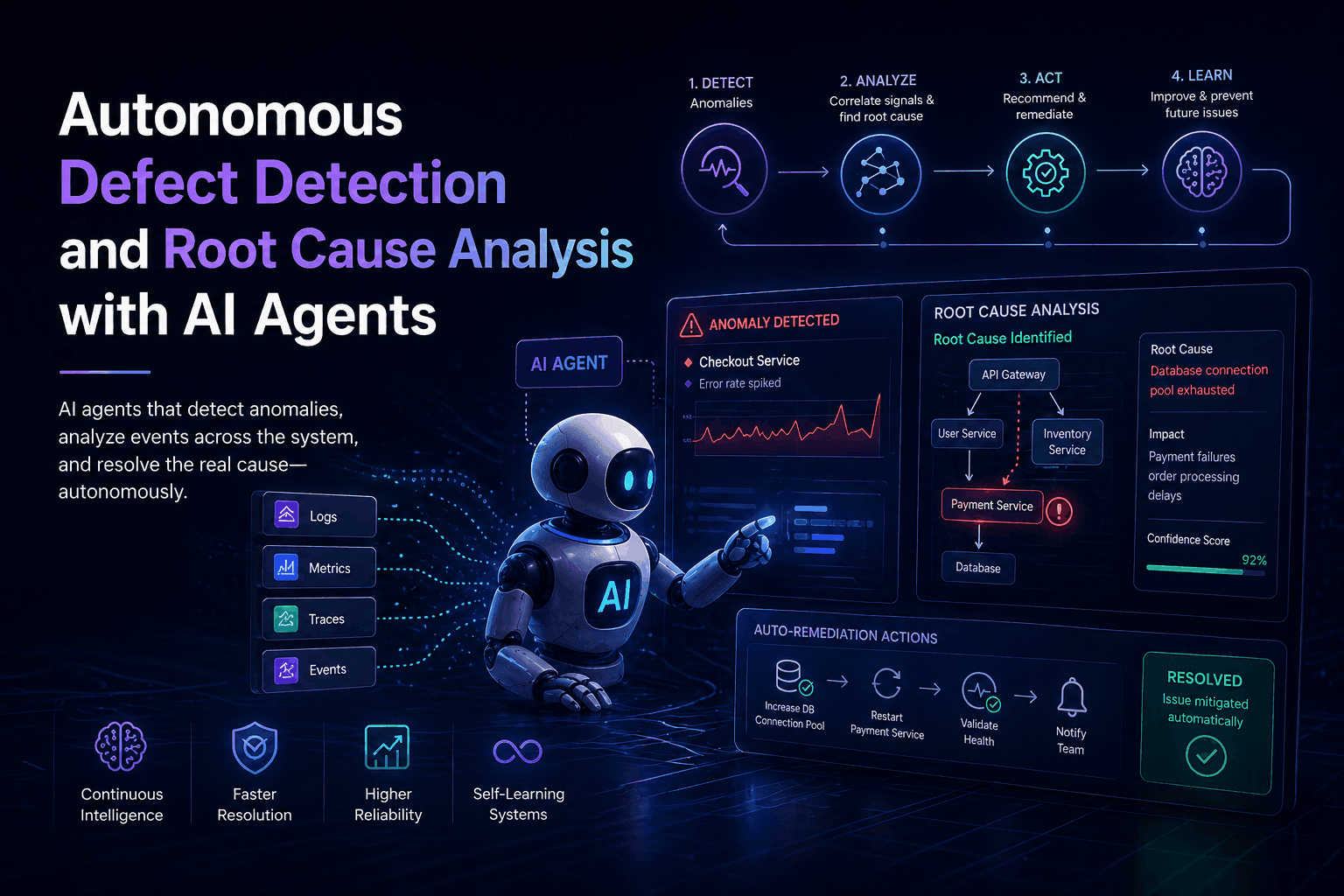
Perception → reasoning → action loop
Enterprise execution shifts from linear workflows to continuous decision cycles, where systems must interpret incoming data, evaluate contextual signals, and execute actions dynamically, ensuring operations remain responsive to changing conditions without requiring predefined rules or manual intervention.
- Perception layer captures inputs from enterprise systems, APIs, and unstructured data sources
- Reasoning layer interprets context, evaluates objectives, and determines optimal actions
- Action layer executes decisions across tools and workflows
This loop enables systems to continuously adapt, rather than wait for predefined triggers.
Memory, tools, and API integrations
Sustained autonomous execution requires systems to retain contextual awareness, interact with enterprise tools, and operate across distributed environments, enabling agents to move beyond isolated intelligence and function as integrated components within operational ecosystems.
- Memory systems store context, past decisions, and evolving state
- Tool integrations allow agents to interact with CRMs, databases, and internal platforms
- APIs enable real-time execution across distributed systems
This transforms agents from isolated models into connected execution entities within enterprise environments.
Multi-agent coordination
Enterprise-scale workflows demand distributed intelligence, where multiple agents operate with specialized roles and collaborate through shared objectives, enabling parallel execution and reducing dependency on centralized control mechanisms that limit scalability.
- Multiple agents operate with specialized roles
- Agents collaborate through shared context and task delegation
- Coordination ensures workflows are executed across functions without bottlenecks
This enables parallel execution and distributed intelligence, improving scalability and efficiency.
Feedback and learning layers
Continuous improvement in agentic systems is driven by feedback mechanisms that evaluate outcomes, refine decision strategies, and adapt execution patterns over time, ensuring systems become more accurate and efficient as operational data increases..
- Outcomes are evaluated against objectives
- Systems adjust decision strategies based on results
- Feedback loops refine execution accuracy and efficiency
This creates a system that is not static but continuously evolving with operational data.
This architecture is what enables agentic AI to function as an execution layer, rather than just a decision-support system, allowing enterprises to move toward fully autonomous operational models.
How Agentic AI Scales Operations Across Business Functions
Agentic AI enables enterprises to transition from isolated automation efforts to fully integrated execution systems, where workflows operate continuously across departments, reducing latency, improving coordination, and enabling scalable, real-time decision-making across complex business environments.
End-to-end workflow automation
Enterprise operations require seamless execution across multiple stages and systems, where agentic AI eliminates fragmentation by orchestrating complete workflows from initiation to outcome, ensuring continuity without manual handoffs or system-level disconnects.
- Agents manage workflows across multiple tools and systems
- Execution flows remain uninterrupted across stages
- Dependencies are dynamically handled without predefined paths
Use cases across departments
Agentic AI extends beyond single-function automation by enabling coordinated execution across departments, allowing enterprises to unify operations and reduce silos that traditionally limit efficiency and scalability.
- Customer support workflows handled autonomously across channels
- DevOps processes managed through continuous monitoring and resolution
- Finance operations executed with real-time validation and reconciliation
Real-time execution benefits
Operational efficiency improves when systems can respond instantly to changing inputs, enabling enterprises to reduce delays and maintain performance in dynamic environments where timing and accuracy are critical.
- Immediate response to system events and data changes
- Reduced dependency on human intervention
- Faster execution cycles across workflows
Efficiency and cost gains
Scaling operations through agentic AI reduces operational overhead while increasing output, allowing enterprises to optimize resource utilization and achieve higher efficiency without proportional increases in workforce or infrastructure complexity.
- Lower operational costs through reduced manual effort
- Improved accuracy and reduced error rates
- Enhanced scalability without linear cost growth
Agentic AI transforms business operations from fragmented automation initiatives into unified execution systems, enabling enterprises to scale efficiently while maintaining control, adaptability, and performance across all functions.
Where Agentic AI Works and Where It Fails in Enterprise Systems
Agentic AI creates value only when deployed in environments aligned with dynamic decision-making, system interoperability, and execution flexibility, while misaligned deployments in rigid, compliance-heavy, or low-variability systems introduce instability, cost inefficiencies, and governance risks.
Fit vs Misfit: Deployment Boundaries of Agentic AI
Where Agentic AI delivers maximum value
- High-variability workflows requiring continuous decision-making
- Cross-system processes where orchestration replaces manual coordination
- Environments with unstructured or evolving data inputs
- Operations that benefit from real-time execution and adaptation
Where Agentic AI creates operational risk
- Deterministic workflows with fixed rules and low variability
- Highly regulated environments requiring strict audit trails
- Systems with limited integration capabilities
- Use cases where human validation is legally mandatory
Cost Dynamics: Scaling Intelligence vs Scaling Expense
Where cost efficiency is achieved
- Reduction in human intervention across high-frequency workflows
- Optimization of execution cycles through autonomous decision-making
- Improved resource utilization across interconnected systems
Where cost escalates
- Continuous compute consumption from persistent execution loops
- Inefficient architectures lacking optimization layers
- Over-deployment in low-value or simple workflows
Control and Visibility: Observability Constraints in Autonomous Systems
Where visibility remains manageable
- Systems with structured observability layers and logging mechanisms
- Environments with defined agent roles and execution boundaries
- Architectures with clear feedback and monitoring pipelines
Where visibility breaks down
- Multi-agent environments without centralized tracking
- Non-linear execution paths lacking traceability
- Limited tooling for debugging autonomous decisions
Security and Governance: Risk vs Control Balance
Where governance can be enforced effectively
- Systems with defined access controls and permission layers
- Environments with integrated compliance and monitoring frameworks
- Architectures designed with auditability in mind
Where governance risks increase
- Autonomous access to multiple enterprise systems without constraints
- Weak identity and access management controls
- Lack of policy enforcement across distributed agents
Agentic AI success is not determined by capability alone, but by precision in deployment, where aligning system design with operational context defines whether it becomes a scaling advantage or a source of systemic risk.
Building Scalable Autonomous Operations with Xccelera’s Multi-Agent Systems
Scaling agentic AI in enterprise environments requires a structured execution layer that unifies orchestration, coordination, and decision-making across systems, enabling autonomous workflows to operate reliably while maintaining control, observability, and integration with existing infrastructure.
Core Execution Components in Xccelera’s Multi-Agent Layer
Enterprise-grade agentic systems require tightly coupled components that collectively enable continuous execution rather than isolated automation.
- Orchestration Engine
Manages task distribution, agent coordination, and workflow sequencing across systems, ensuring that execution remains synchronized even in complex, multi-step operations. - Decision Layer
Embeds reasoning capabilities within workflows, allowing agents to evaluate context, select actions, and adapt execution paths dynamically without relying on predefined rules. - Integration Layer
Connects agents with enterprise systems such as CRMs, ERPs, and internal tools through APIs, enabling seamless interaction across distributed environments without disrupting existing infrastructure. - Memory and Context Layer
Maintains historical state, workflow context, and decision logs, ensuring agents operate with awareness of past actions and evolving conditions.
Operational Model: How Multi-Agent Systems Execute at Scale
Scalable execution is achieved through distributed intelligence, where multiple agents collaborate within a controlled framework to handle complex workflows across enterprise environments.
- Tasks are decomposed into smaller executable units
- Agents are assigned specialized roles based on capability
- Coordination occurs through shared context and orchestration logic
- Execution runs in parallel to reduce latency and improve throughput
System Integration and Deployment Considerations
Enterprise adoption depends on how seamlessly agentic systems integrate with existing infrastructure while maintaining reliability and control.
- API-first architecture ensures compatibility across systems
- Modular deployment enables gradual adoption without disruption
- Observability layers provide visibility into execution flows
- Governance mechanisms enforce control and compliance
Business Impact: From Automation to Autonomous Operations
Operational transformation occurs when execution shifts from human-driven workflows to system-driven intelligence, enabling enterprises to scale efficiently without increasing operational complexity.
- Reduction in manual intervention across workflows
- Improved execution speed and decision accuracy
- Scalable operations without linear workforce growth
- Enhanced coordination across departments and systems
Xccelera enables this transformation by providing a structured multi-agent execution layer that bridges AI intent with real-world operational execution, ensuring enterprises can scale autonomous systems with control, reliability, and measurable impact.
Conclusion: Scaling Enterprise Execution with Agentic AI and Xccelera
Agentic AI is redefining business automation by shifting enterprises from static workflows to autonomous execution systems capable of continuous decision-making and real-time adaptation.
As operational complexity increases, traditional automation models fail to deliver scalability, making execution-layer intelligence a strategic necessity.
Xccelera enables this transition by providing a structured multi-agent ecosystem that orchestrates workflows, integrates enterprise systems, and drives outcome-level execution.
This allows organizations to move beyond fragmented automation and build scalable, intelligent operations that evolve with business demands while maintaining control, efficiency, and resilience.