Agentic Orchestration: The Next Operating System for Data Analytics And Business Intelligence
Agentic orchestration is emerging as the structural control layer for modern analytics environments. As enterprises move beyond static dashboards and reactive reporting, they require systems that interpret signals, coordinate agents, and execute decisions autonomously. This shift reframes business intelligence from a visualization layer into an operational engine powered by multi-agent collaboration, adaptive workflows, and continuous…
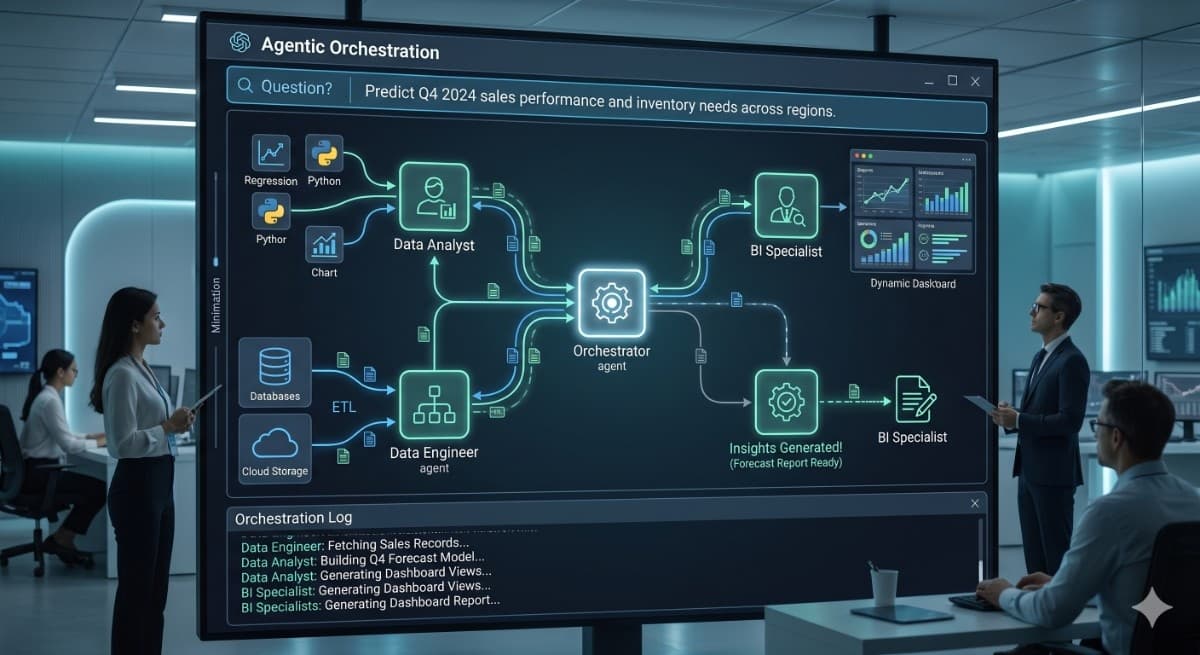
Agentic orchestration is emerging as the structural control layer for modern analytics environments. As enterprises move beyond static dashboards and reactive reporting, they require systems that interpret signals, coordinate agents, and execute decisions autonomously. This shift reframes business intelligence from a visualization layer into an operational engine powered by multi-agent collaboration, adaptive workflows, and continuous reasoning across data ecosystems.
Agentic Orchestration: Why Analytics Needs a New Operating Model
Traditional analytics platforms were designed for insight delivery, not autonomous execution. Dashboards aggregate metrics, but they depend on human interpretation and delayed response cycles. As enterprise data complexity increases, this model creates friction between signal detection and operational action. Organizations now require intelligence systems that not only analyze data but also coordinate decisions across workflows in real time.
Agentic orchestration introduces a coordination layer that governs multiple AI agents working across analytics stacks. Rather than triggering predefined automation rules, agents reason over context, collaborate with specialized agents, and execute tasks dynamically. This architecture transforms analytics from a reporting function into a continuously operating decision system embedded within enterprise infrastructure.
In this write up, we will elaborate on how agentic orchestration redefines data analytics architecture, transforms BI from reporting into execution, establishes governance guardrails, and provides a practical blueprint for enterprise deployment.
Core Architecture of Agentic Orchestration in Data Analytics
Agentic orchestration is not an incremental upgrade to analytics infrastructure. It restructures how intelligence is coordinated, governed, and operationalized across enterprise systems. Instead of pipelines feeding dashboards for human review, a governed network of agents interprets signals, collaborates on decisions, and executes actions within defined policy boundaries.
Below is the architecture presented in a structured enterprise format.
Control Plane: The Orchestration Layer
This layer governs how intelligence is coordinated across the system. It translates business goals into executable workflows, distributes responsibilities, synchronizes outputs, and enforces enterprise policies.
Core responsibilities include:
- Task decomposition and delegation that converts complex analytics objectives into structured agent-level actions.
- Context synchronization ensures agents operate with shared state, data lineage awareness, and aligned objectives.
- Conflict resolution and validation when outputs overlap or diverge across agents.
- Policy enforcement and access control to maintain security and compliance standards.
- Observability and traceability through logging mechanisms that record decision flows and system behavior.
This layer converts isolated AI components into a coordinated intelligence system.
Intelligence Layer: Specialized Agents
The intelligence layer consists of modular agents with domain-specific capabilities. Rather than relying on a single monolithic model, enterprises deploy interoperable agents governed by orchestration policies.
Common agent types include:
- Data ingestion agents that collect, validate, and preprocess enterprise data streams.
- Analytics reasoning agents that detect patterns and generate contextual insights.
- Predictive agents that model scenarios and adjust forecasts dynamically.
- Anomaly detection agents that monitor metrics and trigger alerts in real time.
- Action agents that execute validated decisions within enterprise applications.
Each agent remains scoped, improving scalability and maintainability.
Data and Memory Layer
Autonomous analytics depend on contextual continuity. This layer enables reasoning that persists across time rather than resetting after every workflow execution.
It includes:
- Short-term operational memory that stores active task states, contextual variables, and recent analytical outputs for ongoing workflows.
- Long-term contextual memory that retains historical patterns, decisions, and performance outcomes to improve future reasoning accuracy.
- Data lineage tracking mechanisms that maintain transparency over how inputs evolve into outputs across agent interactions.
This structured memory architecture allows adaptive learning without destabilizing the overall system.
Integration Layer: Enterprise Systems and BI Platforms
Agentic orchestration does not eliminate existing analytics investments. Instead, it overlays coordination intelligence onto them. Through APIs, middleware connectors, and event-driven architecture, agents integrate seamlessly with:
- Data warehouses and lakes to access governed enterprise datasets in real time.
- BI visualization platforms where insights can be validated or escalated for executive review.
- CRM, ERP, and financial systems to operationalize decisions directly within transactional workflows.
- Supply chain and operational platforms where analytics-driven actions can influence inventory, logistics, and resource allocation.
The outcome is a shift from passive insight presentation to active business execution.
Governance and Observability Framework
Autonomy must operate within disciplined boundaries. The governance framework ensures that agentic orchestration remains accountable, auditable, and aligned with enterprise risk management standards.
It incorporates:
- Role-based access controls to prevent unauthorized task execution or data exposure across agent workflows.
- Human-in-the-loop escalation protocols that route high-impact or ambiguous decisions to designated oversight roles.
- Decision traceability logs and explainability layers that document how conclusions were generated across multi-agent interactions.
- Compliance monitoring checkpoints that validate outputs against regulatory and internal policy requirements before execution.
This governance backbone allows enterprises to scale autonomous analytics without compromising control.
In structured terms, agentic orchestration replaces linear data pipelines with a governed, modular, multi-agent system capable of contextual reasoning and coordinated execution. It transitions analytics from static insight generation to an adaptive enterprise intelligence infrastructure.
From Dashboards to Autonomous Insights: Transforming Data Operations
Traditional BI systems prioritize visibility, not execution. Dashboards surface metrics, but analysts must interpret deviations and coordinate actions manually. As data velocity increases, this reactive loop creates operational lag between detection and response.
Agentic orchestration compresses that cycle. Specialized agents continuously monitor data streams, detect anomalies, contextualize signals, and coordinate actions under defined governance policies. Analytics shifts from passive reporting to embedded decision execution within enterprise systems.
Real-Time Insight Generation
Unlike scheduled dashboard refreshes, agentic systems operate continuously.
- Agents monitor streaming and transactional data rather than static snapshots.
- Deviations trigger contextual analysis immediately.
- Historical memory refines interpretation before escalation.
- Low-confidence outcomes are routed for human review.
This reduces latency between signal detection and action.
Autonomous Decision Loops
Validated insights can move directly into execution workflows.
- Inventory adjustments triggered by supply risk signals.
- Fraud mitigation activated upon anomaly confirmation.
- Budget reallocations based on predictive performance changes.
Closed-loop coordination minimizes manual handoffs and accelerates operational response.
Cross-Functional Intelligence
Agentic systems integrate signals across domains.
- Sales performance influences supply forecasts.
- Financial risk indicators reshape procurement thresholds.
- Customer behavior analytics recalibrates service prioritization.
Shared contextual memory ensures decisions reflect enterprise-wide conditions rather than siloed metrics.
Governance, Trust, and Control in Autonomous BI Systems
As analytics systems gain autonomy, governance becomes a structural requirement rather than an afterthought. Agentic orchestration introduces distributed decision-making across multiple agents, which increases coordination power but also elevates operational risk. Without formal oversight layers, enterprises face exposure in compliance, security, and decision accountability.
Human-in-the-Loop Design
Autonomy does not eliminate human oversight. It redefines its placement.
- High-impact or ambiguous decisions are automatically escalated for human validation.
- Confidence scoring mechanisms determine when review thresholds are triggered.
- Override controls allow executives to halt or adjust agent-driven workflows.
This ensures critical decisions remain aligned with strategic intent.
Policy Enforcement and Access Governance
Agentic systems operate across sensitive enterprise data. Governance must be embedded at execution level.
- Role-based access controls restrict which agents can access regulated datasets.
- Policy engines validate decisions against compliance rules before execution.
- Segmentation boundaries prevent cross-domain data misuse.
This prevents autonomy from bypassing enterprise safeguards.
Observability and Explainability
Multi-agent systems require traceability.
- Decision logs record which agents participated in a workflow.
- Input-output mappings provide clarity on how insights were derived.
- Audit trails support regulatory reviews and internal risk assessments.
Explainability mechanisms strengthen organizational trust in autonomous systems.
Risk Management in Agentic Environments
Early implementations often fail due to governance gaps rather than technical limitations.
- Lack of monitoring leads to agent sprawl.
- Poorly defined escalation policies create accountability confusion.
- Inadequate validation frameworks increase operational exposure.
Structured orchestration governance mitigates these risks by centralizing coordination and control.
Implementation Blueprint: Building the Agentic Analytics Stack
Transitioning to agentic orchestration requires structured deployment rather than isolated experimentation. Enterprises that treat agents as standalone pilots often encounter fragmentation, governance gaps, and scalability limits. A phased implementation approach aligns orchestration with enterprise analytics maturity and operational priorities.
Below is a practical deployment blueprint.
Phase 1: Readiness and Architecture Assessment
Before deployment, organizations must evaluate data, infrastructure, and governance maturity.
- Assess data quality, integration consistency, and real-time availability.
- Identify high-friction analytics workflows suitable for automation.
- Map compliance constraints and risk exposure zones.
- Define orchestration ownership across IT, analytics, and business units.
This phase prevents misalignment between ambition and infrastructure capability.
Phase 2: Orchestration Layer Deployment
The orchestration layer should be implemented before scaling agents.
- Establish the control plane responsible for task delegation and monitoring.
- Integrate policy engines and access governance at the outset.
- Deploy observability tools to track agent interactions and decision flows.
- Define escalation thresholds and human validation checkpoints.
Building governance early avoids downstream reengineering.
Phase 3: Targeted Agent Rollout
Instead of enterprise-wide deployment, begin with focused, high-impact use cases.
- Deploy data ingestion and analytics reasoning agents in a single business domain.
- Measure latency reduction, error rates, and operational response times.
- Refine memory architecture and decision validation rules.
- Document measurable ROI before expanding scope.
Controlled pilots establish proof of operational value.
Phase 4: Enterprise Integration and Scaling
Once validated, expand orchestration across interconnected workflows.
- Integrate agents with CRM, ERP, and financial systems.
- Introduce cross-domain contextual reasoning capabilities.
- Standardize orchestration policies across departments.
- Continuously monitor performance, compliance adherence, and cost efficiency.
Scaling must remain modular to prevent architectural rigidity.
Phase 5: Continuous Optimization
Agentic orchestration is not a static deployment.
- Update policy frameworks as regulations evolve.
- Retrain predictive agents using accumulated contextual memory.
- Optimize resource allocation to reduce computational overhead.
- Conduct regular governance audits to maintain trust alignment.
Sustained performance depends on iterative refinement rather than one-time deployment.
A disciplined implementation roadmap transforms agentic orchestration from experimental innovation into a resilient enterprise intelligence layer. Organizations that embed governance, modularity, and measurable value tracking from the outset position analytics as an operational driver rather than a reporting utility.
The Future: Agentic Orchestration as the Operating System of Decision Intelligence
The future of analytics will be defined by execution speed, not visualization quality. As enterprises face real-time volatility, systems must coordinate reasoning and action across domains. Agentic orchestration is emerging as the structural control layer that connects data, agents, and enterprise applications under governed autonomy.
BI platforms will increasingly embed orchestration natively, enabling insights to trigger validated actions within operational systems. Analytics teams will shift from report generation to orchestration governance, while decision cycles compress across departments.
Organizations that institutionalize agentic orchestration will reduce latency, improve cross-functional alignment, and scale intelligence efficiently. Those that remain dashboard-dependent will struggle to operationalize insight at competitive speed.