How Much Do Agentic AI Development Services Cost in 2026? Full Pricing Breakdown
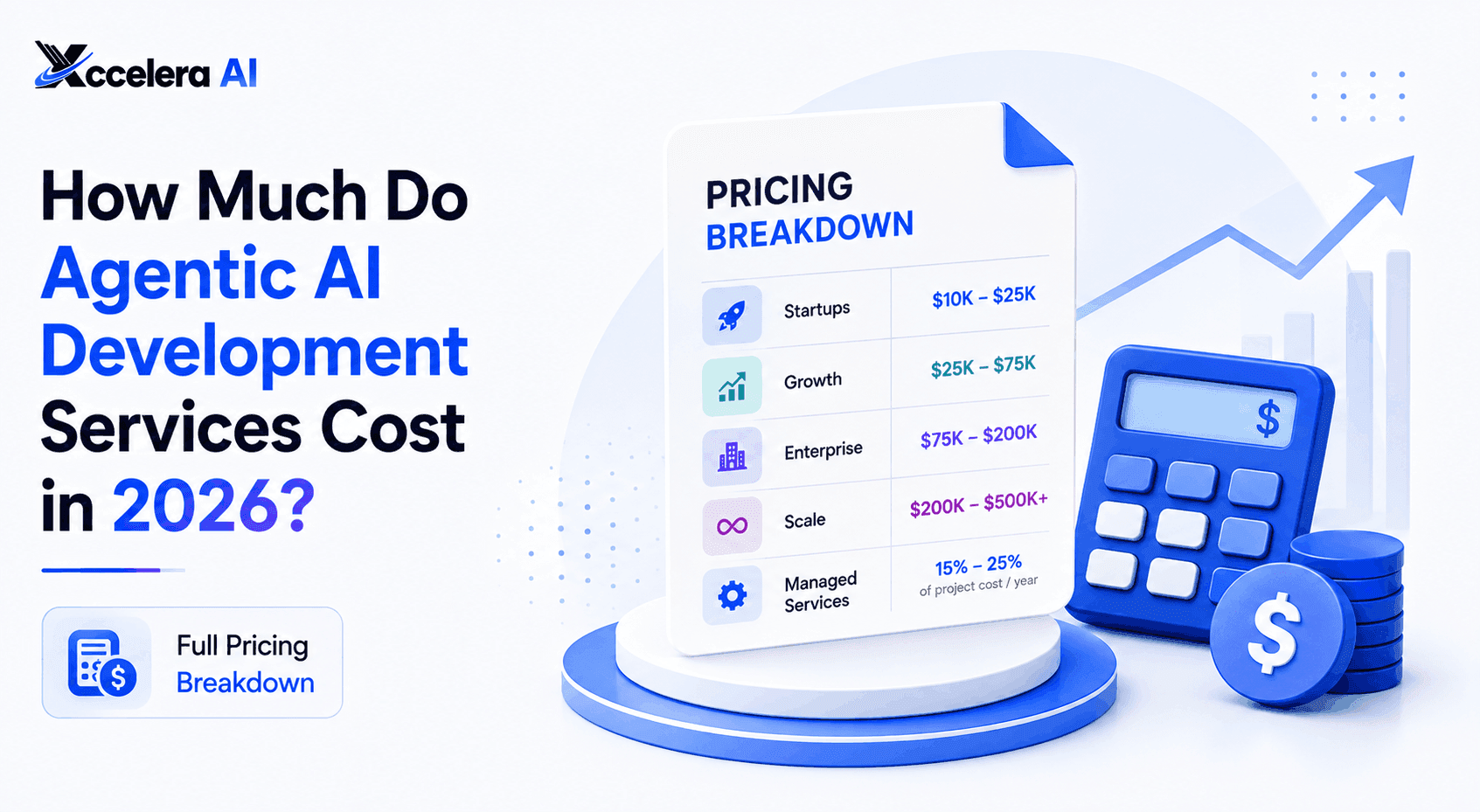
Quick Answer Agentic AI development services cost between $15,000 and $500,000+ in 2026, and the final number depends entirely on scope. A scoped proof of concept runs $15,000 to $50,000. A production-grade single agent costs $50,000 to $150,000. Meanwhile, multi-agent systems and enterprise orchestration climb to $150,000 to $500,000+. After launch, budgets don’t stop there.…
Quick Answer
Agentic AI development services cost between $15,000 and $500,000+ in 2026, and the final number depends entirely on scope. A scoped proof of concept runs $15,000 to $50,000. A production-grade single agent costs $50,000 to $150,000. Meanwhile, multi-agent systems and enterprise orchestration climb to $150,000 to $500,000+.
After launch, budgets don’t stop there. Expect $3,200 to $13,000 per month in operating costs, plus annual maintenance equal to 15 to 30 percent of the build cost.
These ranges align across independent 2026 pricing guides from Geniusee, Azilen, SoftTeco, and Riseup Labs. They also match what Xccelera sees across real client delivery. The rest of this article breaks down where each number comes from, what moves a project between tiers, and how to build a budget that survives contact with production.
The 2026 Market Context for Agentic AI Development
Budget decisions today happen inside a market expanding faster than almost any prior enterprise software category. Four data points define this moment:
- 40% of enterprise applications will embed task-specific AI agents by the end of 2026, up from under 5% in 2025 (Gartner)
- $10.9B projected global AI agents market in 2026, up from $7.6B in 2025 (Grand View Research)
- 23% of organizations have scaled an agentic AI system into production, while 62% are still experimenting (McKinsey)
- 40%+ of agentic AI projects are projected to be cancelled by the end of 2027, mainly due to cost and unclear value (Gartner)
The gap between the second and third numbers matters most for buyers. Spending is accelerating, yet only about one organization in four has actually moved agents from pilot to production. IDC research puts it more bluntly: 88 percent of AI proofs of concept never reach wide deployment.
So what separates the companies that scale from the ones that stall? It’s rarely the model itself. Instead, scoping, data readiness, and cost governance make the difference — and these same variables determine what agentic AI development services actually cost.
What Drives the Cost of Agentic AI Development
Five factors explain most of the variance between a $20,000 engagement and a $400,000 engagement.
1. Agent Complexity and Autonomy
A retrieval-grounded assistant that answers questions from documents sits at the low end. However, an autonomous agent that plans multi-step tasks, calls tools, and takes real actions requires evaluation harnesses, guardrails, and human-in-the-loop controls. Each layer adds engineering time.
2. Number of Integrations
Analysis published by Neontri in 2026 found that integration work — connecting agents to CRM, ERP, and internal APIs — routinely exceeds the cost of the LLM work itself. Poorly documented internal systems can even double integration timelines. As a result, every additional connected system adds scope.
3. Data Readiness
Data preparation is one of the most underestimated line items in agentic AI development. According to Riseup Labs’ 2026 cost analysis, it can sometimes match the modeling cost itself. Clean, accessible, well-permissioned data lowers the quote, while fragmented data raises it.
4. Compliance and Governance Requirements
Azilen’s 2026 industry breakdown shows healthcare and financial services agents costing $120,000 to $400,000+ because of auditability, accuracy, and regulatory demands. Security reviews and compliance audits alone can add $50,000 or more per cycle in regulated deployments.
5. Team Location and Engagement Model
Blended hourly rates in 2026 vary widely: $35 to $65 in Eastern Europe, $45 to $80 in Latin America, and $150 to $300 in the United States, per Softermii’s published benchmarks. Consequently, the same scope can vary 3x to 5x on rate card alone.
These same variables apply whether the deliverable is a single agent or a full portfolio of pre-built and custom AI agents. Pre-built agents compress the first three factors, which is why they anchor the lower pricing tiers below.
Agentic AI Development Pricing Tiers for 2026
Cross-referencing 2026 pricing guides with Xccelera’s own delivery experience produces three consistent tiers.
| Tier | Scope | Typical Cost | Timeline |
|---|---|---|---|
| 1. Proof of Concept / MVP | One scoped workflow, one or two data sources, single-task agent, internal users | $15,000–$50,000 | 3–7 weeks |
| 2. Production Single Agent | Live tool calling, 2–4 integrations, monitoring, human-in-the-loop review | $50,000–$150,000 | 8–16 weeks |
| 3. Multi-Agent System / Enterprise Orchestration | Multiple specialized agents, shared context, governance, 5+ integrations | $150,000–$500,000+ | 4–9 months |
Ranges triangulated from 2026 guides by Geniusee, Azilen, SoftTeco, and Riseup Labs, aligned with Xccelera engagement data.
Two patterns stand out in the market data. First, mid-market buyers cluster tightly — most first production deployments in the United States land between $40,000 and $150,000. Second, tier boundaries are set by autonomy and integrations, not industry. A logistics agent and a customer support agent with matching autonomy levels price similarly, until compliance requirements enter the picture.
Xccelera’s engagement structure maps directly to these tiers through a workshop-first process: platform conceptualization in weeks 0–3, MVP development by week 7, then go-live. This 7-week path applies to Tier 1 and lighter Tier 2 engagements — see AI consulting and development for details.
The Ongoing Costs Most Budgets Miss
Build cost is only part of total cost of ownership. Airbyte framework analysis places initial development at just 25 to 35 percent of three-year cost, with model consumption dominating the remainder.
Azilen’s 2026 benchmark puts post-launch operating spend at $3,200 to $13,000 per month for a production agent. Here’s where that recurring spend goes:
- Model API consumption — $100 to $10,000+ per month depending on volume. Token costs vary by two orders of magnitude across models, and smart model routing can cut per-conversation costs by up to 80 percent.
- Infrastructure and vector database hosting — $200 to $5,000 per month. A low-traffic internal tool can run under $500 monthly, while a customer-facing agent handling thousands of daily interactions can reach $8,000 to $9,000. Notably, Azilen’s 2026 data shows 80 percent of enterprises underestimate AI infrastructure costs by more than 25 percent.
- Monitoring, evaluation, and prompt maintenance — Agents drift as models update and workflows change. Continuous evaluation keeps accuracy stable, which is why quality engineering for agentic systems earns its own budget line.
- Annual maintenance — 15 to 30 percent of the original development cost per year, covering prompt updates, model upgrades, and integration upkeep.
A Worked Example
Consider an $80,000 Tier 2 build, maintained at 20 percent per year, with $1,800 per month in tokens, hosting, and monitoring. That produces a three-year total near $195,000. The build itself is roughly 41 percent of that figure. Budgeting only the build number is the single most common error in agentic AI procurement.
Custom Development vs. Platform Configuration
Not every workflow needs custom agentic AI development. Platform-native agents such as Salesforce Agentforce and Microsoft Copilot start around $15,000 to implement, with maintenance running $2,000 to $6,000 per month, plus per-user licensing.
| Factor | Platform-Native Agent | Custom Agentic AI Development |
|---|---|---|
| Upfront cost | $15,000–$60,000 implementation | $50,000–$500,000+ |
| Recurring licensing | Per-user fees, ~$30/user/month | None — pay model consumption directly |
| Workflow fit | Standardized, inside one platform | Proprietary, across any system |
| Integration reach | Native ecosystem only | Any API, database, or legacy system |
| Ownership | Vendor controls roadmap | Full ownership of architecture and IP |
Salesforce has reported roughly $540 million in annual recurring revenue from more than 18,500 Agentforce deals — clear evidence that platform agents serve a real segment of demand.
The decision rule: Choose the platform when the workflow lives inside one vendor ecosystem and headcount is modest. Choose custom AI agent development when the workflow crosses systems, the user base is large enough that per-seat fees compound, or the process is a competitive asset. Many enterprises run both, pairing AI-powered software development for proprietary workflows with platform agents at the edges.
$50,000 Engagement vs. $250,000 Engagement
Ranges become concrete when placed side by side. Here’s typical scope at each budget level, based on 2026 market data.
| Dimension | $50,000 Engagement | $250,000 Engagement |
|---|---|---|
| Agents delivered | One production agent | Three to six orchestrated agents |
| Autonomy | Single-task with human review | Multi-step planning, autonomous actions |
| Integrations | 2–3 systems | 5–10 systems, including ERP and legacy platforms |
| Data work | Uses existing structured sources | Full pipeline construction and permissioning |
| Governance | Basic logging and access control | Full audit trails and compliance documentation |
| Evaluation | Launch testing plus monthly review | Continuous evaluation with regression testing |
| Timeline | 8–12 weeks | 5–8 months |
At scale, results compound. Xccelera case studies at the $250,000 tier report outcomes such as an 80% reduction in end-to-end data processing time in manufacturing, and a 90% reduction in manual QA audits in a contact center deployment.
Why 40 Percent of Agentic AI Projects Get Cancelled
Gartner’s projection — more than 40 percent of agentic AI projects cancelled by end of 2027 — names three root causes. Fortunately, each maps to a preventable procurement decision.
No baseline metric before the build. Projects justified as “innovation” rather than a measured improvement to a named KPI can’t demonstrate value later. Fix: define the target metric during discovery. Xccelera engagements target published outcome bands of up to 35 percent cost optimization and up to 40 percent workforce productivity improvement, agreed per use case before build begins.
No cost governance for inference. Model consumption is a variable cost. Without routing rules, caching, and volume alerts, monthly spend scales with success — and surprises finance. Fix: require a cost-per-transaction model in the proposal, not just a build quote.
Prototype architecture in production. IDC’s 88 percent figure reflects proofs of concept that were never designed to scale. Fix: require production architecture, observability, and a security model even at the prototype stage.
Buyers should ask every vendor for these three items in writing. Ultimately, the quality of the answers predicts total cost of ownership more reliably than the headline quote does.
How Xccelera Structures Agentic AI Services and Pricing
Xccelera delivers Agentic AI Services through a workshop-first model built to reduce the two largest cost risks above: wrong use case selection and prototype-grade architecture.
- Workshop-first implementation — High-impact use cases are identified and scored before any build spend, so budget attaches to a named workflow and metric.
- Platform economics — Agents are built once on Xccelera’s AI Agent Engineering Platform and deployed across workflows, so the second and third agents cost less than the first.
- Pre-built accelerators — Deployment-ready agents, including the Voice Agent, the ITSM Agent, and customer support agents, shorten Tier 1 and Tier 2 timelines.
- Human-in-the-loop controls — Agents operate with review checkpoints that reduce errors and hallucinations, keeping governance costs predictable in regulated environments.
- Full-lifecycle coverage — Engagements span AI consulting and development, generative-driven development, and quality engineering, so evaluation and maintenance are scoped into the proposal from day one.
These principles power the same AI solutions behind Xccelera’s published case study outcomes: 80% faster data processing in global manufacturing, a 90% reduction in manual QA audits in a multilingual contact center, 95% shorter patient wait times in health tech, and an 18% fuel cost reduction across a 200-vehicle logistics fleet.
Get a Scoped Estimate for Your Use Case
A 45-minute session with an Xccelera agent architect produces a use case shortlist, a tier recommendation, and a cost range you can bring straight to your board. No generic quote. No obligation.


