FrontendX: How AI Turns a Figma URL Into a Verified, Production-Ready React App
Enterprise product teams have largely solved backend velocity. APIs deploy faster. Databases provision in minutes. Infrastructure scales on demand. The frontend, however, remains the bottleneck. Not because frontend engineering is unsophisticated, but because the conversion stage between a designer’s Figma file and a developer’s working React application has never been automated at the execution level…
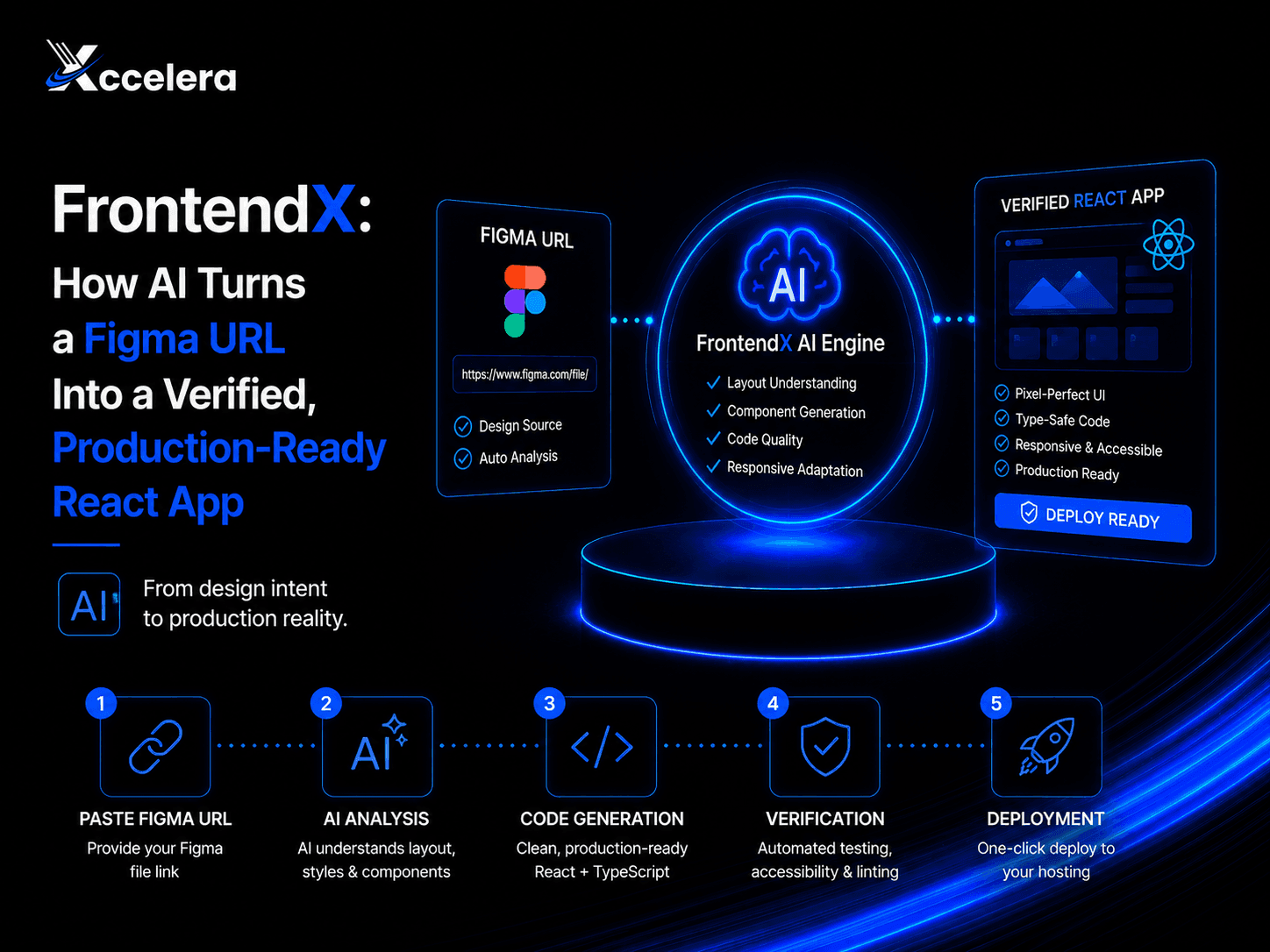
Enterprise product teams have largely solved backend velocity. APIs deploy faster. Databases provision in minutes. Infrastructure scales on demand. The frontend, however, remains the bottleneck. Not because frontend engineering is unsophisticated, but because the conversion stage between a designer’s Figma file and a developer’s working React application has never been automated at the execution level — it has only been assisted.
FrontendX changes the equation entirely. It is not a plugin, a code-suggestion layer, or a design annotation tool. Rather, it is a fully autonomous frontend generation agent that accepts a Figma URL, extracts every design token with precision, generates a complete React application with routing, self-corrects compile errors, and delivers a build-validated output with no human intervention anywhere in the pipeline.
The Handoff Problem That Costs Enterprises Millions
The design-to-engineering handoff is the most consistently broken stage in digital product delivery. Research on product team misalignment attributes 68% of frontend rework costs directly to information lost or never communicated at the handoff boundary.
Figma files show the happy path. They rarely define error states, loading states, empty states, or responsive edge cases with the specificity engineers require to build without assumptions. Consequently, when a developer encounters a design gap, they make a judgment call. That judgment call becomes a QA ticket. That QA ticket then becomes a rework cycle that consumes sprint capacity and compounds across every subsequent release.
This problem, furthermore, is not limited to small teams or immature organizations. Even the most disciplined enterprise product teams face this structural friction because the root cause lies in the tools themselves, not the processes built around them. This is precisely why investing in AI-powered software development has become a strategic priority for forward-thinking CTOs.
The Financial Consequence of Interpretation at Scale
A 2025 analysis of enterprise design workflows confirmed that validating designs before development reduces iteration cycles by 25%, directly avoiding millions in wasted developer rework costs.
For large enterprises specifically, connecting design and engineering teams through optimized workflows and governance infrastructure can generate up to a 9x ROI over three years. Those figures, notably, represent what becomes possible when conversion is accurate. Most organizations, however, are nowhere near that threshold.
The structural cause is not process failure or team misalignment. It is, in fact, architectural. Static Figma files were built to communicate visual intent, not component logic, routing relationships, or build behavior. No amount of design system documentation or handoff ritual resolves what the file format was never designed to do.
Removing human interpretation from the conversion stage is therefore not a process improvement. It is a prerequisite for solving the problem at its root. Organizations that have already embraced digital transformation understand that sustainable velocity requires eliminating structural inefficiency, not merely managing it.
Why Traditional Design-to-Code Tools Fall Short
The market response to the handoff problem has been substantial. Locofy, Anima, V0, Figma Make, and Builder.io’s Visual Copilot each position themselves as design-to-code solutions. Nevertheless, none has closed the gap fully, and the reason is structurally consistent across all of them.
These tools perform visual translation. They read Figma layers and produce JSX or HTML that mirrors the spatial arrangement of the design. They do not, however, understand what components are supposed to do, how routes should interconnect, or whether the output will survive a real build environment.
The Semantic Gap That Breaks Generated Output
Figma components and React components operate on incompatible conceptual models. Figma reasons in layers, visual properties, and spatial relationships. React, on the other hand, reasons in props, state, reusability, and component hierarchy. A tool that performs literal translation between those two paradigms consequently produces output that is architecturally wrong before a developer even opens it.
Engineers receive generated files and spend hours refactoring them into something the codebase can absorb. Industry data from 2025 confirms that frontend developers still consume roughly 80% of their time on mechanical translation work rather than creative problem-solving. The tools promising to solve this are, unfortunately, largely accelerating the same manual process rather than replacing it.
The deeper failure is building integrity. Most existing tools deliver code without confirming it compiles. They do not auto-link routes, resolve dependency conflicts, or self-correct when generated output breaks. As a result, the engineer still owns the debugging cycle. That is not automation — it is assisted transcription with a better interface.
This limitation is also why agentic AI solutions represent such a meaningful departure from conventional tooling. Unlike assistants that require human oversight at every stage, autonomous agents close the loop entirely.
How FrontendX Works: From Figma URL to Production React
FrontendX operates on a fundamentally different execution model. The input is a Figma URL. The output is a verified, production-ready React application. Everything between those two points runs autonomously, without a developer touching the pipeline.
First Stage: Precision Design Token Extraction
FrontendX connects directly to the Figma file and extracts the complete design specification at the token level. Fonts, colors, spacing values, typography scales, component hierarchies, and layout structures are pulled exactly as the designer defined them. Importantly, there is no approximation, no pixel rounding, and no interpretation. What exists in Figma enters the generation pipeline without degradation.
Second Stage: Complete React Application Generation
From the extracted design tokens, FrontendX subsequently generates a full React application including component architecture, routing structure, and all necessary file relationships. Pages are generated as discrete, route-connected components — not as isolated fragments that an engineer must manually wire together. The output, therefore, functions as an application from the moment generation completes.
Third Stage: Autonomous Compile Error Resolution
When the generated code encounters a compile error, FrontendX does not surface it to the user. Instead, it resolves it autonomously. The agent identifies the error, diagnoses the cause within the generated output, applies the correction, and reruns the build validation without any human trigger. This self-correction loop runs silently until the build passes — a capability that fundamentally separates FrontendX from every assisted tool on the market.
According to research on autonomous AI systems, self-correcting agentic pipelines reduce downstream debugging cycles by eliminating the handoff between generation and validation that traditional tools leave entirely to human engineers.
Fourth Stage: Build Validation Before Delivery
Every FrontendX run ends with a confirmed build. The application compiles successfully before output is delivered. Enterprise teams therefore receive React code they can deploy immediately — not code they need to debug first.
Pricing operates on a pay-per-run model with no seat fees: SMALL runs at $0.20 to $2.00, MEDIUM at $2.00 to $3.00, and LARGE at $3.00 to $9.00 per run.
The Autonomous Execution Advantage
There is a distinction that matters operationally between AI-assisted frontend development and autonomous frontend generation. Assisted tools reduce the time a developer spends completing a task. Autonomous tools, by contrast, remove the developer from that task execution stage entirely. FrontendX operates in the second category, and the business consequence for enterprise product organizations is significant.
Speed and Cost at a Different Order of Magnitude
Industry research documented in 2025 confirms that AI development tools reduce frontend build time by up to 70% compared to fully manual workflows. Traditional manual frontend development for a production project costs between $200 and $5,000 per engagement depending on scope and developer rates. FrontendX, in contrast, delivers the same output at $0.20 to $9.00 per run with no recurring overhead, no retainer cost, and no idle spend between runs.
Organizations that adopted AI automation across development workflows in 2025 reported average productivity gains between 40% and 65%. For frontend specifically, where design-to-code translation historically consumes the largest share of non-creative engineering time, autonomous generation compresses an entire delivery phase into a single agent run.
Product teams that previously allocated a dedicated frontend developer to each design sprint can, as a result, redirect that capacity toward architecture, performance optimization, and product logic — the work that actually requires human judgment and cannot be automated. This directly aligns with the broader AI automation advantage that leading enterprises are now structuring their engineering organizations around.
A 2024 McKinsey report on generative AI productivity similarly concluded that software engineering represents one of the highest-value use cases for AI-driven automation, specifically because of the volume of repeatable translation work that consumes developer capacity without generating proportional business value.
Enterprise Use Cases Where FrontendX Delivers Immediate ROI
FrontendX generates the strongest return in environments defined by high design-to-deployment volume, constrained frontend capacity, and pressure to ship without extending timelines or expanding headcount. The pattern holds consistently across enterprise contexts.
Internal tooling backlogs
One of the clearest applications. Operations dashboards, compliance portals, logistics interfaces, and internal productivity tools accumulate in engineering queues because they are deprioritized against core platform work. FrontendX, consequently, clears that backlog without requiring additional developers.
Marketing teams
Managing rapid page deployment across campaigns, regions, and seasonal cycles generate production-ready interfaces directly from approved Figma files, bypassing the engineering queue entirely.
Agencies delivering frontend work across multiple concurrent client engagements compress delivery timelines without scaling their developer roster.
The most strategically significant configuration for enterprise technology leaders is, moreover, the pairing of FrontendX with ApiX, Xccelera’s autonomous backend generation agent. ApiX accepts a configuration input and autonomously generates APIs, database setup, and over 100 tested endpoints with no human supervision. FrontendX accepts a Figma URL and generates the complete React frontend with routing and build validation.
Together, they form a config-to-production full-stack delivery pipeline. A product that previously required weeks of coordinated frontend and backend development now moves from design and configuration to a deployable, tested application through two autonomous agent runs. For teams already leveraging product engineering at scale, this combination represents a step-change in delivery velocity.
For a deeper look at how agentic pipelines compare against traditional development cost models, Xccelera’s analysis of AI agents vs. hiring developers provides a detailed breakdown of where autonomous execution delivers the greatest financial return.
According to Gartner’s research on low-code and AI-assisted development, organizations that fully integrate autonomous code generation into their delivery pipelines are projected to reduce custom application development effort by more than 60% by 2027 — a figure that aligns closely with documented FrontendX performance benchmarks.
How Xccelera Is Redefining Frontend Delivery for the Enterprise
The industry has pursued the design-to-code problem for years through better collaboration tooling, richer annotation workflows, and assisted code generators. None of those approaches, however, removed the core dependency: a human developer who must interpret, translate, and validate every conversion. Xccelera’s FrontendX removes that dependency at the structural level — not through process improvement, but through autonomous execution.
A Production-Grade Agent Built for Enterprise Scale
Xccelera builds, deploys, and maintains production-ready AI Agents that function as digital workers, executing tasks autonomously across enterprise workflows with human teams retaining strategic direction. FrontendX is the direct application of that principle to the frontend delivery layer. It does not suggest React code or annotate Figma files — it generates, self-corrects, validates, and delivers a working React application from a URL, operating within Xccelera’s broader agentic AI platform.
Xccelera’s enterprise performance benchmarks are measurable and documented: up to 35% cost reduction, up to 40% productivity improvement, and live deployment in under 7 weeks from concept to production.
For CTOs, VPs of Engineering, and product leaders evaluating where autonomous AI agents generate concrete, near-term return in 2026, the frontend delivery layer is one of the most immediate answers available. The design already exists. The specification already lives in Figma. FrontendX, ultimately, turns it into a React application that ships.
To understand the full scope of what autonomous agents can achieve across the enterprise stack, explore Xccelera’s breakdown of how agentic AI platforms differ from traditional development — and what that difference means for teams ready to move beyond assisted tooling entirely.


