FrontendX Case Study: 30-Screen SaaS Dashboard — Designed, Generated and Shipped Same Day
FrontendX designed, generated, and shipped a 30-screen SaaS dashboard that typically consumes six to eight weeks of frontend engineering — all within a single working day. No engineer wrote code manually, No design handoff cycles consumed the schedule, No compile errors blocked delivery. This case study breaks down the execution sequence, the technical architecture that…
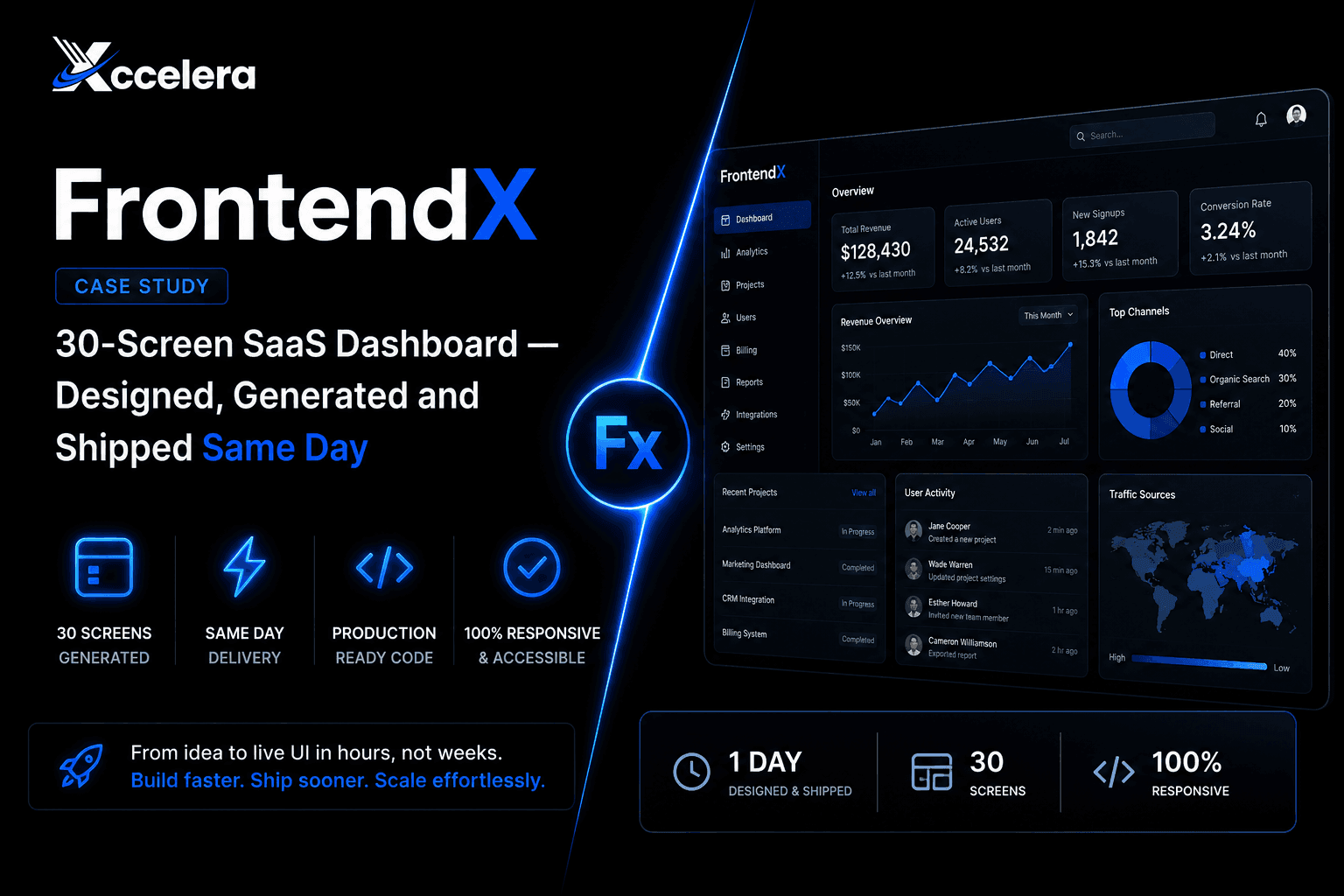
FrontendX designed, generated, and shipped a 30-screen SaaS dashboard that typically consumes six to eight weeks of frontend engineering — all within a single working day. No engineer wrote code manually, No design handoff cycles consumed the schedule, No compile errors blocked delivery. This case study breaks down the execution sequence, the technical architecture that made it possible, the economics of same-day frontend delivery, and what it means for enterprise product teams still operating under conventional frontend timelines.
The Frontend Development Problem That Won’t Go Away
The Real Cost of Multi-Screen Builds
Enterprise product teams have absorbed the frontend bottleneck for years as a fixed cost of delivery. A SaaS dashboard built in 2025 runs between $15,000 and $50,000 for a US-based team, with senior frontend specialists billing at $70 to $150 per hour. Those figures reflect single-scope projects. Moreover, when you scale to 30 screens with full routing, role-based views, and enterprise-grade component complexity, the project scope compounds in ways that sprint planning rarely accounts for upfront.
This is precisely why teams exploring AI-powered software development are reconsidering the assumptions that have governed frontend delivery for years.
Why 30 Screens Changes the Equation
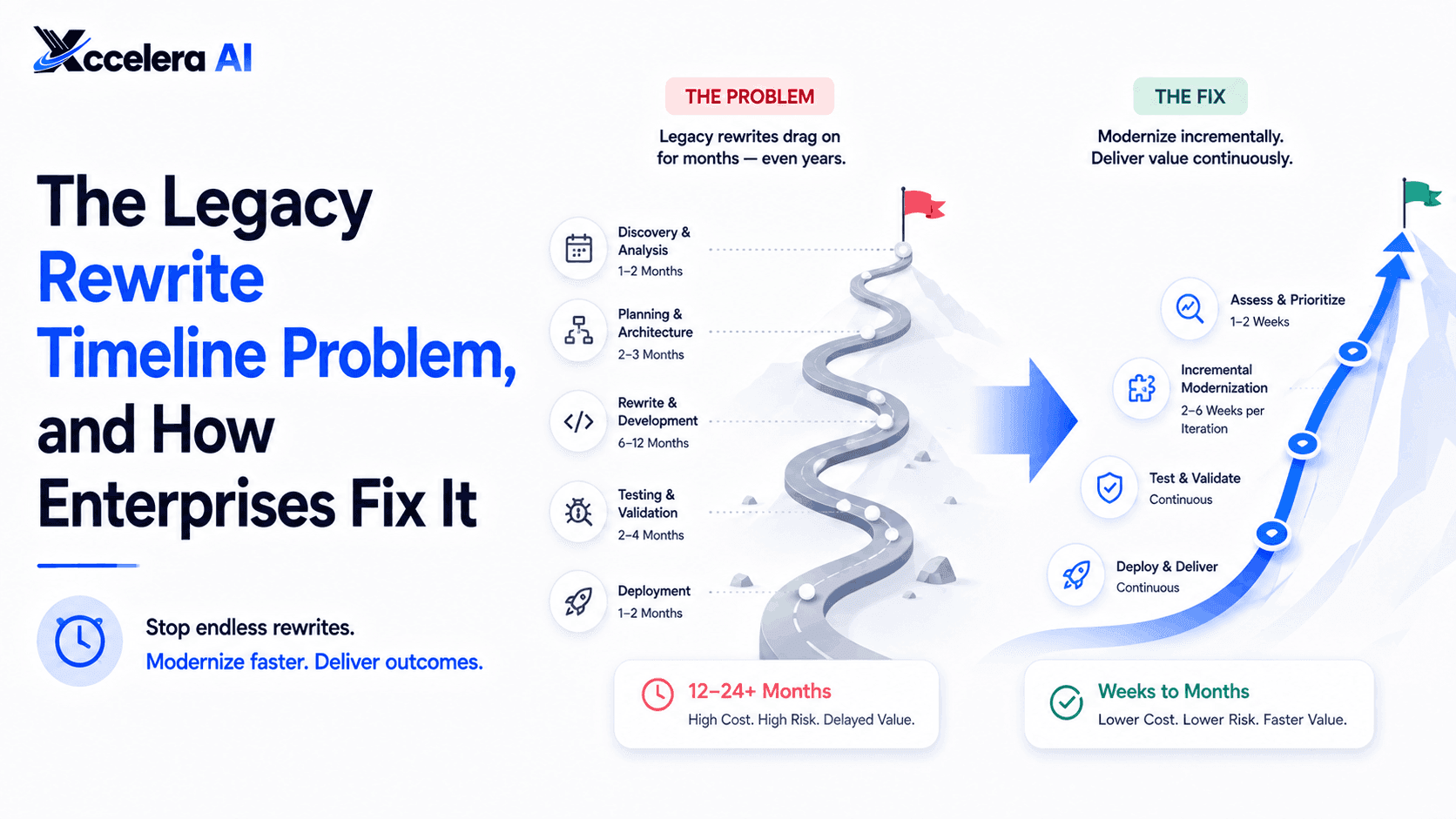
The industry benchmark for converting a Figma screen to production-ready React code runs at two to three days per screen when factoring in layout interpretation, component structuring, routing logic, state management scaffolding, and compile error resolution.
At that rate, a 30-screen application demands a six-to-ten-week frontend engagement before a single line of backend integration begins.
For CTOs managing product roadmaps under competitive release pressure, that timeline is not a delay. It is, in fact, a structural constraint baked into the delivery model.
The deeper problem is not speed alone. The manual translation process introduces inconsistency. Spacing drifts from design spec. Developers hardcode typography tokens instead of referencing them. Engineers write routing logic from memory rather than extracting it from the design hierarchy. As a result, the gap between what the design file specifies and what ships to staging is rarely zero — and closing it costs additional review cycles that extend the timeline further.
What Autonomous Frontend Generation Actually Means
Developers have applied the phrase “AI-assisted frontend development” loosely to tools that autocomplete JSX, suggest Tailwind classes, or help a developer write a button component faster. That category of tooling accelerates manual work. It does not, however, eliminate it.
Direct Figma Ingestion vs. Plugin Workflows
Autonomous frontend generation operates at a fundamentally different level. The input is a Figma URL. The agent accesses the design file directly through the Figma API, extracting the full design tree as structured data: component hierarchy, spacing values, typography tokens, color variables, layout constraints, and node relationships. No export step, No plugin intermediary, No design handoff document. Consequently, the design file itself becomes the source of truth for code generation.
This approach is a natural extension of broader agentic AI solutions that are redefining how software gets built across the enterprise stack.
What Gets Extracted and What Gets Built
From that structured input, the agent constructs the full React application. It generates components with exact font families, color values, padding, and margin as the design specifies. It infers routes from the screen hierarchy and links them automatically. Furthermore, when compile errors surface during build validation, the agent identifies the error, applies the patch, and reruns the build without human intervention. The result is a React application that compiles cleanly, routes correctly across all screens, and reflects the design specification with high fidelity.
The distinction between this and a Figma plugin that generates rough component scaffolding is, therefore, the difference between a draft and a deliverable.
According to GitHub’s 2024 Octoverse Report, AI-assisted coding tools are now used by the majority of professional developers — yet most still operate as autocomplete accelerators rather than autonomous build systems. FrontendX represents the next generation of that capability curve.
The 30-Screen Dashboard — Build Sequence and Outcomes
Project Parameters
This case study examined a 30-screen enterprise SaaS dashboard. The scope included a full navigation structure, role-based view states, data display components across multiple screen types, and a routing architecture connecting all thirty screens into a coherent application flow. Under conventional development assumptions, this project carried a six-to-eight-week frontend estimate before any backend wiring.
Execution Sequence
The build sequence ran as follows. The team submitted the Figma URL as the sole input. Subsequently, the agent parsed the design file, mapped the component and screen hierarchy, and began generating React components in sequence. It pulled typography, color, and spacing values directly from the design tokens rather than approximating them. It constructed routing from the navigational hierarchy the design structure identified.
During build validation, the agent autonomously detected and resolved compile errors through iterative patch cycles. Notably, no human wrote a single line of code. No review cycle was necessary to align the output with the design file.
What the Output Looked Like
The agent delivered a fully functional React codebase with clean routing across all 30 screens, design-accurate components, and a successful build validation state. Design fidelity held at the token level. The project that would have occupied a frontend team for six to eight weeks was, ultimately, production-ready within a single working day.
That outcome does not represent an edge case. Rather, it represents what happens when teams remove the manual translation layer from the process entirely.
Teams that have already adopted custom AI agents for backend and data workflows will recognize this pattern immediately — the same autonomous execution logic that powers agent-driven pipelines now drives frontend generation at production scale.
The Economics — What Same-Day Delivery Does to the Cost Model
Traditional Build Costs vs. Per-Run Pricing
A SaaS dashboard build at US developer rates carries a baseline cost of $15,000 at the lower end of complexity and climbs past $50,000 for enterprise-grade multi-screen applications. That cost reflects labor hours, not output quality. A team spending six weeks on a 30-screen build bills for the process of translation, not for the intellectual work of architecture or the strategic work of product judgment.
Per-run pricing restructures that equation entirely. The cost of a frontend generation run is not denominated in hours. It is, instead, fixed to the output scope. SMALL runs cover foundational builds. MEDIUM runs address standard application complexity. LARGE runs handle enterprise-scope projects. The delta between a per-run cost and a six-week engineering engagement is not marginal. It is, in short, a fundamental shift in how frontend delivery gets priced and planned.
A McKinsey analysis on AI-driven software productivity found that generative AI tools can accelerate developer output by 20 to 45 percent on routine coding tasks. Autonomous generation, as demonstrated here, pushes that ceiling significantly further.
Where the Savings Actually Land
The economic argument is not only about what the run costs. It is, more importantly, about what the engineering team does with the time that translation work previously consumed. Senior frontend engineers billing at $100 to $150 per hour rank among the most expensive contributors to a product team. Redirecting that capacity from Figma-to-code translation toward architecture decisions, performance optimization, and system integration work produces compounding returns that a cost-per-screen analysis does not capture.
For VPs of Engineering and CTOs building annual delivery plans, same-day frontend generation is therefore not a line-item saving. It is a structural reallocation of the highest-cost resource on the product team.
What This Signals for Enterprise Product Teams
The ability to generate a 30-screen React application in a single day is not primarily a story about speed. It is, in essence, a signal that one of the most resource-intensive constraints in enterprise product delivery has become a variable rather than a fixed cost.
Sprint Planning Assumptions Are Due for Revision
Product teams have treated frontend development timelines as stable planning inputs for most of the past decade. Sprint velocity calculations, release roadmaps, and team headcount decisions have all relied on the assumption that screen-level frontend work takes days, not hours. When that assumption no longer holds, the downstream planning implications extend well beyond a single project.
Product teams that revise their delivery models around autonomous frontend generation can increase release cadence without increasing headcount. That is a competitive variable, not an operational detail. Furthermore, teams adopting generative-driven development frameworks are already seeing this advantage compound across successive release cycles.
The DORA State of DevOps Report consistently shows that elite-performing engineering teams deploy significantly more frequently than their peers — and autonomous code generation is increasingly one of the differentiating factors behind that gap.
Engineering Capacity Moves Up the Stack
The larger strategic implication is where senior engineering capacity gets directed once translation work disappears. Teams that previously allocated two-thirds of their frontend sprints to converting designs to components can redirect that capacity toward the problems that require genuine technical judgment: system architecture, API design, performance optimization, accessibility compliance, and integration reliability. Those are the decisions that determine whether a product scales. They are also, critically, the decisions that no agent can automate.
Agentic AI Is Restructuring Product Development End-to-End
The 30-screen build is one data point in a broader pattern. Agentic AI systems are progressively absorbing the execution layers of product development across the enterprise. As a result, teams that recognize this early and restructure their delivery models accordingly will operate with a structural speed advantage that compounds over successive release cycles.
McKinsey’s 2025 research estimated that agentic AI could automate 25 to 40 percent of current work hours in typical software-enabled workflows. Frontend translation sits squarely within that range. This is not, therefore, a future-state scenario — it is already the operational reality for teams deploying multi-agent systems across their product development pipelines.
For additional context on how enterprises are operationalizing this shift, MIT Sloan’s research on AI in software engineering provides useful framing on the broader transition from augmentation to automation in knowledge work.
FrontendX by Xccelera — The Agent Behind the Build
Xccelera built the 30-screen SaaS dashboard in this case study using FrontendX, its autonomous frontend generation agent.
FrontendX takes a Figma URL as input and outputs a fully functional React application with accurate routing, build-validated code, and design-faithful components. Specifically, it extracts exact fonts, colors, spacing, and typography directly from the Figma file. It auto-links all routes across the application. It identifies and resolves compile errors without human intervention. The user writes no code. The process requires no supervision during generation.
FrontendX operates on a pay-per-run model with no seat fees. SMALL runs are priced from $0.20 to $2.00. MEDIUM runs range from $2.00 to $3.00. LARGE runs, covering enterprise-scope builds like the 30-screen case study, run from $3.00 to $9.00. Against a $15,000 to $50,000 conventional build cost, the pricing model resets the unit economics of frontend delivery at the project level.
FrontendX is part of Xccelera’s Accelerators portfolio, a product line built for engineering teams, product leaders, and founders who need production-ready output without the overhead of traditional development cycles. For CTOs, VPs of Engineering, and PMs evaluating how to restructure their frontend delivery, FrontendX represents the most direct path from Figma design to working React application available today.