ApiX vs Traditional Backend Development: A Side-by-Side Breakdown for Engineering Leaders
Engineering teams lose weeks and thousands of dollars to manual backend cycles. ApiX eliminates that overhead by autonomously generating APIs, database setups, and 100+ tested endpoints from a single config. This breakdown gives engineering leaders a direct, data-grounded comparison of what traditional backend development costs versus what autonomous generation delivers. The Hidden Cost of Traditional…
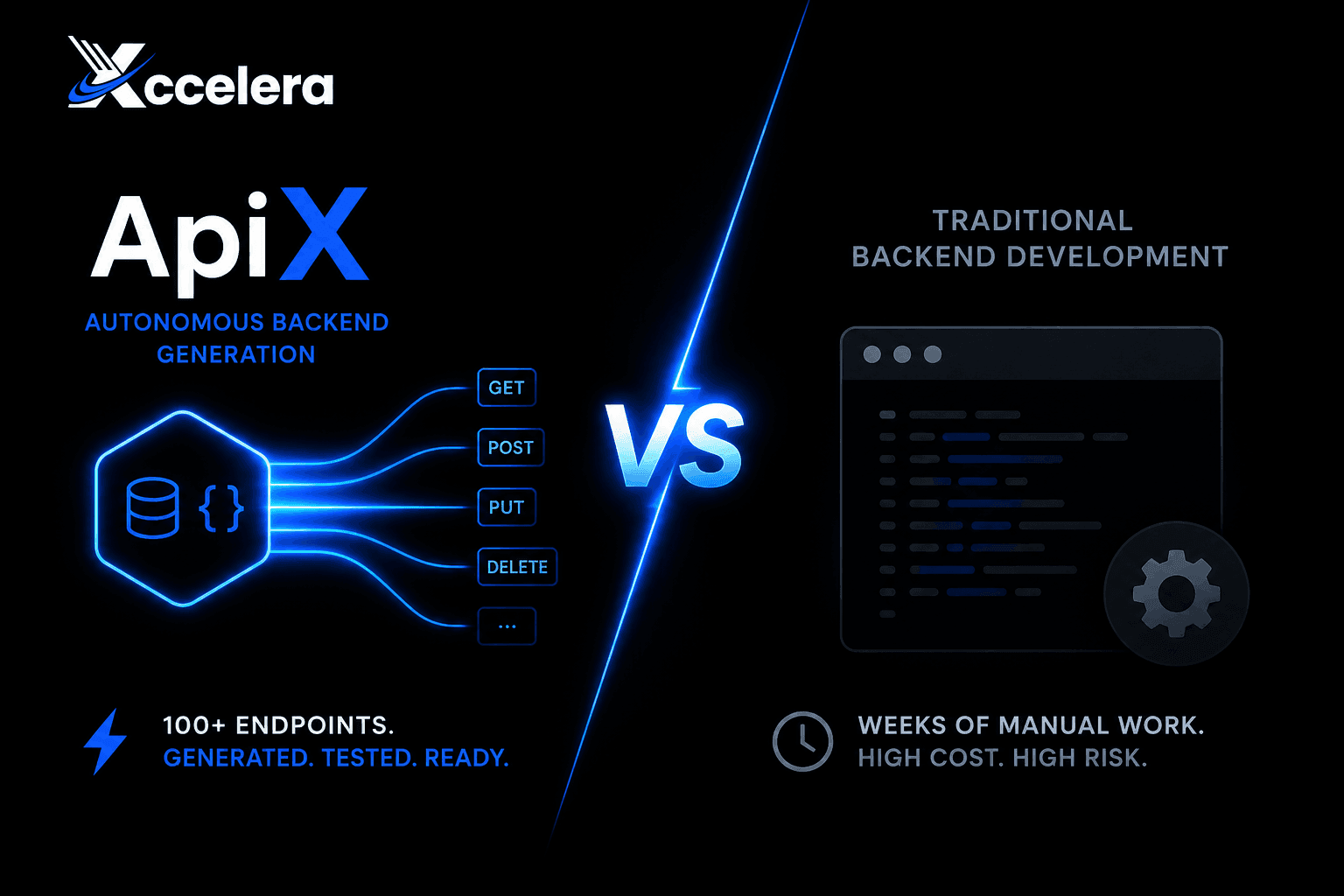
Engineering teams lose weeks and thousands of dollars to manual backend cycles. ApiX eliminates that overhead by autonomously generating APIs, database setups, and 100+ tested endpoints from a single config. This breakdown gives engineering leaders a direct, data-grounded comparison of what traditional backend development costs versus what autonomous generation delivers.
The Hidden Cost of Traditional Backend Development
What Engineering Budgets Actually Absorb
Most engineering leaders approve backend projects based on quoted delivery timelines. However, what those timelines rarely account for is the compounding overhead that accumulates before a single endpoint reaches production.
A mid-sized backend project handled by a US-based developer costs between $200 and $5,000 per engagement, depending on scope and seniority. Furthermore, mid-sized custom applications routinely run between $100,000 and $500,000 when full delivery is factored in, with AI-driven development pricing still evolving as automation reshapes how repetitive coding tasks are billed. That range, moreover, rarely captures the full operational drag.
The hours absorbed by manual API scaffolding, boilerplate setup, database configuration, and iterative debugging do not appear on project invoices as line items. Instead, they surface as timeline overruns and re-scoping cycles. Most backend APIs do not fail because of bad code. In fact, they fail because of decisions made in the first two weeks of a project — including the wrong architecture, no versioning plan, weak authentication, or skipped contract testing.
For engineering leaders managing multiple parallel projects, this structural inefficiency compounds across every backend engagement. As a result, the real cost of traditional development is not the quoted rate. It is, ultimately, the accumulated overhead of every manual decision point between config and production. To understand how AI-powered software development is redefining these cost structures, it helps to look at autonomous generation as a category shift — not merely a tooling upgrade.
What Autonomous Backend Generation Actually Means
Traditional AI-assisted coding tools augment developers. Specifically, they suggest code, auto-complete functions, and flag syntax errors. Autonomous backend generation, by contrast, operates on a fundamentally different model: it removes the developer from the execution loop entirely.
A new architectural pattern is consequently emerging, shaped by event streams, vector stores, memory layers, and autonomous reasoning loops. Where traditional backends were request-driven, the new generation is event-driven, vector-centric, and memory-streamed. Autonomous generation, therefore, sits at the operational edge of this shift. This is precisely the territory that agentic AI solutions are designed to occupy.
The Execution Model
ApiX operates on a POST-config architecture. An engineering leader or developer submits a configuration. The system then generates the backend, sets up the database, builds the endpoints, tests them, and corrects errors — all without human supervision at any stage. Pre-embedded prompts handle the intelligence layer. Additionally, auto DB validation with fallback support across Postgres and SQLite handles infrastructure resilience. Live endpoint testing, moreover, runs within the same execution cycle.
While AI coding tools once offered simple autocompletion, current-generation tools are increasingly autonomous agents that can plan, code, test, and deploy with minimal human intervention — handling repetitive CRUD operations, database indexing, and API scaffolding and, in doing so, allowing developers to focus on higher-level architecture. This trend aligns with what McKinsey’s research on developer productivity describes as a structural shift in how engineering value is created and measured.
The distinction matters for engineering leaders because it changes the resource calculation entirely. Autonomous generation does not simply reduce developer hours — it eliminates the need for developer hours on execution-layer tasks altogether.
Speed, Scope, and Scale: Where ApiX Outpaces Traditional Teams
Endpoint Volume and Delivery Timelines
A traditional backend sprint to deliver 100-plus tested endpoints requires scoping, development, QA, and integration cycles. Depending on team composition and project complexity, that timeline ranges from days to weeks.
ApiX, on the other hand, delivers 100+ endpoints, database validation, and live endpoint testing within a single run. The cost of that run sits between $3.00 and $9.00 for a large-tier project.
According to Stack Overflow’s 2024 Developer Survey, around 72% of organizations have adopted AI in their software engineering workflows, citing measurable improvements in delivery speed and reduced post-deployment bugs. Consequently, backend teams can now iterate faster, experiment more confidently, and focus on architecture rather than repetitive coding.
The scale advantage, furthermore, compounds as project complexity increases. In traditional development, more endpoints mean proportionally more developer hours, more QA cycles, and more integration risk. In an autonomous model, by contrast, complexity is absorbed by the execution layer rather than transferred back to the engineering team as additional sprint capacity.
Auto-Correction as a Production Safeguard
ApiX auto-probes and corrects database errors during execution. This is not a post-deployment monitoring function — rather, it is built directly into the generation cycle. As a result, the output that reaches engineering review has already passed internal validation. That single operational characteristic, therefore, eliminates an entire category of debugging overhead from traditional backend workflows. Engineering teams that have adopted custom AI agent development strategies recognize this kind of closed-loop error handling as a foundational reliability advantage.
The Real Cost Comparison: ApiX Pricing vs Traditional Development
The numbers below are not projections. They are, instead, direct comparisons based on publicly available market rates and ApiX’s published pricing tiers.
ApiX Per-Run Pricing
| Tier | Cost Per Run |
|---|---|
| SMALL | $0.20 – $0.55 |
| MEDIUM | $0.90 – $2.10 |
| LARGE | $3.00 – $9.00 |
Traditional Backend Development Costs
| Resource | Cost |
|---|---|
| Human developer (per project) | $200 – $5,000 |
| Supabase / Firebase subscription | $25 – $99/month (recurring) |
| US freelance backend developer | $60 – $140/hour |
The benchmark that fundamentally reframes the decision for engineering leaders is this: 500 ApiX runs on a large-tier application equal the cost of one freelance backend project. That is not a per-feature comparison. Rather, that is 500 full execution cycles — each delivering generated APIs, tested endpoints, and validated database setups — at the price of a single human-supervised engagement.
The rapid growth of AI-native products and cloud infrastructure complexity created major demand spikes for highly specialized engineers. At the same time, AI coding assistants made many implementation-heavy development tasks faster and more commoditized. ApiX, as a result, operates at the far end of that commoditization curve, removing per-seat and per-subscription cost structures entirely in favor of pay-per-run execution. This mirrors the broader economic argument explored in The Economics of AI Agents, where the return-on-execution model consistently outperforms legacy licensing approaches.
Where Traditional Development Still Holds Ground
Not every backend requirement maps cleanly to autonomous generation. Engineering leaders who deploy ApiX without understanding its boundaries will, in turn, encounter gaps that erode the efficiency gains.
Early-stage products move fast, and that speed is necessary. But speed often hides structural weaknesses. Endpoints get written quickly. Business logic mixes with routing. Authentication gets patched together. Database schemas evolve reactively. In scenarios where the business logic itself is ambiguous or deeply custom, therefore, human architectural judgment remains the stronger input.
Three scenarios where traditional development retains a clear advantage:
- Complex custom business logic — where the requirements cannot be expressed in a configuration and require iterative human reasoning to define correctly.
- Highly regulated environments — in sectors like fintech and healthcare where compliance review, audit trails, and human-in-the-loop validation are regulatory requirements, not optional governance layers. The GitHub research on responsible AI deployment confirms that regulated industries consistently require additional human oversight layers that autonomous tools alone cannot satisfy.
- Legacy system integration — where existing infrastructure carries undocumented dependencies, non-standard data models, or organizational constraints that require senior engineering judgment to navigate safely. Xccelera’s legacy system modernization services address precisely these edge cases, where automation must be paired with deep architectural expertise.
The practical conclusion for most engineering teams is, therefore, a hybrid model: ApiX handles execution-layer backend generation at scale, while senior developers focus on architecture, compliance, and integration logic where human judgment is genuinely irreplaceable.
Engineering Leader’s Decision Framework: When to Deploy ApiX
The decision to deploy autonomous backend generation is not simply a technology choice. It is, more precisely, a resource allocation decision.
Use ApiX when one or more of the following conditions apply:
- Speed pressure is the primary constraint. MVPs, prototypes, and time-sensitive product launches where backend delivery timelines are the critical path. Xccelera’s MVP development framework integrates ApiX as the default execution layer for exactly these high-velocity scenarios.
- Endpoint volume is high. Projects requiring 50-plus endpoints where manual generation creates compounding QA overhead.
- Team capacity is limited. Engineering teams with senior developers already committed to architecture, integration, or compliance work who cannot absorb execution-layer backend tasks without sprint disruption.
- Cost-per-run ROI is clear. At $3.00 to $9.00 per large-tier run, the break-even calculation against a $200-plus developer engagement is, consequently, straightforward for any engineering manager.
The DORA 2025 State of DevOps Report found that over 80% of developers believe AI makes them more productive. However, AI amplifies existing strengths and weaknesses — meaning, consequently, that teams without solid practices see little benefit from AI adoption.
That finding applies directly to ApiX deployment. The tool delivers maximum return when it is deployed against well-scoped requirements with clear configuration inputs. Engineering leaders who deploy it without a defined project architecture will, in effect, replicate in automation what they struggled with in manual development.
ApiX in the Broader Xccelera Accelerator Ecosystem
Autonomous backend generation does not operate in isolation. The decision to deploy ApiX at scale connects directly — and necessarily — to how an engineering organization structures its entire delivery layer.
Xccelera’s ApiX is the backend generation component within a broader Accelerators portfolio designed to compress full-stack delivery timelines. It operates alongside FrontendX, which turns Figma designs into fully working React applications with routing and build validation. Together, the two agents cover the full application generation stack autonomously: backend and frontend, from config and design to tested, deployable output. This integrated approach reflects the same philosophy behind generative-driven development — where intelligent agents handle execution so engineering talent focuses on decisions that compound over time.
The commercial model reflects the operational logic. No seat fees. No recurring subscriptions. Pay per run. Engineering leaders managing project-based delivery cycles pay only for execution, not for access. Backend engineers are, as a result, no longer building static infrastructures. They are instead designing dynamic systems that learn, adapt, and scale continuously. Xccelera’s Accelerators portfolio is built for exactly that operational reality — giving engineering organizations the autonomous execution layer that translates architectural decisions into production-ready output without the manual overhead that traditional development cycles carry by default.
For engineering leaders evaluating where autonomous backend generation fits their stack, ApiX is available at xccelera.ai.