How a B2B SaaS Team Shipped a 30-Endpoint API Without a Single Backend Developer
The landscape of software development is undergoing a structural realignment. Modern technology ecosystems demand unprecedented architectural velocity, forcing executive leadership to rethink long-standing dependency structures. When cross-functional squads deploy intricate digital services, conventional engineering barriers begin to melt away. Furthermore, by leveraging autonomous orchestration platforms like ApiX by Xccelera, fast-moving enterprises are fundamentally altering the…
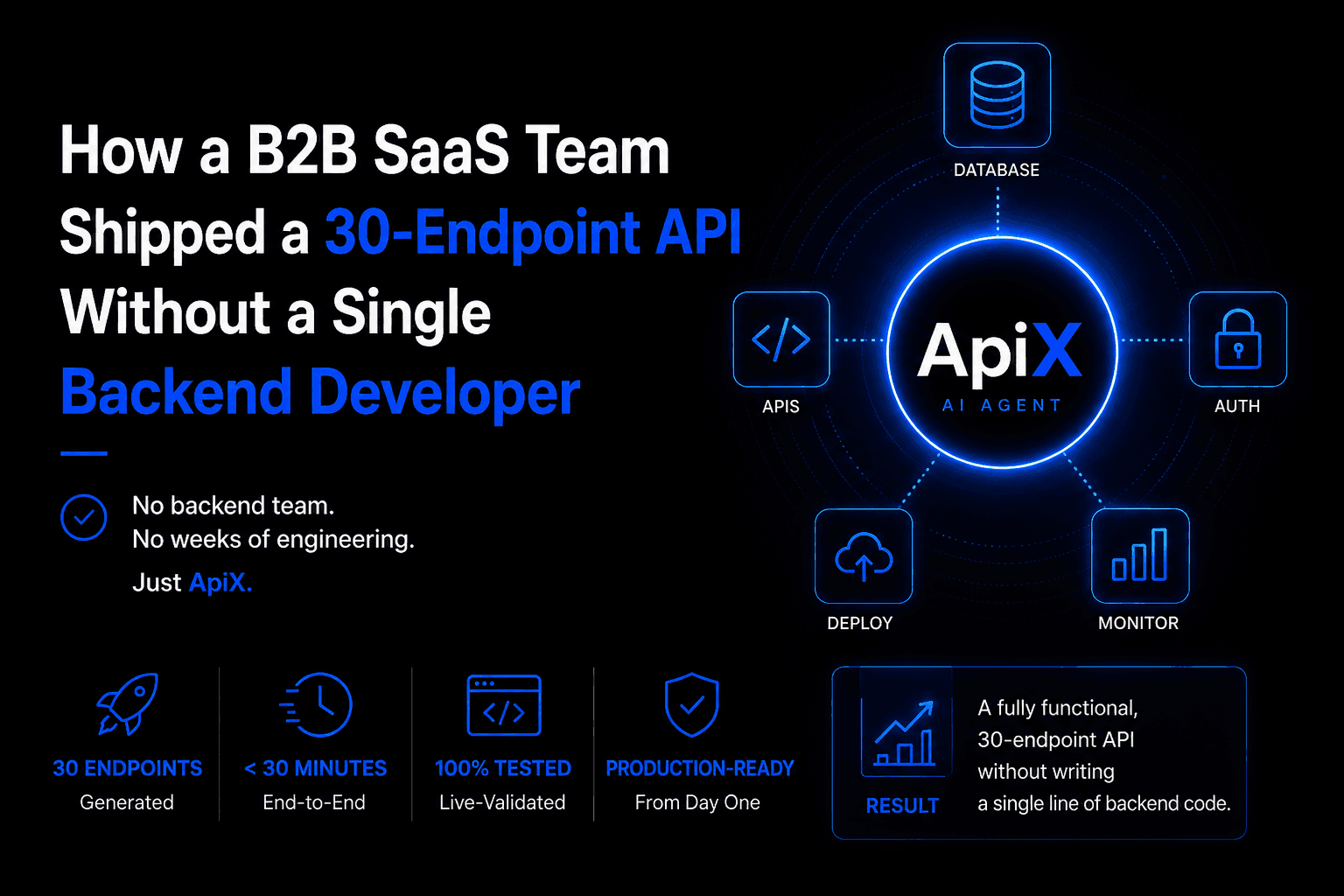
The landscape of software development is undergoing a structural realignment. Modern technology ecosystems demand unprecedented architectural velocity, forcing executive leadership to rethink long-standing dependency structures. When cross-functional squads deploy intricate digital services, conventional engineering barriers begin to melt away. Furthermore, by leveraging autonomous orchestration platforms like ApiX by Xccelera, fast-moving enterprises are fundamentally altering the speed and economics of system production.
The Paradigm Shift: Engineering Without Traditional Backends
Modern B2B SaaS teams are steadily moving away from traditional engineering structures to accelerate software delivery. Historically, deploying enterprise web systems required dedicated infrastructure engineers to provision databases, manage microservices, and configure routing layers. As a result, this reliance often created significant organizational friction, delaying product shipping cycles by months.
By adopting a modern backendless design philosophy, product teams can now establish robust data nodes entirely independently. This shift, therefore, transforms infrastructure from a rigid coding task into a dynamic configuration layer — unlocking rapid feature shipping without waiting on engineering queues. According to McKinsey’s research on developer productivity, organizations that reduce engineering bottlenecks consistently see 40–60% faster time-to-market outcomes.
Democratizing Pipeline Infrastructure
Transitioning away from classic server setups consequently allows companies to bypass deep backend engineering queues entirely. Technical managers are increasingly leveraging AI-powered software development to establish functional operational ecosystems almost instantly. These visual orchestration frameworks handle horizontal resource scaling, database provisioning, and routing tables automatically — without writing a single line of server-side code.
As a result, product leads can deploy intricate workflows without needing to write traditional server-side scripts. Eliminating these low-level tasks, in turn, optimizes resource utilization and shifts internal technical focus away from baseline infrastructure maintenance toward core product differentiation. For a deeper look at how Xccelera enables this shift across the full product stack, explore our product engineering services.
Anatomy of ApiX: Deconstructing a 30-Endpoint Architecture
Deploying an intricate, multi-layered data landscape requires an organized configuration strategy to function efficiently — and without any manual coding overhead. Specifically, the ApiX initiative required building thirty unique endpoints to manage complex data manipulation, customer onboarding workflows, and third-party web service integrations. Building this setup through standard development methods would typically require months of schema creation, route mapping, and unit testing.
Instead, the team designed a fully functional visual map to govern inbound payloads and outbound server responses. This blueprint, moreover, systematically handles intricate application logic while maintaining clean internal separation between services. To understand how agentic development compares to traditional API approaches, explore how enterprises are turning agentic AI hype into real systems. Teams building APIs without automation consistently face significantly longer delivery timelines.
Structural Mechanics of Code-Free Schemas
Managing multiple functional data paths ultimately requires a reliable, abstract relational foundation. Using modern data layers allows teams to visually map object structures and manage properties without executing complex SQL scripts. Additionally, the platform handles user identity management, automated webhooks, and live data streaming right out of the box.
This structured layer ensures that every single custom data pathway operates with minimal latency. Removing manual database tuning, therefore, allows product owners to directly modify field schemas on the fly, keeping production environments highly responsive to shifting business demands. You can see this architecture in action on the ApiX product page, where the full capabilities of autonomous backend generation are documented in detail.
Eliminating the Middleware Bottleneck via Product-Led Orchestration
Modern software delivery frequently faces bottlenecks within intermediate routing layers, where data requires extensive parsing and transforming between systems. When non-technical managers take direct control of these orchestration layers, system logic transforms from custom code into clear configuration tasks — a shift that is both dramatic and measurable.
This tactical change enables product-led squads to connect disparate cloud tools, map variable fields, and establish automated logic without any engineering support. Consequently, teams eliminate tedious backend development cycles, effectively transforming the middleware layer into a highly flexible tool for rapid business experimentation. As Gartner’s research on low-code platforms notes, product-led orchestration can reduce application delivery timelines by up to 50% in enterprise environments.
Operational Freedom from Legacy Pipelines
By utilizing advanced, accessible data management directories, organizations can orchestrate complex web workflows almost instantly. Modern gateway proxies handle request routing, rate limiting, and analytics collection without custom code. These visual control boards, furthermore, allow operators to transform payload data formats instantly, ensuring compatibility between legacy software installations and modern applications.
This centralized approach not only reduces system bugs but also empowers product teams to manage end-to-end data pipelines completely independently. Teams looking to modernize outdated systems can additionally benefit from Xccelera’s legacy system modernization services, which bridges the gap between existing infrastructure and modern agentic pipelines
Security, Compliance, and Data Integrity Safeguards
Deploying decentralized gateways requires strict adherence to global compliance standards, data privacy laws, and security protocols. Without traditional engineers manually writing validation logic, security configuration necessarily shifts to automated, platform-wide guardrails. Modern backendless architectures address these needs by integrating encryption protocols, access control mechanisms, and detailed event logging directly into the infrastructure layer.
This approach, as a result, ensures that every automated endpoint remains protected against common web vulnerabilities — preserving enterprise security integrity without requiring manual code audits. For reference, OWASP’s API Security Top 10 provides an industry-standard framework that ApiX’s security layer is designed to align with, covering injection attacks, broken authentication, and excessive data exposure.
Hardening Decentralized Gateways
Operating secure cloud software requires a reliable collection of vetted, production-grade web resources. Technical leaders regularly cross-reference curated community assets to select infrastructure tools with built-in access controls. These managed cloud options, moreover, provide automated secure socket layers, token verification, and isolation frameworks by default.
Leveraging these standardized, secure cloud environments consequently allows teams to safeguard sensitive corporate records, block unauthorized network requests, and maintain reliable uptime metrics across all active web endpoints. This level of built-in security is a cornerstone of Xccelera’s agentic AI solutions, where enterprise-grade compliance is embedded at every layer of the stack. For teams that need additional guidance, Xccelera’s AI agent consulting practice helps organizations design and harden their agentic deployments end to end.
Accelerating Time-to-Market for Modern Founders
For expanding businesses, speed to market is a critical metric that directly dictates long-term market capture and competitive positioning. Avoiding traditional infrastructure setups minimizes up-front technical debt and, equally important, eliminates heavy engineering overhead during crucial growth phases. Teams can now easily validate product hypotheses, launch functional features, and iterate on user feedback in real time — without waiting for backend development cycles to complete.
This high velocity, in turn, allows founders to reallocate financial capital toward market acquisition and product design, establishing a highly efficient operational model. Andreessen Horowitz’s analysis of software-defined businesses reinforces this point, noting that development speed is increasingly the primary differentiator between category leaders and laggards in the B2B SaaS market.
Capital Efficiency and Development Velocity
Minimizing overhead allows expanding software companies to build highly competitive prototyping setups at a fraction of traditional costs. By utilizing documented infrastructure registries, operations managers can source and combine proven cloud tools to manage high data loads at negligible costs. Furthermore, this approach avoids expensive upfront licensing agreements and long development timelines that typically burden early-stage teams.
Teams can rapidly prototype, test, and launch complex data connections — significantly reducing traditional engineering timelines and maximizing corporate capital efficiency. For early-stage ventures in particular, Xccelera’s MVP development service provides a structured path from idea to production-ready product without the overhead of hiring a full backend engineering team.
The Xccelera Blueprint: Autonomous Execution and Strategic Advantage
The future of software architecture, without question, belongs to organizations that treat infrastructure as a strategic, automated asset rather than a costly operational dependency. The Xccelera framework institutionalizes these no-code development patterns, enabling enterprises to transition from manual, developer-dependent engineering to fully autonomous digital operations.
By leveraging advanced agentic workflows, Xccelera empowers non-technical product teams to design, secure, and scale enterprise-grade data networks — without touching server infrastructure at any point. This evolution, therefore, fundamentally redefines the role of technical leaders, turning traditional software development into an agile, highly automated process. MIT Sloan’s research on agentic automation confirms that enterprises adopting autonomous execution frameworks consistently outperform peers on both innovation speed and operational cost metrics.
Scaling Enterprise Capabilities Seamlessly
Integrating intelligent automation changes how modern businesses scale their digital ecosystems — and the impact is both immediate and compounding. This technology shifts the development paradigm from manual programming to high-level strategic orchestration. Enterprises utilize the core capabilities of multi-agent systems to automate complex system integration, maintain strict data compliance, and scale operations smoothly across departments.
Ultimately, embracing this automated blueprint allows forward-thinking enterprises to eliminate engineering bottlenecks, maximize organizational output, and sustain a powerful competitive edge in the modern B2B SaaS landscape. To get started with Xccelera’s autonomous API generation, explore ApiX and book a demo with the team today.
Ready to ship your next product without backend dependencies? Discover what Xccelera builds for enterprises like yours →


