LibX vs Snyk vs Dependabot: Why AI-Powered Dependency Management Wins Every Time
Most development teams don’t have a dependency problem. They have an intelligence problem. Open-source packages now constitute the majority of enterprise code, and the tools built to govern them were designed for a slower threat environment. Rule-based scanners surface alerts. Developers triage manually. Vulnerabilities persist anyway. AI-native dependency management replaces that reactive cycle with…
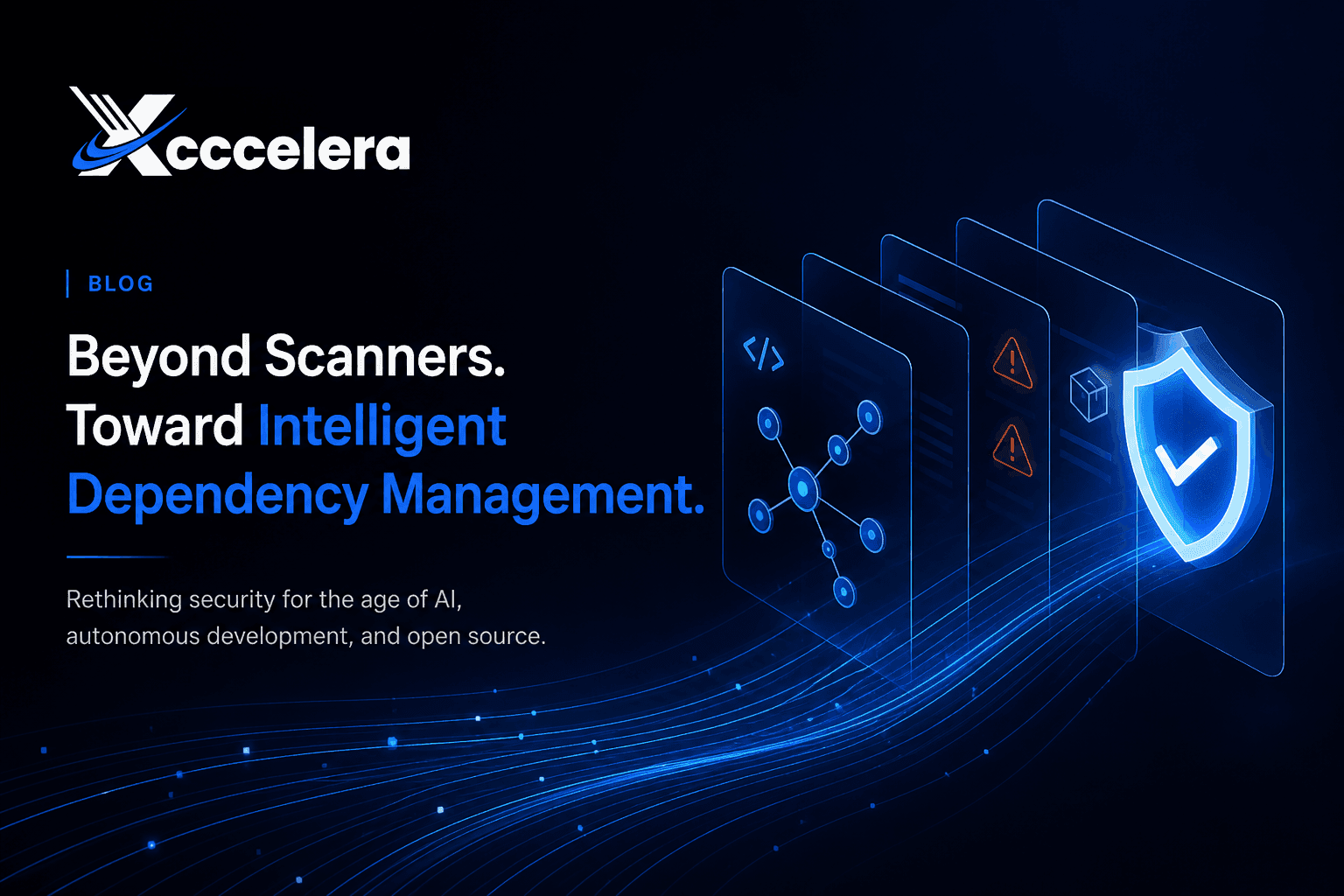
Most development teams don’t have a dependency problem. They have an intelligence problem. Open-source packages now constitute the majority of enterprise code, and the tools built to govern them were designed for a slower threat environment.
Rule-based scanners surface alerts. Developers triage manually. Vulnerabilities persist anyway. AI-native dependency management replaces that reactive cycle with continuous, predictive intelligence that acts before exposure becomes breach.
The question for engineering leaders in 2026 is not whether to automate dependency governance. It is whether the automation they rely on is intelligent enough.
Why Enterprise Dependency Management Has Become a Security Crisis
The threat model for software dependencies has changed faster than most enterprise security programs have adapted. What was once a quarterly patch discipline has become a continuous, high-velocity risk surface that static governance frameworks were never designed to handle at scale.
Supply chain attacks doubled in 2025, with global losses reaching $60 billion, according to industry analysis. The attack surface expanded beyond known CVEs into compromised maintainer accounts, injected build pipelines, and packages that sat dormant in production for months before activating. A coordinated campaign in late 2025 alone compromised over 25,000 repositories and distributed malicious versions to millions of downstream users.
AI coding assistants accelerated the problem in a specific direction. Research across major package ecosystems found that a meaningful share of dependency versions recommended by AI tools carry known vulnerabilities. A portion are hallucinated entirely, referencing packages that do not exist in any live registry. When those recommendations enter enterprise codebases at the speed AI-assisted development enables, the gap between what scanners detect and what actually ships widens in real time.
Alert volume is compounding the challenge. Vulnerability counts have doubled over five years while unscored CVEs have grown 37 times faster than the infrastructure built to process them. Engineering teams are not losing the dependency battle because they lack tools. They are losing it because the tools they have were built for a different volume and velocity of risk.
For enterprises already investing in AI-powered software development, dependency governance is the security layer that must evolve at the same pace as the development pipeline itself.
What Snyk and Dependabot Solve (And Where the Ceiling Is)
The leading dependency scanning platforms currently in enterprise use earned their adoption by solving real problems. Understanding exactly what each resolves is necessary before understanding where both stop.
One operates as a platform-native scanner that opens automated pull requests for outdated or vulnerable dependencies with near-zero configuration overhead. The other delivers a broader security surface: vulnerability database coverage across containers and infrastructure, reachability analysis that traces call paths to vulnerable functions, and a composite risk scoring model that combines exploit maturity, fix availability, and exposure probability into a single prioritization signal.
Both approaches reflect genuine engineering competence. The platform-native tool is the fastest path to baseline security coverage for any repository without prior tooling in place. The developer-first security platform offers deeper intelligence and a proprietary vulnerability database that significantly outpaces the largest publicly available source. For organizations running linear, single-platform pipelines at moderate scale, combining both addresses the majority of scanning needs adequately.
The ceiling appears at enterprise complexity. Neither tool was architected for agentic development environments where AI agents select and introduce dependencies autonomously. Neither offers predictive upgrade path modeling that accounts for downstream breaking changes before a pull request is opened. Both require development teams to process, prioritize, and act on alerts generated by database logic rather than contextual intelligence trained on live production behavior. At enterprise scale, that gap between alert and remediation is precisely where vulnerabilities survive.
Teams building on agentic AI solutions will find that rule-based scanners simply cannot keep pace with the speed at which autonomous agents introduce new dependencies into production systems.
The Structural Problem With Rule-Based Scanning in 2026
Rule-based dependency scanning operates on a foundational assumption that vulnerability intelligence is current, scored, and actionable. In 2026, none of those conditions hold reliably across the open-source ecosystem that enterprise teams depend on most.
Analysis of more than 1,700 open-source CVEs in 2025 found that nearly 65 percent lacked a formally assigned severity score. When researchers scored those independently, 46 percent classified as high or critical, meaning a large share of serious exposures enter the ecosystem without any prioritization signal attached. The median time for official CVE scoring reached 41 days in 2025, while exploit proof-of-concepts and maintainer patches frequently appear within hours of initial disclosure. Scanners operating on official vulnerability feeds are structurally late to every significant threat.
The false signal problem compounds the latency issue. One large-scale analysis identified over 20,000 packages incorrectly flagged as vulnerable alongside more than 167,000 exploitable components that went unflagged entirely. Engineering teams consuming that intelligence spend cycles on non-issues while the real exposures clear the pipeline undetected.
End-of-life dependency exposure adds a third structural failure. Between 5 and 15 percent of components in enterprise dependency graphs are end-of-life, meaning CVE coverage for those versions is incomplete or entirely absent. Scans return clean results not because the software is safe but because the advisory infrastructure no longer tracks it. Rule-based tools inherit every blind spot baked into the databases they query. That is not a configuration problem. It is an architectural one.
How AI-Powered Dependency Management Changes the Execution Model
The distinction between AI-native dependency management and augmented rule-based scanning is not a matter of interface or reporting dashboards. It is a fundamentally different execution model at the architectural level, one that shifts the entire governance posture from reactive detection to continuous, predictive intelligence.
From Detection Lag to Predictive Governance
Rule-based tools wait for a CVE to be scored, then surface it. The temporal gap between threat emergence and scanner detection is where the most consequential exposures currently live, and closing that gap requires a system that does not depend on official scoring cycles to act.
AI-native platforms monitor package registries, maintainer activity, build behavior, and exploit probability signals simultaneously, flagging risk before it receives an official identifier. That operational shift transforms dependency management from a scheduled audit function into a continuously running intelligence layer that operates at the speed of actual threat emergence rather than the speed of database updates.
At the execution layer, AI systems scan repository manifests, detect outdated libraries, cross-reference exploit prediction scores, and model which upgrade paths introduce breaking changes before a pull request is opened. A full platform migration that would consume weeks under manual management executes in days when detection, grouping, testing, and PR generation run autonomously across subsystems.
Agentic Governance at the Point of Introduction
The governance problem in AI-assisted development environments is not that vulnerabilities exist. It is that they now enter codebases at machine speed through AI coding assistants that select dependencies without security context.
When AI coding agents introduce packages autonomously, the only governance layer that operates at equivalent speed is an AI layer that vets those selections at the point of introduction rather than in a downstream post-commit scan. Research confirms that extending AI agents with real-time dependency intelligence produces measurable improvement in dependency safety outcomes. That finding points directly to where the toolchain investment needs to land.
Continuous SBOM operationalization represents the governance evolution that static scanning cannot replicate. Rather than generating a point-in-time software bill of materials for compliance purposes, AI-native platforms maintain a queryable, continuously updated record correlated against live vulnerability feeds. When a critical exposure drops, the system identifies affected production services in minutes, not after the next scheduled scan window.
The Enterprise Decision Framework for AI-Native Dependency Governance
Engineering leaders evaluating dependency tooling in 2026 are not choosing between good and better options. They are choosing between tools calibrated for a slower threat era and platforms built for the agentic development environment that now defines enterprise software delivery. That distinction requires a structured evaluation framework, not a feature checklist.
What Legacy Evaluation Criteria Miss
The criteria that historically drove SCA tool selection — ecosystem coverage, CI/CD integration, and automated PR generation — remain necessary but are no longer sufficient conditions for enterprise-grade dependency governance.
Multi-stack organizations with polyglot codebases, containerized workloads, and AI-assisted pipelines need dependency intelligence that operates across all of those surfaces from a single governance layer. Tools that cover a subset of languages with reachability analysis and the remainder with basic CVE matching do not meet that threshold when production risk is distributed across 25 or more ecosystems simultaneously. Coverage breadth and intelligence depth are different capabilities, and enterprise tooling decisions that conflate them leave structural gaps in the governance model.
The True Cost of Alert-Only Tooling
Per-developer pricing compounds visibly at enterprise scale. What appears manageable at 50 developers represents a significant operational line item at 500, and that spend purchases alert generation rather than remediation execution.
Engineering teams absorbing that cost still require a human triage layer to determine which alerts represent genuine risk, which are false positives, and which require upgrade paths that will not break downstream dependency chains. That triage layer does not disappear because a scanner exists. It expands proportionally with alert volume, consuming senior engineering capacity on work that AI-native platforms resolve autonomously.
Agentic governance frameworks encode dependency policy directly into the development workflow, enforcing compliance at selection time rather than after deployment — which is the only enforcement model that actually scales with AI-assisted development velocity. Organizations already running DevSecOps for secure development will recognize that this enforcement-at-selection model is the natural evolution of shifting security left in the pipeline.
LibX Gives Enterprises the Dependency Intelligence Layer They Cannot Build Alone
Alert generation is not dependency governance. The evidence across 2025 and 2026 confirms that static scanning, delayed CVE coverage, and per-alert triage workflows cannot match the speed or complexity of modern software supply chain risk.
Enterprises running AI-assisted development need an AI-native governance layer operating at the same velocity as their pipelines. LibX delivers exactly that: continuous dependency intelligence, predictive remediation, and agentic enforcement built for the production environments where legacy tools consistently fall short.
For engineering leaders ready to move beyond scanning and into autonomous dependency governance, LibX is the operational foundation that makes that transition executable.