From Config to Full-Stack: How ApiX And FrontenX Deliver Production Apps Autonomously
Enterprise software delivery is broken by speed, not talent. ApiX and FrontendX, purpose-built accelerators, convert configuration inputs into production-ready, full-stack applications autonomously, eliminating manual scaffolding, compressing delivery timelines, and freeing engineering teams to focus on outcomes autonomous full-stack app development rather than overhead. Why Traditional Software Development Cannot Scale at Enterprise Speed The bottleneck in…
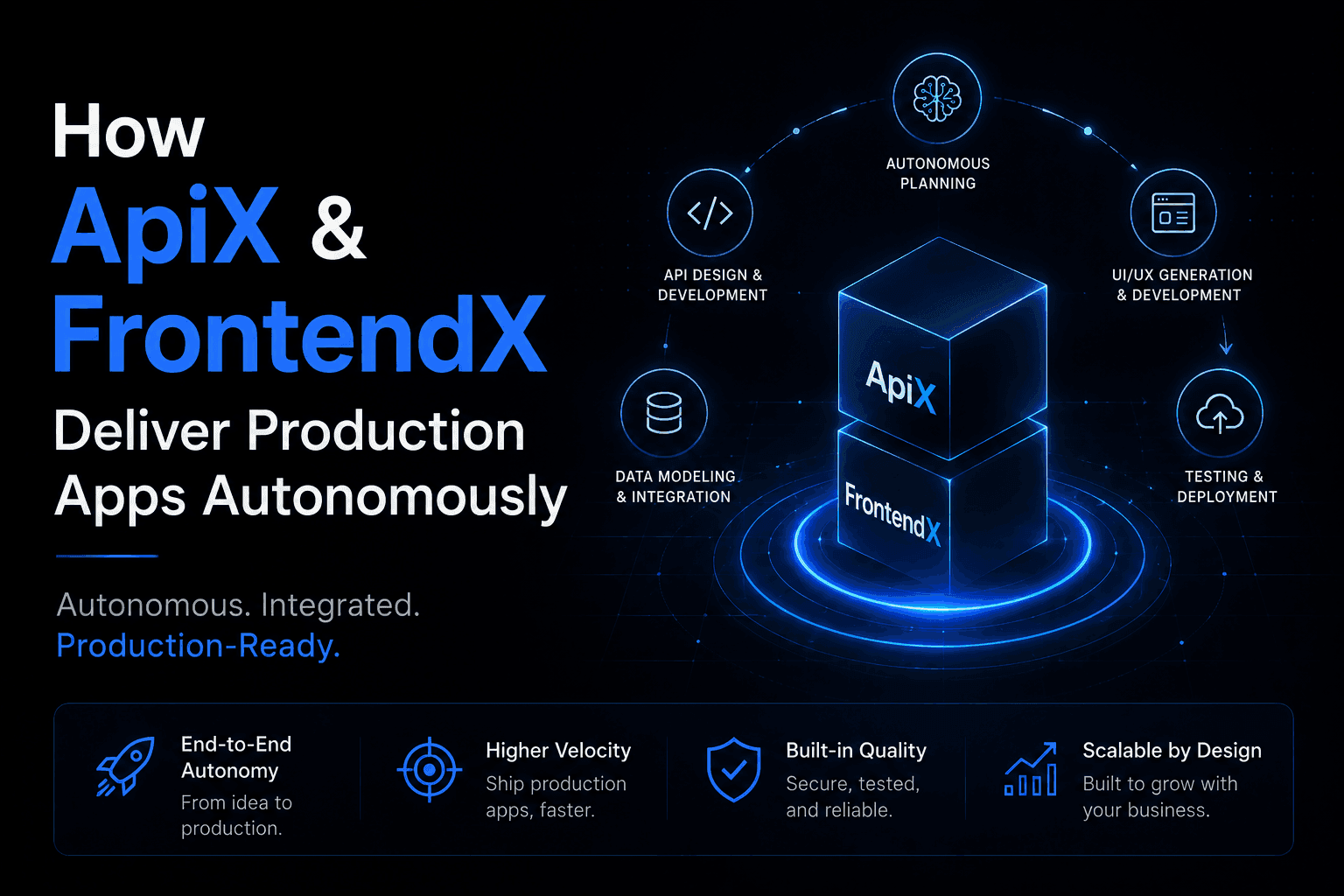
Enterprise software delivery is broken by speed, not talent. ApiX and FrontendX, purpose-built accelerators, convert configuration inputs into production-ready, full-stack applications autonomously, eliminating manual scaffolding, compressing delivery timelines, and freeing engineering teams to focus on outcomes autonomous full-stack app development rather than overhead.
Why Traditional Software Development Cannot Scale at Enterprise Speed
The bottleneck in enterprise software delivery is not engineering talent. It is the pipeline architecture that talent operates within.
A January 2026 analysis by AlixPartners found that AI-accelerated coding tools deliver 20 to 30% productivity gains in software development, yet most organizations fail to capture strategic business value from those improvements. Build and test phases accelerate. Planning, deployment, and product strategy do not. As a result, the constraint shifts upstream, not away.
Speed Without Structure Produces a Different Problem
Traditional development pipelines were designed for human-executed, sequential workflows. Adding AI coding assistants to these pipelines produces faster code generation inside a structure that was already broken. Furthermore, the volume, frequency, and complexity of delivery that modern enterprise operations now demand cannot be absorbed by this model. More developers writing code faster does not resolve a structural delivery failure. This is why AI-powered software development must be paired with delivery architecture reform — not just developer tooling.
The Gap No Point Solution Closes
When the bottleneck moves from writing code to scaffolding backends and coordinating frontend delivery, isolated tools produce diminishing returns. Consequently, the organizations gaining ground in 2026 are not those with better developers. They are those with better delivery architectures — ones where the pipeline itself generates the product. To understand how agentic architectures are replacing traditional development models entirely, see Agentic AI Platform vs. Traditional Development.
The Market Signal: Enterprises Are Moving to Config-Driven Delivery
The numbers are no longer projections. Instead, they are adoption signals that enterprise leaders cannot afford to misread.
Gartner forecasts that 40% of enterprise applications will embed task-specific AI agents by the end of 2026, up from less than 5% in 2025. That is an eightfold increase in a single year. In addition, the low-code and AI application builder market, currently valued at $37.39 billion, is projected to reach $264 billion by 2032, growing at a CAGR of 32.2%. Over 80% of enterprises are expected to have deployed AI-enabled applications before this year closes.
From Exploration to Execution
These figures reflect a structural shift in how enterprise software gets built and shipped. Organizations that entered 2025 in exploration phases are discovering in 2026 that their competitors have already moved to production. The agentic AI market reached $7.6 billion in 2025, yet only 2% of organizations have deployed it at scale. That gap between market size and enterprise adoption defines exactly where competitive risk is concentrating.
Config-Driven Delivery as the Response
Autonomous full-stack app development is the execution layer this shift demands. Enterprises are therefore not just buying tools. They are restructuring how software delivery works at the architectural level, from configuration input to deployed product. Xccelera’s generative-driven development model is purpose-built for exactly this restructuring.
What “Config to Full-Stack” Actually Means in 2026
Most organizations conflate config-to-full-stack delivery with no-code tooling. However, the distinction matters significantly.
Config-to-production is a delivery architecture where a structured configuration input triggers autonomous generation across four layers of a software application. Each layer must reach production quality and connect to the others without manual intervention at any stage.
The Four Layers of Autonomous Delivery
- Backend and API layer. Routes, data schemas, authentication logic, and integration connectors generate directly from the configuration specification — no developer-written scaffolding required.
- Frontend interface layer. UI components, routing, state management, and responsive layouts produce autonomously and bind to the backend natively.
- Data model layer. Database schemas and relationships derive from the specification and align to the API structure automatically.
- Deployment layer. The application packages for deployment within existing cloud or infrastructure environments without manual pipeline configuration.
Where Generic No-Code Tools Fall Short
Generic no-code platforms generate the frontend and stop there. The technical cliff — where customization depth, backend complexity, and enterprise compliance requirements exceed what visual builders can produce — separates a prototype from a deployable product. Moreover, spec-driven development, where structured specifications serve as the source of truth for autonomous execution, is the architectural principle that config-to-production delivery operationalizes at enterprise scale. For a deeper look at how this compares to hiring dedicated engineering capacity, see AI Agents vs. Hiring Developers: Complete Cost Comparison.
ApiX: The Autonomous Backend Engine Built for Enterprise Delivery
Enterprise backend development consumes the majority of delivery timelines. ApiX removes that constraint entirely.
Rather than requiring engineers to write API routes, configure authentication layers, build data schemas, and connect integration endpoints manually, ApiX generates each of these components directly from a structured configuration input. As a result, the output is not a scaffold or a template. It is production-grade backend infrastructure, ready for deployment into existing enterprise environments.
What ApiX Generates From Configuration
ApiX autonomously produces RESTful and event-driven API routes aligned to the data model in the configuration input. Authentication and authorization logic generates alongside the API layer — not bolted on after the fact. Additionally, integration connectors for third-party services, internal enterprise systems, and cloud environments are included within the same execution sequence.
The Plan-Execute-Validate Loop
ApiX does not generate blindly. Instead, it operates within a plan-execute-validate loop where the configuration specification drives an initial execution plan, that plan produces backend output, and the output validates against the specification before delivery. This architecture is consistent with how leading agentic AI solutions achieve production reliability without constant human direction at each step.
The result, therefore, is backend delivery measured in hours, not sprint cycles.
FrontendX: From Specification to Production-Grade Interface
FrontendX addresses the layer that most autonomous delivery systems treat as secondary. The frontend is not a design concern. It is, in fact, an enterprise delivery problem.
When specifications enter FrontendX, the accelerator interprets UI requirements, interaction logic, and data binding needs simultaneously. What it produces is not a wireframe or a design mockup. Rather, it is a fully functional, component-structured frontend application connected natively to the ApiX-generated backend.
- Component generation. FrontendX produces modular UI components aligned to the application’s data model and API contract, eliminating manual React or framework-specific build work.
- Routing and state management. Application routing structures and state handling logic generate from the specification without developer configuration.
- Responsive layout output. Layouts build to enterprise display standards across device types without separate design-to-code translation steps.
- Native backend binding. FrontendX connects to ApiX-generated endpoints automatically, removing the integration work that typically separates frontend and backend delivery into separate team efforts.
- Enterprise quality standards. Generated output meets the accessibility, performance, and structural standards that enterprise production environments require.
Generic vibe-coding platforms produce demos. FrontendX, by contrast, produces interfaces that ship.
One Pipeline, Two Engines: How ApiX and FrontendX Deliver Together
The value of ApiX and FrontendX does not sit in either accelerator individually. Rather, it sits in the delivery architecture they form when operating as a unified system.
Why the Traditional Handoff Model Breaks Down
In traditional full-stack delivery, the backend and frontend exist as separate workstreams that separate teams manage through sequential handoffs. That handoff is where delivery slows, where context gets lost between engineering layers, and where timelines compound. ApiX and FrontendX are therefore designed to eliminate that boundary entirely.
How a Shared Specification Resolves the Integration Problem
Both accelerators share the same configuration specification as their source of truth. The data model that ApiX uses to generate backend routes is the same model FrontendX uses to generate frontend components and data bindings. Because the specification is shared, the output is inherently aligned. There is consequently no backend-to-frontend integration phase, because the integration resolves during generation, not after it.
Parallel Execution and Coherent Output
Where the workload permits, backend and frontend generation can execute in parallel, compressing total delivery time further. The orchestration layer coordinating both accelerators manages execution sequencing, validates cross-layer alignment, and ensures the final output represents a coherent, deployable full-stack application rather than two separate generated artifacts requiring manual assembly. One configuration trigger. One pipeline. One production-ready application.
Where This Stack Delivers Maximum Enterprise Value
The ApiX and FrontendX delivery model produces its strongest returns in enterprise scenarios where the cost of delay is high and the capacity for manual development is constrained.
Internal Operations Platforms
An enterprise logistics team needs a route optimization dashboard connected to live inventory data. With traditional delivery, that application requires a backend engineer, a frontend engineer, and a minimum of several sprint cycles. With config-to-production delivery, however, the same application ships in hours, fully connected and deployment-ready. See how Xccelera delivered this in practice: AI-Driven Outbound Optimization for a Leading Logistics Company.
Client-Facing Portals
Financial services organizations building customer-facing data portals face compliance requirements and performance standards that generic no-code tools cannot meet. ApiX generates compliant backend logic, and FrontendX produces the interface. As a result, the delivered application meets enterprise standards without a dedicated development team assigned to it. Xccelera’s work in fintech delivery illustrates the depth of this compliance-aware generation model.
Parallel MVP Delivery
Enterprise ventures and innovation labs routinely need multiple product concepts validated simultaneously. Traditional delivery forces sequential prioritization because engineering capacity is finite. Autonomous full-stack app development, however, removes that constraint. Multiple applications can generate, deploy, and test in parallel without proportional increases in engineering headcount. Xccelera’s MVP development capability builds directly on this delivery model.
A 2026 Microsoft research study recorded generative AI delivering 3.4x to 4.2x ROI when enterprises embed it into core application workflows rather than treat it as an external add-on. Config-to-production delivery is exactly that embedding at the infrastructure level.
How Xccelera Powers Enterprise Teams From Config to Production
Enterprise leaders evaluating autonomous delivery platforms in 2026 are asking one question: which partner can move this from architecture to production without adding delivery risk?
Xccelera answers that question through ApiX and FrontendX — two accelerators purpose-built to convert configuration inputs into deployed, production-grade full-stack applications without manual scaffolding at any layer. These are not prototyping tools. They are, instead, enterprise delivery engines designed for the complexity, compliance requirements, and integration depth that enterprise environments demand.
A Committed Delivery Timeline
The go-live-in-7-weeks commitment that defines Xccelera’s delivery model applies directly here. ApiX handles the backend. FrontendX handles the interface. The orchestration layer connecting both accelerators therefore ensures the output is coherent, validated, and deployment-ready within a timeline that traditional development pipelines cannot approach.
Engineers Stay in Control
Human-in-the-loop governance is embedded throughout. Engineers do not disappear from this model. Instead, they shift from writing foundational code to reviewing generated output, validating business logic, and directing the configuration specifications that drive autonomous execution. This mirrors the collaborative architecture described in Human-Agent Collaboration in Generative-Driven Development.
As the enterprise technology landscape moves toward what analysts now describe as intelligence orchestration, the organizations building delivery infrastructure today are establishing the competitive baselines their industries will operate against tomorrow. Xccelera builds that infrastructure.


