How LibX Closes the CVE-to-Fix Gap Automatically — Without Breaking Your Codebase
Software dependencies carry hidden security flaws called CVEs (Common Vulnerabilities and Exposures). When left unpatched, they escalate into breach events, failed audits, and broken builds that stall delivery. LibX by Xccelera closes this gap through a 17-step AI pipeline using automated CVE remediation. It scans GitHub repositories, upgrades vulnerable Python and JavaScript dependencies, patches breaking…
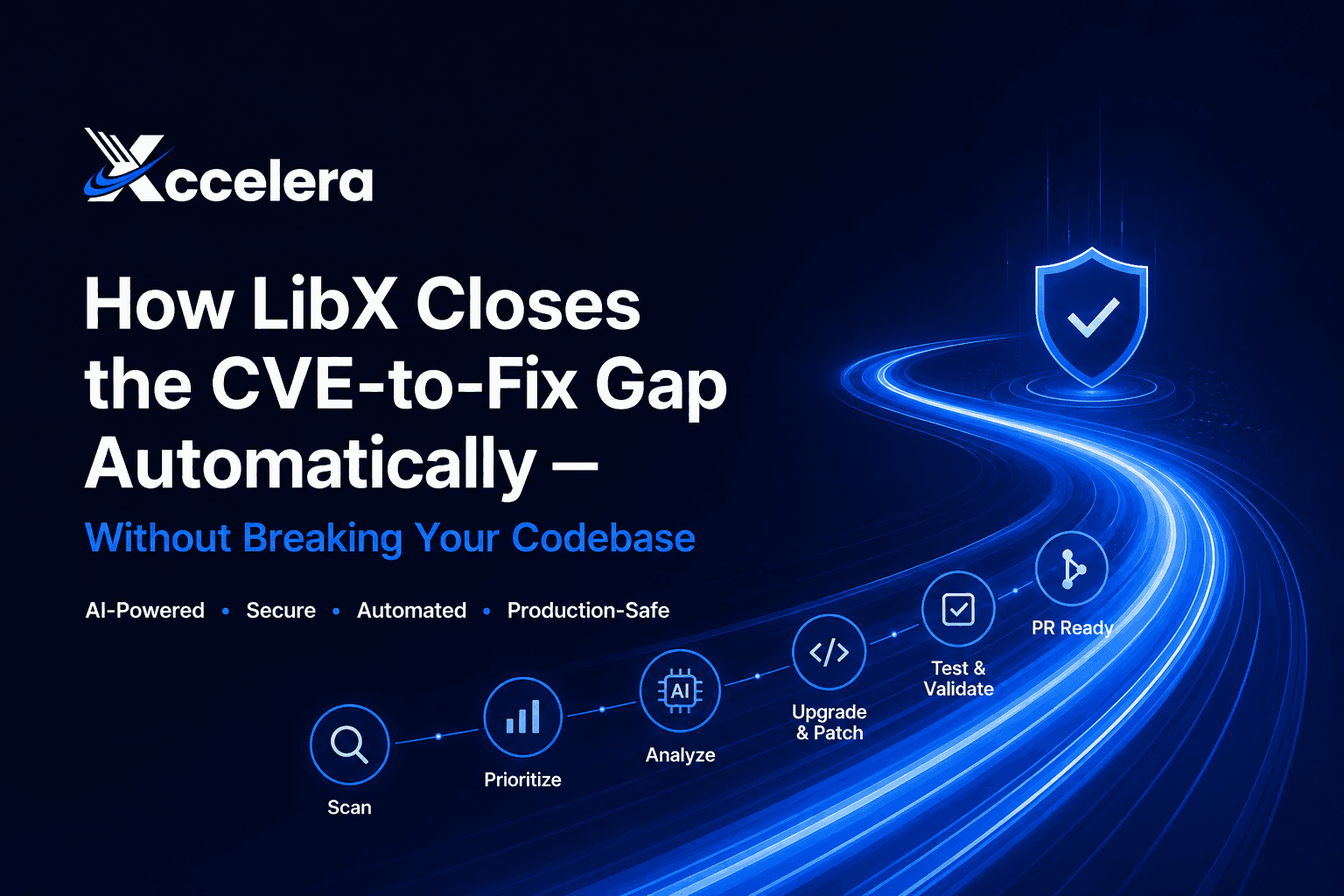
Software dependencies carry hidden security flaws called CVEs (Common Vulnerabilities and Exposures). When left unpatched, they escalate into breach events, failed audits, and broken builds that stall delivery. LibX by Xccelera closes this gap through a 17-step AI pipeline using automated CVE remediation. It scans GitHub repositories, upgrades vulnerable Python and JavaScript dependencies, patches breaking code, resolves test failures automatically, and delivers ready-to-merge pull requests. As a result, remediation that once consumed engineering days now completes in minutes — without disrupting production stability.
The CVE Accumulation Problem Engineering Teams Cannot Outrun
Every software application runs on dependencies. Furthermore, every dependency carries risk. Common Vulnerabilities and Exposures (CVEs) are publicly disclosed security flaws catalogued across three primary databases: the Open Source Vulnerability database (OSV), the National Vulnerability Database (NVD), and the GitHub Security Advisory database (GHSA). When a CVE surfaces in a library an application depends on, engineering teams have a narrow window to act before attackers do.
That window is shrinking faster than most organizations can respond.
The Numbers Have Outpaced Manual Capacity
In 2025, security researchers disclosed 48,185 CVEs — a 20.6% jump over the previous year’s already record-breaking volume. Consequently, scanners now generate findings faster than any team can manually triage, prioritize, and patch them. According to a February 2026 analysis by Talentica, 62% of organizations still rely on manual remediation workflows. Moreover, fewer than 10% report high confidence in their ability to remediate on schedule.
Exploit Windows Are Collapsing
The Cloud Security Alliance’s May 2026 research confirms what practitioners already experience firsthand: AI-assisted threat actors exploit one-day vulnerabilities at scale. Meanwhile, enterprise patching cycles stretch across weeks. Complex runtime dependencies requiring compatibility testing before production deployment consistently show the longest remediation windows.
Detection has never been the hard part. In fact, fixing a CVE without breaking the codebase that depends on it is where engineering teams consistently fail — and where automated CVE remediation becomes non-negotiable.
What the CVE-to-Fix Gap Actually Costs Engineering Teams
From Technical Debt to Financial Liability
Unresolved CVEs rarely stay technical. Instead, they become audit failures, breach events, and missed certification windows. A May 2026 cost analysis by Techsy reveals that first-time compliance audits across SOC 2, HIPAA, PCI-DSS, and ISO 27001 routinely surface 20 to 50 remediation findings. These findings require structured engineering responses. Remediation alone demands 100 to 500 engineering hours, frequently equaling or exceeding the audit cost itself. Most teams budget for the audit. However, few budget for the full quarter of engineering time that follows it.
Automation Changes the Breach Equation
The financial stakes of leaving CVEs unresolved are no longer theoretical. According to the IBSS Corp cybersecurity compliance dataset published in April 2026, organizations deploying security AI and automation reduce average breach costs by $1.67 million compared to those operating without it — dropping from $5.52M to $3.85M per incident. Additionally, the same dataset reports that 82% of organizations plan to increase compliance technology investment in 2026. Automated dependency upgrade platforms address an average of 11 or more compliance activities simultaneously.
Security debt compounds. Therefore, every sprint that passes without security dependency management automation is a sprint where exploit probability rises, compliance posture weakens, and the engineering cost to remediate grows larger. The CVE-to-fix gap is not an IT inconvenience. Rather, it is a business continuity risk with a measurable dollar value attached.
How AI-Powered Dependency Scanning Eliminates the Guesswork
Traditional vulnerability scanners deliver a list. However, what they do not deliver is a decision. AI-powered vulnerability patching closes that gap. It transforms raw CVE data into prioritized, actionable remediation queues, eliminating the manual triage layer that consumes engineering hours before a single patch is written.
Stage 1: Signal Aggregation Across Three Databases
LibX pulls CVE signals simultaneously from OSV, NVD, and GHSA. This triangulated approach ensures no disclosed flaw slips through a single-source gap. Both Python and JavaScript dependency graphs are scanned at the repository level without manual configuration per project. As a result, direct and transitive dependencies are covered in a single pass.
Stage 2: Exploitability-Weighted Prioritization
Raw CVSS scores rank severity. However, they do not rank exploitability. AI-powered scanning applies EPSS-weighted models that prioritize vulnerabilities based on active attacker interest rather than theoretical severity alone. According to a March 2026 report from AlgeriaTech News, teams migrating from pure CVSS prioritization to EPSS-weighted models reduce their effective remediation workload by 60 to 80 percent. Consequently, engineering effort focuses where actual exploit activity exists.
Stage 3: Full Dependency Graph Analysis
A CVE in a direct dependency is straightforward. In contrast, a CVE in a transitive dependency — a package your package depends on — requires mapping the full graph. AI scanning at this depth, as documented by OpenHands in January 2026, determines whether a vulnerable package is actively invoked or simply present. This prevents over-patching that introduces unnecessary upgrade risk into otherwise stable codebases.
Inside the 17-Step Pipeline: From CVE Detection to Merged PR
Most vulnerability management tools stop at detection. Specifically, they flag a CVE, point at a dependency version, and hand the problem back to an engineer. LibX operates differently. Its 17-step automated pipeline carries each identified vulnerability through the complete remediation sequence — from initial scan through to a reviewed, test-passing, ready-to-merge GitHub pull request — without requiring engineering input at any intermediate stage.
Detection Through Dependency Resolution
The pipeline opens with repository scanning across OSV, NVD, and GHSA, establishing which dependencies carry active CVEs. From there, LibX identifies the minimum safe version for each affected package. It then resolves version compatibility across the full dependency tree and executes the upgrade. Standard automation typically ends here. LibX, however, continues through every stage that standard tools leave to engineers.
Where Standard Tools Stop, LibX Continues
According to GitHub’s April 2026 changelog, even advanced AI-assisted dependency tools acknowledge that major version upgrades frequently introduce breaking API changes, deprecated method calls, and incompatible type signatures. These issues require code modifications well beyond a simple version bump.
LibX’s pipeline addresses this directly. After executing the dependency upgrade, the pipeline runs the existing test suite and captures any failures. It then diagnoses root causes through AI analysis, modifies affected code to restore compatibility, and re-runs tests before generating the pull request.
As documented in a Johal.in analysis of GitHub Actions and Dependabot 2026, automated dependency management at this depth reduces CI/CD pipeline breakage from dependency conflicts by 76%. Therefore, the PR that reaches an engineer’s review queue is already green.
Breaking Code No More: How LibX Handles Dependency Conflicts
Why Dependency Upgrades Break Production
The failure mode is predictable. A scanner identifies a vulnerable library. An automated tool bumps the version. The build fails. Tests collapse. Subsequently, the patch sits in a branch for days while engineers debug compatibility errors that have nothing to do with the original CVE. This is not an edge case. Instead, it is the standard experience of security dependency management without AI-assisted patch resolution.
Major version changes are the primary breakage source. When a library moves from version 2 to version 3, public APIs change, method signatures shift, and type contracts break. A version bump that resolves a critical vulnerability can simultaneously disable unrelated functions across a codebase that relied on the previous interface.
How LibX Resolves Conflicts Before the PR Opens
LibX treats test failure not as a stop signal but as diagnostic input. When an upgraded dependency breaks a test, the AI patching layer analyzes the failure output. It then maps the issue to the specific API change responsible and modifies affected code to restore compatibility.
According to Zafran’s October 2025 research on agentic remediation architecture, this pattern — where agents fix breaking changes rather than report them — marks the critical evolution separating vulnerability remediation pipelines from vulnerability notification tools. GitHub’s 2026 Actions security roadmap reinforces the same principle: secure-by-default automation requires deterministic, verifiable outcomes at every pipeline stage.
As a result, LibX’s conflict resolution layer produces stable, test-passing upgrades as the artifact that reaches human review — not broken branches that consume additional engineering cycles.
Compliance-Ready by Default: Audit Trails, Dashboards, and Dry-Run Mode
Regulatory frameworks do not just require patched dependencies. In addition, they require documented proof that remediation happened — when it happened, what changed, and who authorized it.
Engineering teams operating under SOC 2, PCI-DSS, HIPAA, or ISO 27001 cannot satisfy auditors with a closed GitHub PR alone. Instead, they need structured, timestamped evidence trails that hold up under formal audit scrutiny. LibX generates that evidence as a native output of its automated CVE fixing pipeline, not as a reporting layer added afterward.
Three Compliance Outputs Built Into Every Remediation Run
Full audit trail: Every scan event, triage decision, dependency upgrade, code change, test execution, and PR generation is timestamped and logged. Consequently, this creates an end-to-end remediation record aligned with SOC 2, HIPAA, PCI-DSS, and ISO 27001 documentation requirements.
Real-time compliance dashboard: Security and compliance leadership access live remediation status across all monitored repositories. As a result, there is no need to track engineers for progress updates during audit preparation cycles.
Dry-run mode: Before any code change executes, LibX’s dry-run preview surfaces the exact modifications the pipeline intends to make. This enables compliance review and authorization without triggering live changes to production-linked codebases.
According to SentinelOne’s April 2026 analysis of vulnerability remediation tools, automated platforms that produce compliance-ready reporting significantly reduce audit preparation burden. Furthermore, they enable non-technical leadership to monitor remediation progress directly. IBSS Corp’s 2026 cybersecurity audit cost data confirms that organizations without automated documentation routinely face post-audit remediation costs per finding that eliminate any savings from deferred patching.
LibX by Xccelera: Zero-Delay Security That Protects What You Ship
Security Debt Has a Business Cost. LibX Removes It.
Engineering leadership in Fintech, Healthcare, SaaS, and Enterprise Software share one pressure point: security dependency management that moves at delivery speed without becoming a delivery bottleneck. Manual CVE remediation, as documented by Carnegie Mellon’s Software Engineering Institute in March 2025, carries costs that scale with codebase complexity and vulnerability volume. The longer remediation waits, the more expensive it becomes to execute.
Built for Python and JavaScript at Enterprise Scale
LibX is Xccelera’s AI-powered automated security dependency upgrade platform, built for engineering teams managing Python and JavaScript repositories at production scale. Its 17-step pipeline executes the complete vulnerability remediation pipeline without human intervention at intermediate stages. Specifically, it delivers ready-to-merge GitHub PRs with passing tests and full audit context attached. Hexnode’s December 2025 analysis of CVE remediation workflows confirms that tightly coupled detection-to-action pipelines produce superior compliance outcomes compared to fragmented, multi-tool approaches.
Where LibX Sits in Xccelera’s Accelerator Stack
LibX operates within Xccelera’s Accelerators product line alongside ApiX for API-layer integrations and FrontendX for autonomous frontend generation. Together, they deliver end-to-end acceleration covering security, backend, and frontend — without separate vendor relationships. For CTOs and VPs carrying security debt across Python and JavaScript codebases, LibX compresses remediation from days to minutes while keeping production stable and compliance documentation current. Explore LibX at xccelera.ai.