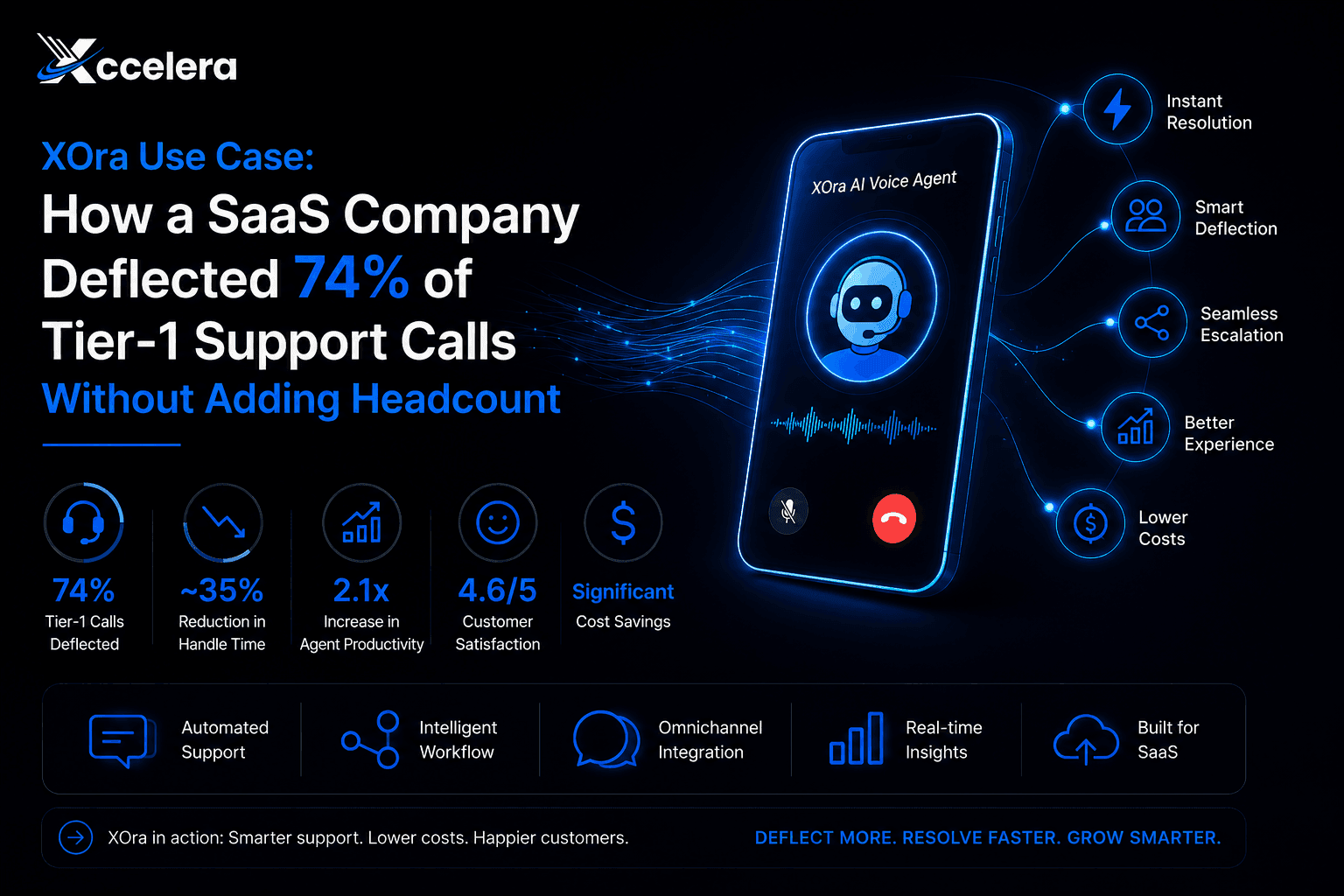
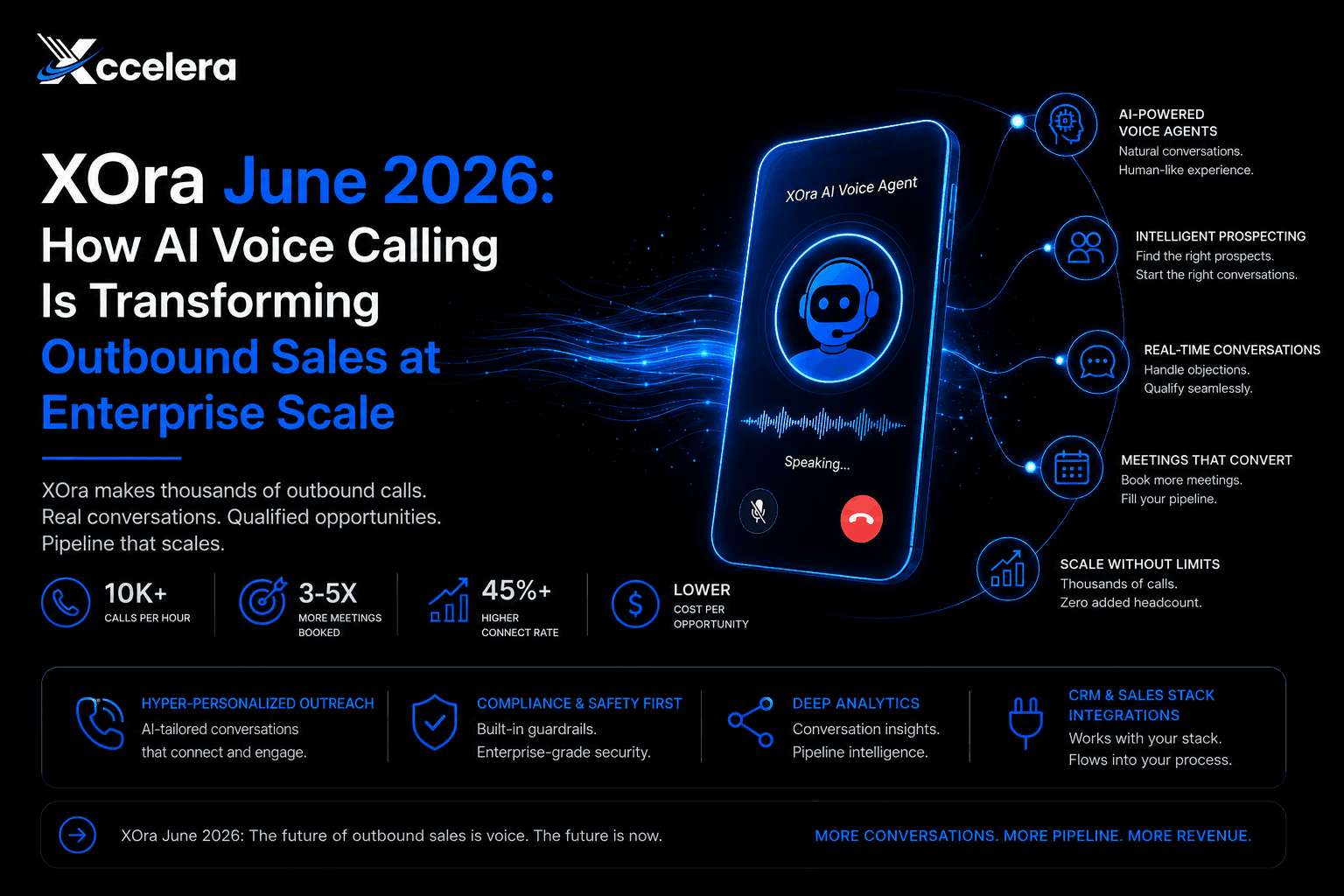
XOra: Xccelera AI Voice Agent That Handles Enterprise Calls Without Human Handoffs
Enterprise AI Voice Agent has moved from pilot program to production infrastructure. XOra, Xccelera’s autonomous voice agent, resolves inbound and outbound enterprise calls end-to-end without human handoffs, updating CRM records, executing transactions, and closing interactions in real time. The technology stack, compliance mandates, ROI benchmarks, and deployment realities driving this shift define how forward-thinking enterprises…
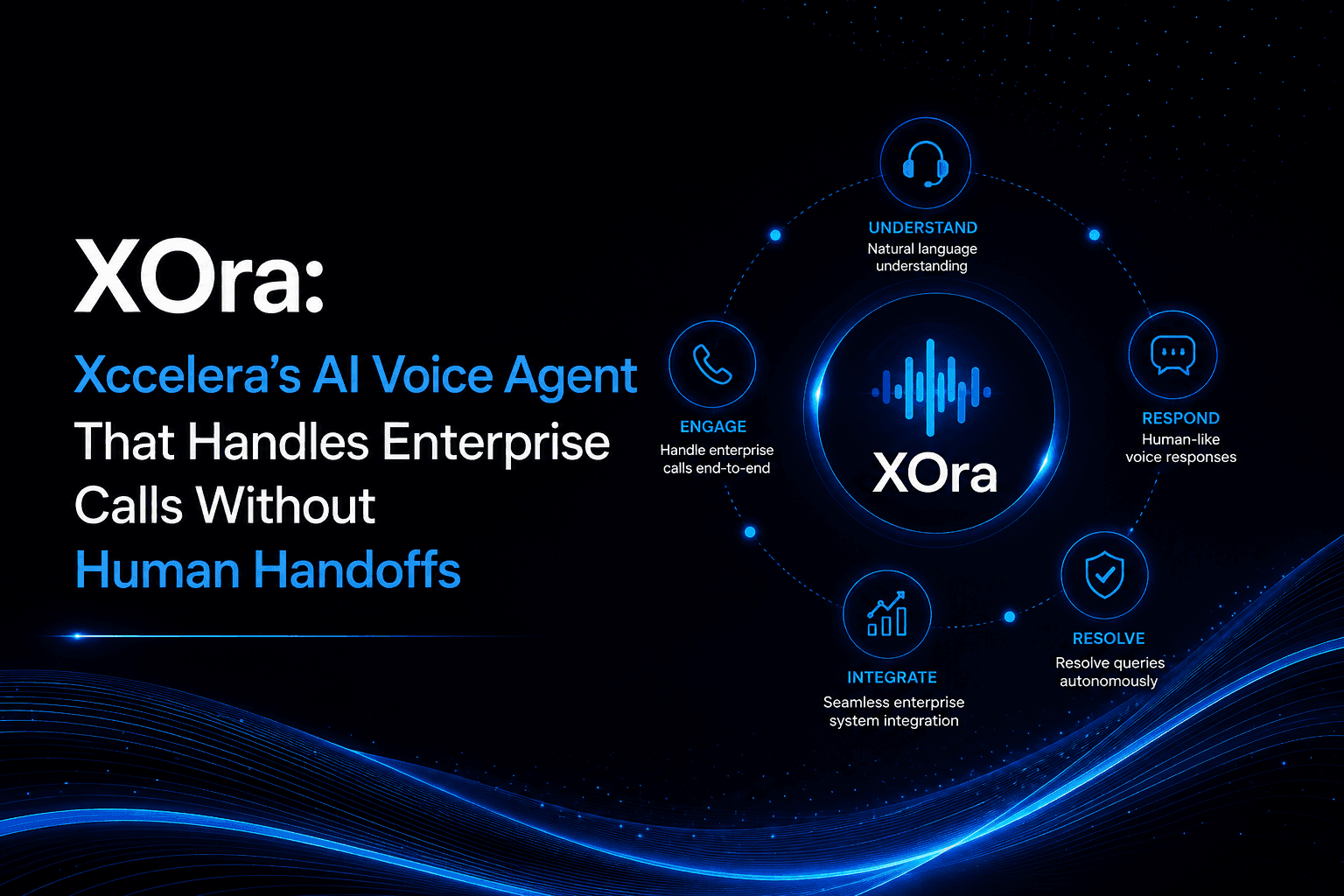
Enterprise AI Voice Agent has moved from pilot program to production infrastructure. XOra, Xccelera’s autonomous voice agent, resolves inbound and outbound enterprise calls end-to-end without human handoffs, updating CRM records, executing transactions, and closing interactions in real time. The technology stack, compliance mandates, ROI benchmarks, and deployment realities driving this shift define how forward-thinking enterprises are rebuilding their voice operations in 2026.
The $80 Billion Signal: Why Enterprise Voice AI Has Crossed Its Inflection Point
The global voice AI market stood at $2.4 billion in 2024. By 2034, that number will reach $47.5 billion at a 34.8% compound annual growth rate. These figures do not represent projection slides. They reflect operational decisions already being executed across the enterprise market.
Production at Scale
Production voice AI deployments grew 340% year over year across more than 500 enterprise organizations in 2025. 80% of businesses plan to integrate voice AI into customer service by the close of 2026. Among Fortune 500 companies, 67% are already running live, customer-facing production systems today.
The Economics Driving Urgency
An AI-handled call costs approximately $0.40. A human-handled call runs between $7 and $12. That differential forces a nine-figure annual decision for any contact center operating at scale. Three forces converged to make 2026 a structural inflection point: speech recognition matured for real-world conditions, customer expectations permanently reset after years of capable consumer AI, and compliance infrastructure caught up with regulatory requirements across banking, healthcare, and insurance. All three arriving together converted pilot programs into production infrastructure. Enterprises seeking to understand the full financial picture can explore the economics of AI agents and how ROI compounds over time.
From Routing to Resolution: What Separates AI Voice Agents from IVR Systems
Traditional IVR systems were never designed to resolve anything. They were designed to route. A caller presses a number, gets transferred to a queue, and waits for a human to handle the actual work. The system managed the call. A person managed the problem. That structure defined enterprise contact centers for thirty years.
The Agentic Voice Inversion
Agentic voice AI reverses that model entirely. The voice agent authenticates the caller, retrieves the account, applies business policy, executes the transaction, confirms the outcome, and closes the loop. No transfer, No queue, No human handoff required for structured call types. Resolution happens inside a single natural conversation. To understand how agentic systems differ fundamentally from earlier automation tools, see AI agents vs. AI assistants: core differences and enterprise use cases.
What Containment Rate Measures
Containment rate — the percentage of calls resolved without human transfer — separates capable voice AI from capable demos. First-generation bots delivered containment rates between 20% and 30%. Production-grade agentic voice systems in 2026 consistently achieve 60% to 85% containment on Tier-1 call types, closing the gap that kept IVR replacement theoretical for over a decade.
The Technical Stack: How ASR, LLM, and TTS Function as a Unified Execution Layer
Automatic Speech Recognition: The Entry Point
Automatic Speech Recognition converts spoken audio into processable text in real time. Modern ASR handles regional accents, background noise, and natural interruptions with word error rates as low as 4.9% under benchmark conditions. This front-end accuracy determines whether the entire downstream pipeline performs at enterprise quality.
Large Language Models: Where Reasoning Happens
Once speech becomes text, a Large Language Model processes intent beyond simple keyword matching. The LLM maintains full conversational context across multi-turn dialogue, applies business knowledge, and determines the appropriate action. This layer is where the difference between a scripted bot and an intelligent agent becomes operationally measurable.
Text-to-Speech and the Orchestration Layer
Text-to-Speech converts the LLM response into natural spoken output, targeting sub-800ms delivery to preserve conversational rhythm. Above all three components sits the orchestration layer: the system managing conversation flow, tool integrations, telephony connections, and context continuity across the interaction. First-generation platforms stitched these components sequentially, producing compounded latency. Enterprise AI Voice Agent with modern streaming pipelines run them in parallel, cutting total response time significantly and enabling the sub-700ms performance that enterprise production environments require.
The 700ms Rule: Why Latency Determines Whether Enterprise Voice AI Actually Works
In text-based chat, a three-second response delay is acceptable. In voice, anything beyond 700 milliseconds breaks the conversational illusion entirely. Callers assume the agent did not hear them and begin speaking again, creating collision loops that degrade resolution rates and caller trust simultaneously.
The Architecture Problem Behind Latency
The traditional STT → LLM → TTS pipeline compounds delay at every stage. Speech recognition, language model inference, and speech synthesis each add processing time sequentially. Under load, this pipeline regularly produces latency between 1,100ms and 2,000ms, well past the threshold where natural conversation survives. Streaming architectures solve this by running components in parallel, targeting the 300ms to 500ms range that production-optimized platforms consistently achieve.
Why This Matters Operationally
Platforms running optimized streaming configurations benchmark end-to-end latency near 590ms under production conditions. Platforms without streaming pipelines regularly exceed 800ms on realistic call loads. For enterprise teams, latency is not a technical footnote. It directly determines caller abandonment rates, containment performance, and whether the deployment generates returns that justify its operational cost structure.
Enterprise Use Cases, Failure Modes, and the 80% Autonomy Ceiling
AI voice agents perform with high consistency across structured, high-volume workflows. Production data documents the returns clearly. The limitations are equally documented and require deliberate architectural planning before any deployment begins.
Where Voice Agents Consistently Deliver
- Tier-1 customer support: billing inquiries, order status, and account verification achieve 60–85% containment rates on well-defined call flows
- Appointment scheduling: healthcare deployments report 40% reduction in administrative staff time across patient communication workflows
- Collections and payment reminders: financial services organizations see 20–30% improvements in recovery rates through consistent, high-volume outbound automation
- Lead qualification: inbound and outbound call handling at volumes no human team can sustain at equivalent cost
Where the Ceiling Appears
Production evidence consistently places the autonomous resolution ceiling at 70–80% for well-defined use cases. The remaining 20–30% involves ambiguity, missing data, multi-topic calls, or high-emotion interactions where human judgment delivers outcomes current agentic systems cannot replicate. Off-script handling remains the most frequently cited performance gap across enterprise deployments through 2025 and 2026. Auditing Tier-1 call volume, calculating cost per interaction, and mapping the automation ceiling specific to each workflow before deployment separates sustainable production rollouts from underperforming pilots.
Compliance Architecture: HIPAA, SOC 2, and TCPA as Deployment Baselines
The Legal Landscape Governing Enterprise Voice AI
A 2024 FCC ruling formally classified AI-generated voices as artificial or pre-recorded under the Telephone Consumer Protection Act. That determination brought enterprise voice AI under the same consent framework governing human-operated outbound calling. For any marketing-related call, prior express written consent is now required before an AI agent contacts a customer. Compliance is not a post-deployment consideration. It is an architectural requirement from day one.
What Enterprise-Grade Compliance Demands
HIPAA compliance applies to any voice agent touching protected health information, requiring technical safeguards, administrative controls, and Business Associate Agreements with platform vendors. SOC 2 Type II certification functions as the baseline trust credential for enterprise procurement across regulated industries. Beyond these, production-grade deployments require PII redaction during active calls, encrypted data transmission, consent capture at the interaction level, and complete audit trails that satisfy legal review without manual reconstruction. Platforms that treat compliance as an enterprise-tier add-on introduce deployment risk that no per-minute cost advantage offsets over time. For a deeper view on securing agentic systems, review this practical checklist for AI agent identity, access control, and monitoring.
Healthcare, Finance, and B2B Sales — Where Voice AI Deployments Are Scaling Fastest
Three industries are leading enterprise voice AI production in 2026. Each operates under distinct operational pressure. Each has found autonomous voice execution to be the most viable response at scale.
Healthcare
Patient communication volume overwhelms administrative capacity across large health systems. Enterprise AI Voice Agent handles appointment confirmation, prescription notifications, post-discharge check-ins, and adherence reminders autonomously, cutting administrative staff time by 40% in documented deployments. One hospital network reduced wait times from 45 minutes to under two minutes through autonomous scheduling, projecting $1.2 million in annual savings. See how AI-driven healthcare transformation with generative AI is reshaping patient communication at scale.
Financial Services
Collections and payment reminder workflows deliver 20–30% recovery rate improvements at scale. Fraud notifications, insurance follow-ups, and voice NPS surveys execute at volumes no human team sustains economically. SOC 2 Type II certification and HIPAA-equivalent data controls function as non-negotiable baseline requirements across this vertical. For a broader view of AI in this space, explore AI agents in finance and banking: 12 real-world applications.
B2B Sales Operations
Inbound lead qualification and outbound appointment setting exceed human SDR capacity during peak demand periods. Voice agents pre-qualify, schedule, and route sales-ready leads to human closers, accelerating pipeline velocity without proportional headcount growth.
CRM Integration and Real-Time Data — The Infrastructure That Makes Enterprise AI Voice Agent Operational
A voice agent operating without live CRM access is a structurally advanced IVR system. It can speak naturally. It cannot act operationally. The integration layer between voice AI and enterprise back-end systems determines whether a deployment generates returns or generates friction.
Four Integration Requirements for Production-Ready Voice AI
- Real-time account retrieval during the active call, enabling the agent to access customer history, account status, and open cases without delay or manual lookup.
- Policy application against live business logic, allowing the agent to operate within approved parameters rather than fixed response trees.
- Workflow execution and back-end transaction completion during the call, updating CRM records, triggering service workflows, and confirming outcomes before the interaction closes.
- Post-call data structuring, converting unstructured audio into searchable records that surface sentiment patterns, objection signals, and resolution trends at scale.
Platforms without native CRM integration require external connector overhead that compounds latency, increases failure points, and limits the operational depth that makes agentic voice financially justified at enterprise scale.
ROI Benchmarks and Deployment Timelines: What Enterprise Leaders Actually Track
The financial case for Enterprise AI Voice Agent is no longer theoretical. A Forrester Consulting study documents three-year ROI between 331% and 391% for production voice AI deployments, with one composite organization realizing $10.3 million in savings. Payback periods run under six months for most well-executed enterprise rollouts. Organizations with average Tier-1 call costs above $15 and monthly volumes above 5,000 calls typically reach positive ROI within the first quarter.
Five ROI Dimensions Finance Teams Measure
- Cost reduction drives the initial business case, with documented operational savings of 30–50% within three months of production deployment.
- First-contact resolution and average handle time measure operational efficiency improvement.
- CSAT and NPS scores track customer experience impact, where production agentic voice now matches or exceeds human satisfaction scores on routine journeys.
- Agent productivity captures the upstream benefit of redirecting human specialists toward complex, high-judgment interactions.
Pilot-to-production timelines run six to twelve weeks for standard use cases when service workflows, data access requirements, escalation paths, and governance controls are mapped before deployment begins rather than discovered during it.
How XOra by Xccelera Handles Enterprise Calls Without Human Handoffs
Enterprise voice AI has moved past technology differentiation as the primary adoption variable. The differentiating factor in 2026 is deployment architecture: connecting voice intelligence to live enterprise systems, governing it against compliance requirements, and producing measurable outcomes within a defined operational timeline.
XOra: Purpose-Built for Enterprise Voice Autonomy
XOra, Xccelera’s enterprise AI voice agent, is built on that operational premise.
- XOra handles inbound and outbound enterprise calls autonomously, authenticating callers, retrieving live CRM data, applying business logic, executing transactions, and closing interactions without human handoff across structured call types.
- Integration spans CRM, ERP, and operational back-end systems, enabling real-time context access during active calls.
- Compliance architecture covers enterprise-grade data governance, audit logging, and security controls aligned with regulated industry requirements.
Xccelera deploys XOra in under seven weeks from engagement to production, supported by its broader agentic AI solutions portfolio spanning autonomous workflow design, orchestration, and enterprise system integration.
As the voice AI market approaches $47.5 billion by 2034, organizations building production voice infrastructure today establish the operational advantage that compounds decisively over time.