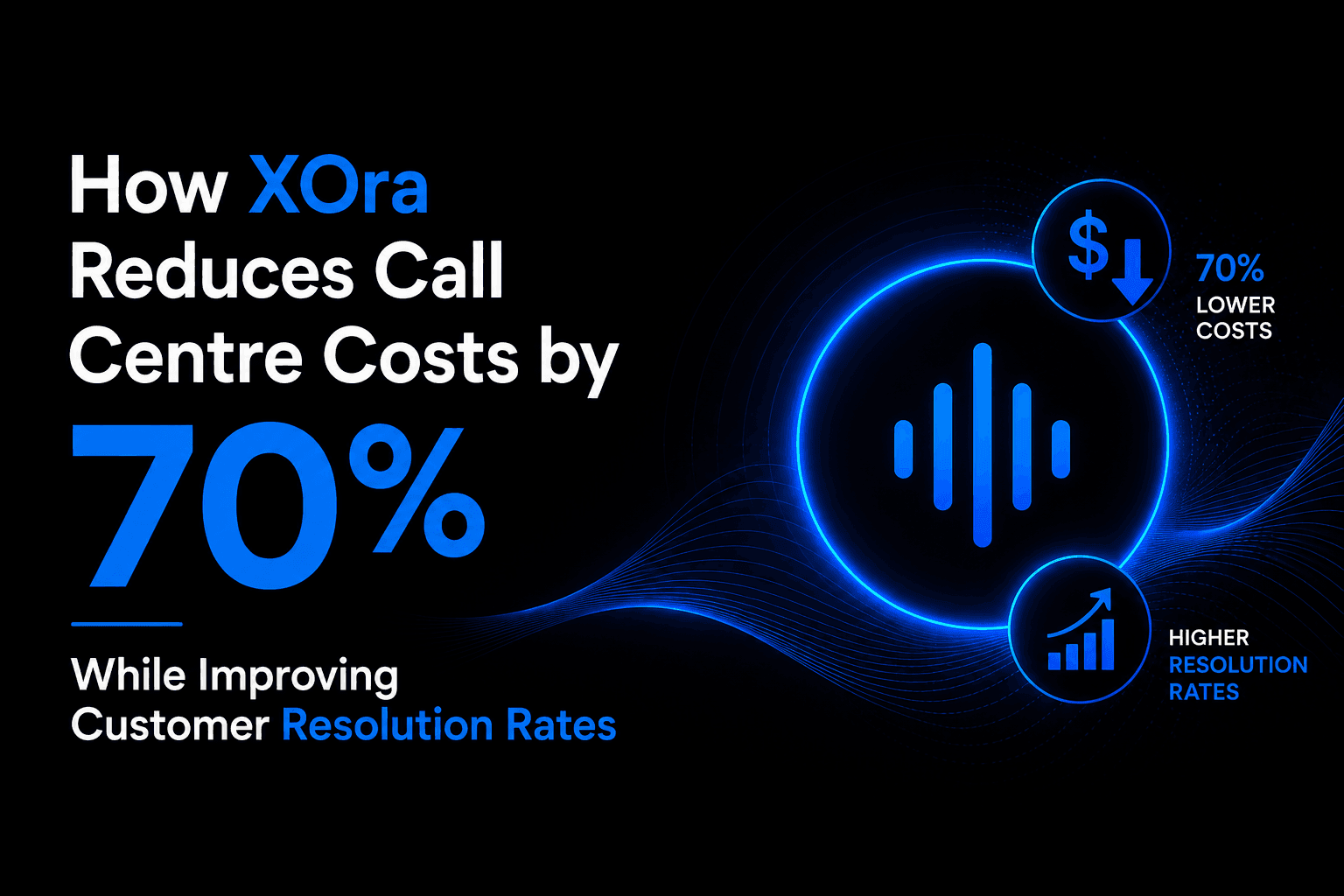
How XOra Reduces Call Centre Costs by 70% While Improving Customer Resolution Rates
Enterprise call centers lose billions annually to labor-driven cost structures that traditional IVR systems cannot fix. AI voice agents are changing that math, delivering 65–90% operational cost reductions while pushing first-call resolution rates to 55–70% across production deployments. The architecture, economics, and governance behind this shift are now defining competitive advantage in enterprise customer operations.…
Enterprise call centers lose billions annually to labor-driven cost structures that traditional IVR systems cannot fix. AI voice agents are changing that math, delivering 65–90% operational cost reductions while pushing first-call resolution rates to 55–70% across production deployments. The architecture, economics, and governance behind this shift are now defining competitive advantage in enterprise customer operations.
The Hidden Cost Structure That Is Draining Enterprise Call Centers
The cost problem inside enterprise contact centers is not a technology deficit — it is a structural one. Labor remains the dominant cost variable, and labor in this environment is inherently unstable. Call center turnover rates reached 40–45% in 2025, roughly twice the rate of most other industries. Each departure triggers a replacement cycle costing between $22,500 and $42,000, before accounting for the productivity loss sustained during onboarding.
The Peak-Period Trap
Compounding the turnover problem is peak-period exposure. Most centers staff to average demand, which means high-volume periods immediately reveal coverage gaps. Those gaps translate into overtime costs, emergency hiring, or abandoned call queues — all three outcomes carry direct financial penalties. Organizations locked to headcount-based scaling models absorb the full weight of these cycles repeatedly, quarter after quarter.
Incremental improvements — whether workforce scheduling tools or basic automation — address symptoms rather than structural drivers. The economics of a traditional contact center are engineered to cost more as volume grows.
Why IVR Systems Cannot Solve a Workforce Economics Problem
The replacement for a broken staffing model cannot be another routing layer. That is precisely what Interactive Voice Response (IVR) systems deliver: routing technology, not resolution technology. Enterprises spent years adding IVR complexity without addressing the underlying resolution gap, and the costs of that approach are now measurable.
Where IVR Containment Fails
Containment rates in legacy IVR deployments average between 20–40%. The remaining 60–80% of callers either abandon the system entirely or demand immediate transfer to a human agent — which directly negates the cost benefit the routing layer was designed to produce. Modern AI voice agent deployments, by contrast, achieve containment rates between 60–80%, revealing how wide the IVR performance gap actually is.
The architectural problem runs deeper than containment. Legacy systems bolt together separate APIs for speech processing, language reasoning, and audio output, creating 1–3 second latency delays that customers register immediately as service failure. IVR does not fix that — it inherits it.
How AI Voice Agents Structurally Redirect the Cost Curve
Three structural shifts separate AI voice agent economics from traditional contact center models, each removing a compounding cost variable that legacy architectures could not address.
- Labor Decoupling
AI voice agents absorb over 80% of inbound interactions without human involvement. Businesses automating call operations with production-grade AI automation platforms report operational cost reductions reaching 90% compared to in-house contact center operations. Volume no longer determines headcount requirements.
The Cost-Per-Call Conversion
- Per-Interaction Cost Compression
AI voice agent pricing in 2026 ranges from $0.05 to $1.00 per minute. Traditional cost-per-call figures regularly exceed $12 when agent salaries, infrastructure, and overhead are fully loaded into the calculation. The unit economics shift from fixed labor overhead to variable consumption.
- Infinite Concurrency
A single AI voice deployment handles thousands of simultaneous calls during peak periods without degradation in response quality or handle time. The staffing ceiling that previously defined call capacity no longer exists as an operational constraint.
First Call Resolution Is the Metric That Actually Defines Customer Lifetime Value
The Financial Weight Behind FCR
First Call Resolution (FCR) is not an operational vanity metric — it is a direct driver of customer retention economics. Industry research documents that a 1% improvement in FCR generates approximately $286,000 in annual savings for a contact center operation. Customer lifetime value compounds in direct proportion to resolution reliability, giving FCR a revenue dimension that most enterprise finance teams still underestimate.
Where AI-Native Platforms Set New Benchmarks
AI-native voice platforms achieve first contact resolution rates of 55–70%, with average handle times under 3 minutes. The industry average for human-assisted voice calls sits between 4 and 7 minutes. That performance gap reflects a structural advantage: AI voice agents access CRM data, purchase history, and account records in real time during the call itself — context human agents typically retrieve manually or not at all. See our analysis on customer satisfaction improvement for a deeper look at how agent experience compounds FCR gains.
The Architecture Behind Real-Time Resolution at Scale
Production voice AI deployments grew 340% year-over-year in 2026 across more than 500 enterprise organizations. That growth reflects convergence across three technical maturation points: large language models reaching reliability thresholds for real-time spoken dialogue, telephony APIs maturing to support low-latency integration, and live deployment data confirming measurable ROI at scale.
The Latency Threshold That Determines Deployment Success
The architectural divide in enterprise voice AI runs along a single line: speech-to-speech systems versus multi-API chained pipelines. Most legacy voice platforms route audio through separate speech-to-text, LLM reasoning, and text-to-speech layers in sequence, generating 1–3 second delays. Speech-to-speech architectures compress that cycle to 100–750ms, eliminating the pause customers register as system failure.
Enterprise-grade uptime SLA requirements sit at 99.5–99.9%. At those availability thresholds, real-time CRM retrieval during active calls becomes operationally viable, giving every interaction access to account history, purchase patterns, and open case data without placing a caller on hold. For the full economics of this shift, explore the ROI case for AI agents.
Compliance and Governance Cannot Be Retrofitted Into AI Voice Deployments
The average cost of a healthcare data breach reached $9.77 million in 2024, and 68% of those incidents traced back to a misconfigured customer touchpoint. Phone is the most regulated touchpoint because callers verbalize protected health information, payment card numbers, and account credentials within the first 30 seconds of nearly every call. A voice agent that captures or transmits that data without proper controls becomes a regulatory liability before it resolves a single ticket.
Enterprise procurement teams in financial services, healthcare, and retail now require the following before an evaluation window opens:
- SOC 2 Type II and ISO 27001 for information security governance
- HIPAA with signed Business Associate Agreements for healthcare data environments
- PCI-DSS Level 1 coverage for payment card data handling
- GDPR and state-level privacy compliance for data residency and consent management
- TCPA disclosures and Do Not Call suppression for all outbound voice automation
- ISO 42001 for AI governance — now appearing as a standard RFP requirement
Building the Governance Layer
Compliant voice AI architecture requires AES-256 encryption for data in transit and at rest, role-based access controls, immutable audit trails with timestamp accountability, and real-time PHI redaction before storage. Cross-functional governance boards spanning IT, Legal, CX, and Security represent the operational standard in mature enterprise deployments. Our guide to securing AI agents covers the full identity, access, and monitoring checklist for production environments.
Measuring ROI: From Deployment Decision to Value Realization
In 2025, a mid-sized credit management firm in Chicago deployed an AI voice agent to handle verification and payment reminder calls. Within one quarter, results were concrete:
- 40% reduction in agent workload
- 30% decrease in average handle time
- $95,000 in documented annual savings
- Customer wait times dropped from 8 minutes to under 3 minutes without adding a single human headcount
The ROI Timeline Enterprises Should Expect
That outcome reflects a deployment pattern now consistent across verticals. Most enterprises reach break-even within 60–90 days of production launch, driven by three compounding return streams: direct labor cost reduction, revenue recovery from previously abandoned or missed calls, and CSAT improvement that reduces churn at contract renewal.
Per-minute pricing models — ranging from $0.05 to $1.00 — replace seat-based legacy contracts that scale poorly against volume growth. Gartner’s research on conversational AI in customer service provides useful external benchmarks for evaluating these projections.
How XOra Delivers Enterprise-Grade AI Voice Operations
XOra is Xccelera’s AI voice agent platform, built for enterprise organizations that cannot afford gaps in compliance coverage, resolution performance, or system integration during deployment. The platform operationalizes the full architecture of autonomous call handling: real-time CRM retrieval, speech-to-speech processing, and compliance-aligned data governance across regulated industry environments.
From Deployment to Measurable Outcome
XOra’s deployment model is outcome-based from the first engagement. Integration layers connect directly to existing CRM infrastructure, knowledge bases, and ticketing systems without requiring foundational changes to the underlying technology stack. Compliance coverage spans HIPAA, PCI-DSS, SOC 2, and GDPR requirements, with audit trail architecture and real-time data redaction built into the core system rather than appended after deployment.
Enterprise organizations deploying XOra gain the ability to scale call handling capacity without proportional headcount increases, achieve first-call resolution benchmarks that compound into measurable retention gains, and satisfy governance requirements across financial services, healthcare, and enterprise software procurement cycles. Explore Xccelera’s contact center transformation solution for a full end-to-end overview. Deployment timeline runs under 7 weeks from scoping to production, with human-in-the-loop escalation pathways maintained throughout the operational model. For broader context, McKinsey’s research on AI-enabled customer service confirms the long-term value trajectory XOra is built to deliver.