Human-Agent Collaboration: Leading Generative-Driven Development in 2026
Human-Agent Collaboration in Software Development has moved beyond experimental copilots into structured execution frameworks embedded across engineering systems. In 2026, enterprises are shifting from prompt based assistance toward coordinated task agents integrated into development pipelines. According to Microsoft AI trend analysis for 2026, organizations are operationalizing AI across core workflows rather than isolated productivity…
Human-Agent Collaboration in Software Development has moved beyond experimental copilots into structured execution frameworks embedded across engineering systems. In 2026, enterprises are shifting from prompt based assistance toward coordinated task agents integrated into development pipelines.
According to Microsoft AI trend analysis for 2026, organizations are operationalizing AI across core workflows rather than isolated productivity tools. Similarly, reporting by TIME highlights the emergence of AI agents working in coordinated clusters instead of single response interfaces.
This shift redefines Generative Driven Development. Agents now handle scoped tasks such as requirement synthesis, code drafting, and test generation, while humans define constraints, validate outputs, and manage risk thresholds. Productivity is no longer measured by code volume alone, but by orchestration efficiency and validation throughput.
In this write up, we will elaborate on architectural models, SDLC integration, economic impact, organizational shifts, India AI Summit signals, governance, Human-Agent Collaboration in Software Development and strategic adoption frameworks shaping 2026.
Technical Architecture of Collaborative Intelligence Systems
Generative driven development depends on architecture, not prompts. Without structured system design, agent execution becomes unreliable, opaque, and operationally risky. Scalable collaboration requires defined execution layers, control boundaries, and measurable oversight mechanisms.
At the foundation sits a reasoning layer that interprets objectives and decomposes them into structured subtasks. An orchestration engine distributes those tasks across specialized agents responsible for coding, documentation, testing, or compliance analysis. This modular design prevents over concentration of authority in a single model instance.
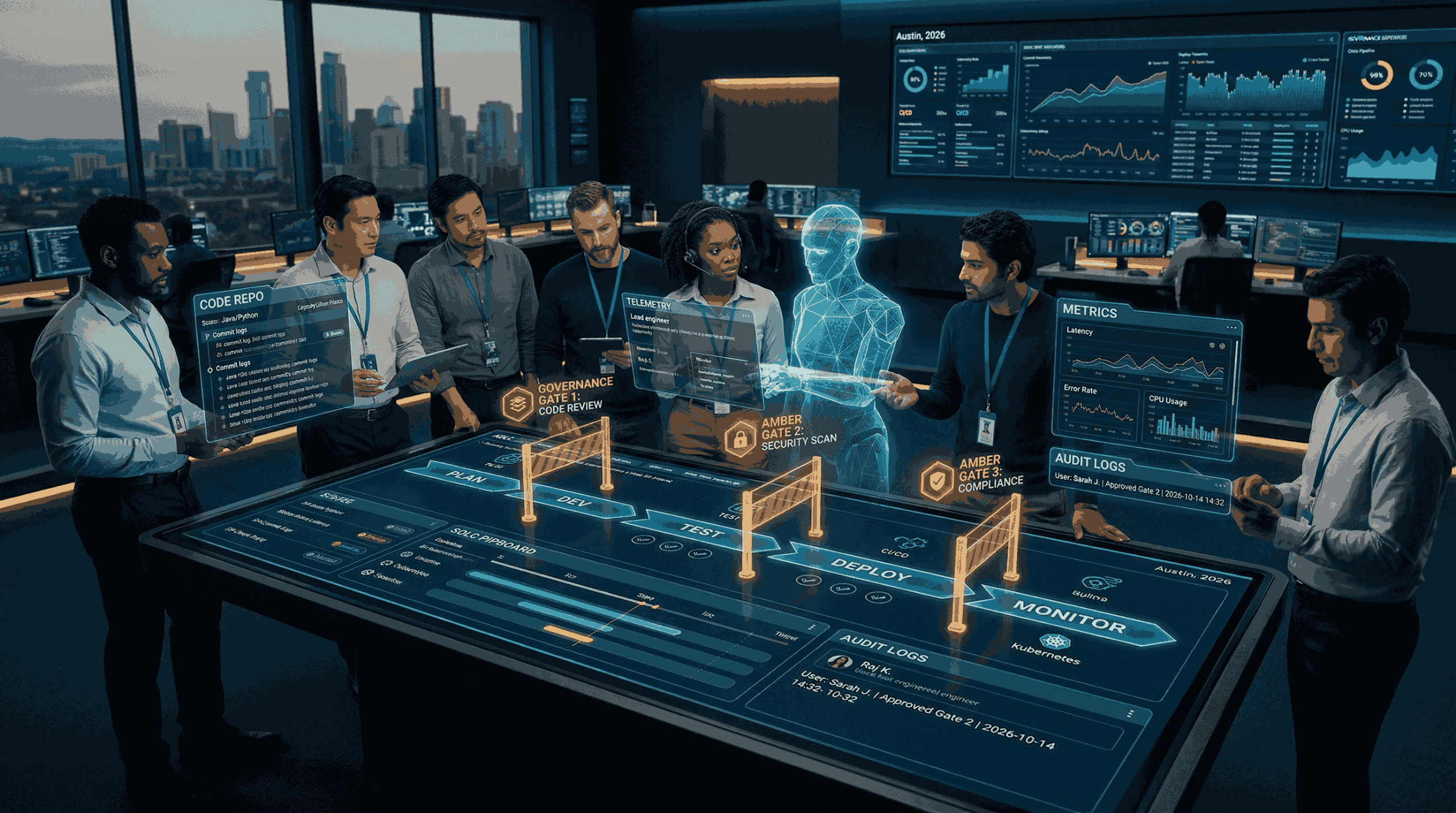
Above the execution layer, validation gates enforce controlled autonomy. No production merge, infrastructure modification, or release cycle proceeds without human approval thresholds. Observability dashboards track agent output quality, drift patterns, and failure rates in real time.
Core architectural components include:
- Task decomposition and assignment pipelines
- Human validation checkpoints before critical actions
- Continuous feedback integration loops
- Performance telemetry and audit trails
- Role based permission frameworks
When embedded into CI CD systems and engineering workflows, this layered model transforms generative tools into accountable execution partners rather than isolated assistants.
Generative Driven Development Across SDLC Phases
Embedding collaborative intelligence across the full software lifecycle determines whether generative systems create incremental gains or structural transformation. Limiting agents to code suggestions leaves value unrealized. Integrating them across planning, build, validation, and release phases creates compounding efficiency.
During requirement planning, agents analyze product briefs, user stories, and historical tickets to generate structured technical specifications. Developers refine constraints and define risk boundaries before execution begins.
In the architecture phase, generative systems propose design patterns, dependency maps, and performance tradeoffs. Human oversight ensures alignment with scalability goals and regulatory obligations.
Within coding workflows, agents draft modular components, refactor legacy blocks, and surface optimization suggestions. Engineers validate logic integrity, security exposure, and maintainability before merge approval.
For testing and QA, automated systems generate edge case scenarios, regression scripts, and coverage reports. Human reviewers assess risk thresholds and approve release readiness.
Finally, in deployment and monitoring, agents track anomalies, suggest rollback triggers, and summarize incident data. Leadership teams retain decision authority on production changes.
Operational value emerges when collaboration spans every SDLC stage rather than functioning as an isolated coding assistant.
Economic Impact and ROI of Collaborative Intelligence
Enterprise adoption in 2026 is capital driven with Human-Agent Collaboration in Software Development. Generative systems must justify infrastructure investment through measurable operational and financial outcomes rather than experimental productivity spikes.
Structural Cost Redistribution Across Engineering
Collaborative intelligence changes how engineering capital is deployed. Instead of expanding delivery capacity by hiring proportionally more developers, organizations invest in orchestration frameworks, validation layers, and observability systems that scale execution non linearly.
Economic effects become visible through:
- Parallel execution of documentation, testing, and refactoring that compresses cycle time without proportional labor growth
- Early defect interception mechanisms that prevent downstream remediation costs and post release incident handling
- Reallocation of senior engineering bandwidth toward architecture, innovation, and high complexity problem solving
- Reduced dependency on repetitive manual processes that previously consumed sprint capacity
- Accelerated iteration velocity enabling faster competitive positioning and revenue realization
This is not incremental efficiency. It is structural capital redistribution.
Financial Durability Through Risk Adjusted Efficiency
Returns in generative driven development emerge when output stability increases while volatility decreases. ROI is therefore measured through efficiency resilience rather than headcount reduction alone.
Financial durability strengthens through:
- Lower regression frequency due to layered validation and automated quality enforcement
- Higher throughput per sprint while maintaining defect containment thresholds
- Deployment predictability supported by monitoring agents that detect anomalies before escalation
- Reduced opportunity loss from delayed launches as orchestration eliminates bottlenecks
- Conversion of fixed salary expansion into scalable infrastructure investment with compounding impact
Sustained returns depend on disciplined autonomy boundaries and governance integration. Without structured oversight, financial performance erodes despite automation volume.
India AI Impact Summit 2026: Collaboration as a National Signal
The India AI Impact Summit 2026 positioned Human-Agent Collaboration in Software Development as a strategic direction rather than a speculative concept. Policy leaders, enterprise operators, and technology architects converged around one consistent theme: AI must amplify human capability, not replace it.
Across keynote discussions and enterprise showcases, the emphasis was on structured co working models where agents execute defined tasks under human supervision. The narrative focused on workforce augmentation, skill transition, and operational integration across public and private sectors.
Discussions at the summit highlighted:
- National investment in AI infrastructure designed to support scalable human agent collaboration rather than isolated automation pilots
- Enterprise case studies demonstrating agent assisted workflows in finance, commerce, and governance environments
- Workforce development initiatives aimed at reskilling engineers to manage, validate, and orchestrate intelligent systems
- Emphasis on accountability frameworks ensuring AI outputs remain traceable and reviewable
The summit did not promote unchecked autonomy. Instead, it reinforced a balanced model where innovation velocity is matched with regulatory foresight and human oversight.
For organizations observing global trends, the message was clear. Collaborative intelligence is becoming a policy supported direction in major growth markets. Leadership in 2026 requires alignment between technological capability and workforce readiness.
Governance Architecture and Risk Containment in Agent Integrated Systems
As generative systems move deeper into production workflows, risk exposure expands proportionally. Collaborative intelligence increases velocity, but without structured governance, it can amplify errors, propagate hallucinations, and introduce systemic vulnerabilities across engineering pipelines.
The primary challenge in 2026 is not capability. It is a controlled discipline.
When agents generate code, refactor dependencies, or recommend infrastructure changes, they operate within probabilistic reasoning models. This introduces uncertainty layers that traditional deterministic software systems were never designed to accommodate. Without containment strategies, autonomy drift can escalate rapidly.
Risk concentration typically emerges across five domains:
- Model hallucination embedded into production logic without sufficient human validation.
- Security vulnerabilities introduced through dependency generation or configuration suggestions.
- Accountability ambiguity when agent generated decisions lack traceable audit trails.
- Autonomy escalation where agents exceed predefined execution boundaries.
- Data leakage risks when models interact with sensitive repositories.
Mitigation requires governance architecture embedded directly into development pipelines rather than external review committees.
Effective control models in 2026 include:
- Tiered authority structures defining which actions require mandatory human approval.
- Audit logging systems that record every agent intervention within version control environments.
- Observability dashboards that monitor output deviation and anomaly patterns.
- Policy driven execution constraints restricting access to critical systems.
- Red team simulation exercises testing collaborative failure scenarios.
Organizations leading generative driven development treat governance as an engineering layer, not a compliance afterthought. Risk containment becomes programmable.
The most resilient enterprises design autonomy boundaries with explicit escalation triggers. When uncertainty thresholds are crossed, control automatically reverts to human decision makers.
Velocity without control destabilizes operations. Structured collaboration with embedded oversight strengthens them.
Strategic Blueprint for Leading Generative Driven Development in 2026
Leadership will be defined less by model adoption and more by orchestration maturity. The organizations that outperform will not be those deploying the largest number of agents, but those designing disciplined collaboration systems that align human judgment with structured autonomous execution.
Generative driven development requires phased integration. High performing enterprises begin by embedding agents into bounded workflows such as documentation drafting, regression testing, or dependency analysis. Once stability metrics improve and defect volatility declines, authority is gradually expanded under predefined control layers. This staged progression prevents operational shock while building measurable trust in the system.
Strategic alignment begins with authority design. Every organization must define which decisions agents can execute independently and which actions require escalation to human review. These authority matrices become the backbone of collaboration discipline. Without them, autonomy drifts into unpredictability.
Technology investment must also shift from isolated model access toward orchestration infrastructure. Agents need to integrate natively with version control environments, CI CD systems, and monitoring frameworks. Collaboration cannot live inside chat windows. It must exist inside production pipelines where accountability is enforceable.
Equally important is measurement redesign. Output volume no longer signals strength. Stability, validation throughput, deployment predictability, and capital efficiency become the real performance indicators. Organizations that quantify these metrics create defensible operational advantages.
Finally, workforce evolution becomes central. Engineers transition from pure task execution toward system supervision, architectural refinement, and risk governance. The most valuable talent will be those who understand how to design collaboration contracts between humans and intelligent systems.
The next phase of competitive advantage will belong to enterprises that treat collaborative intelligence as an engineered discipline rather than an automation experiment. Structured autonomy, enforceable oversight, and measurable execution control will define generative leadership in 2026.
Conclusion
Generative driven development is defined by collaboration design, not model novelty. The transition from assistive tools to structured human agent execution is reshaping how engineering teams operate, allocate capital, and measure performance.
Sustainable advantage does not come from automation volume. It comes from disciplined orchestration, clear authority boundaries, embedded validation checkpoints, and measurable oversight.
Organizations that engineer controlled autonomy while redefining workforce roles will achieve durable leverage. Those that chase speed without governance will amplify instability.
The future belongs to enterprises that master structured collaboration between human judgment and intelligent systems.