What Happens When AI Agents Become Part of the Engineering Operating Model
The AI agents engineering operating model at most companies is broken before it starts. By 2027, Gartner predicts more than 40% of agentic AI projects will be dead — not because the models failed, but because nobody built an operating model that could survive contact with production. That reframes the entire conversation for engineering leaders.…
The AI agents engineering operating model at most companies is broken before it starts. By 2027, Gartner predicts more than 40% of agentic AI projects will be dead — not because the models failed, but because nobody built an operating model that could survive contact with production.
That reframes the entire conversation for engineering leaders. The question was never “should we use agents.” The real question is whether the structure around them holds up once the pilot ends and real load hits.
Capability was never the bottleneck. Governance is.
How Engineering Teams Are Quietly Restructuring Around AI Agents
Job titles haven’t caught up yet, but the work already has.
Teams used to hand out tickets one by one to individual engineers. Now agents pick up a chunk of that work independently, and the shift is structural, not cosmetic.
Anthropic’s 2026 State of AI Agents Report found that teams are saving time at nearly the same rate across four completely different areas:
- Writing code
- Research and notes
- Testing and review
- Early planning
Close to 59% time savings across each category. That even spread is the real story. Agents aren’t speeding up one step anymore. They sit inside the whole operating model, and that changes how work gets planned long before anyone touches code.
Planning Changes Before Tooling Does
The shift usually starts quietly, in planning, not in a big tooling rollout.
Leads begin writing tickets with enough detail for an agent to run them unsupervised. That takes more discipline than most teams are used to. Sprint planning now counts agent capacity next to human capacity, with its own line rather than a hidden boost tacked onto someone’s plate.
Standups often include a quick note on what an agent finished overnight. Retros ask a new question: was this task clear enough for an agent to run without help?
This is precisely what a well-designed AI agents engineering operating model looks like at the team level: governance baked into the rhythm of daily work, not bolted on after something breaks.
From AI-Assisted Coding to Agent-Driven Development Pipelines
For years, AI in coding meant smart autocomplete: a developer typed, a model guessed, a human said yes or no.
Stanford HAI’s 2026 AI Index Report shows how fast that changed in a single year:
- SWE-bench (real GitHub issues): scores rose from roughly 60% to near 100%
- OSWorld (full computer-use tasks): agents jumped from 12% to 66% success
That’s not an incremental step. It’s a different way of working, and leaders still planning around the old model are missing both the upside and the risk.
What Actually Changes at Each Step
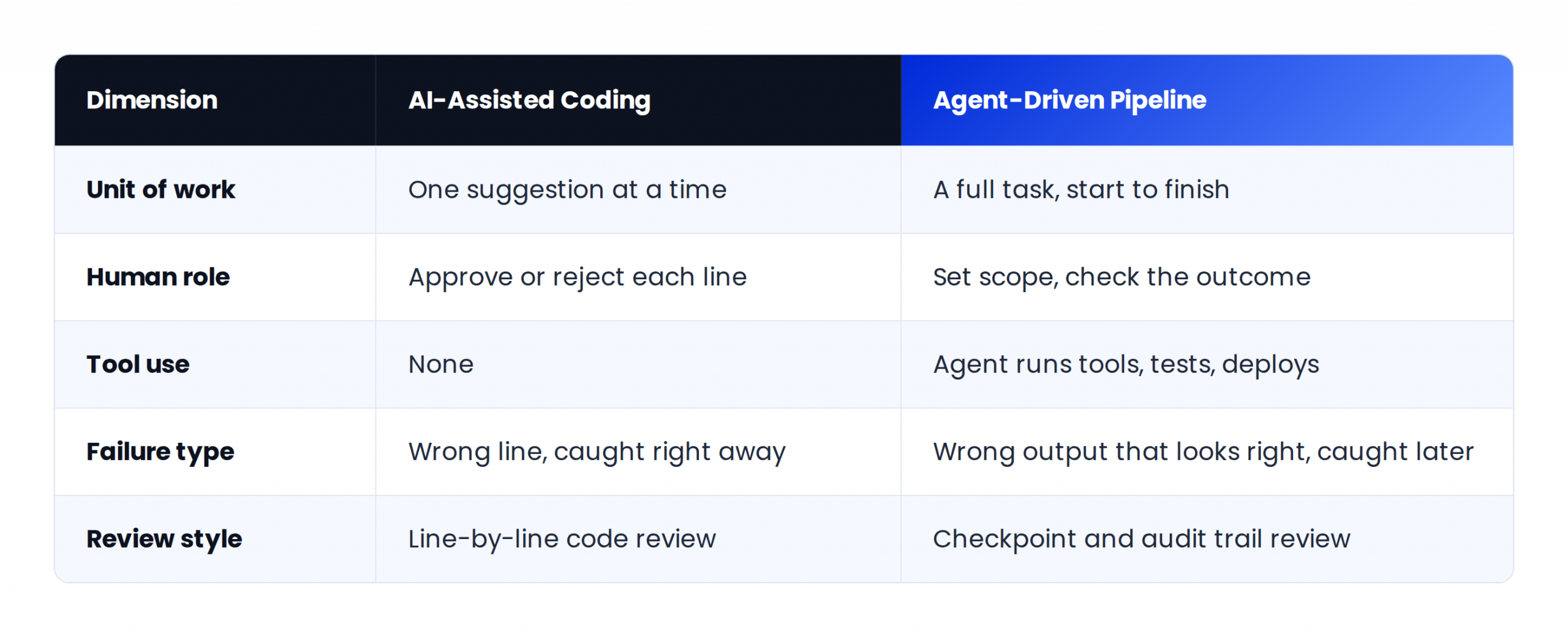
A 66% success rate still means one try in three fails, and in messier real-world settings, that number tends to get worse. Teams that treat agents as autocomplete with manners make a costly mistake: they keep old-style reviews for new-style risk. Problems show up in production instead of code review, where they cost far more to fix.
Governance Gaps Are the Real Bottleneck
Most teams still can’t answer why enterprise AI pilots fail at scale, and the answer is rarely the model.
Without a clear AI agents engineering operating model, what looks like a capability problem is almost always a process problem. Gartner predicts over 40% of agentic AI projects will be canceled by the end of 2027, driven by rising cost, unclear value, and weak risk controls. Most agentic AI work today is early experimentation driven by hype, not a structured operating framework, and that gap hides the real cost of running agents at scale once the pilot ends.
Three Blockers That Keep Showing Up
- Audit trails that don’t scale. Review steps built for human pull requests buckle under the volume of agent-made changes each week.
- Unclear accountability. When an agent-made change causes an outage, teams often can’t say who approved that scope in the first place.
- Access sprawl. Agents pick up broad tools and repo access faster than security can review it, and each new link widens the risk.
None of these are model problems, no matter what a vendor pitch claims. They’re process problems, and good design fixes them, not a newer model next quarter.
Redefining Developer Roles Inside an Agent-Augmented Team
DORA’s 2025 State of AI-Assisted Software Development report puts it plainly: AI acts as an amplifier. It makes strong teams stronger and rough teams rougher, instead of fixing either one by itself.
That effect is already reshaping daily work, and engineering teams are visibly restructuring around agentic workflows well before recruiting gives the new roles a name.
For a deeper look at how human oversight and agent autonomy co-exist in practice, the guide to human-agent collaboration in generative-driven development covers the ownership model in detail.
Four Role Types Already Taking Shape
- Agent supervisor. Watches several agent workstreams at once instead of writing every line personally, spending more time on scope than syntax.
- Scope writer. Writes task specs clear enough for an agent to run without back and forth, a skill closer to technical writing than coding.
- Verification engineer. Focuses on testing and audit review for agent output, a role that barely existed two years ago.
- Platform builder. Builds the tools, access rules, and guardrails that let agents run safely inside real systems.
Engineers who ignore all four tend to lose ground fastest. The amplifier effect cuts both ways, depending entirely on how a team responds.
Measuring Engineering ROI in an Agent-Integrated Lifecycle
Most companies that try agentic AI never scale it into production. McKinsey’s ongoing State of AI research keeps finding the same gap: a wide split between teams that pilot agents casually and teams that run them at real scale with returns a board can see.
That gap is where most engineering leaders lose the ROI case internally, not at the pilot stage, where every demo looks great regardless of what the numbers later show.
Metrics That Actually Reach Leadership
The common mistake is measuring agent value the old way: lines of code written, suggestions accepted, hours saved on paper. None of that connects to what a CFO or board tracks.
A stronger method ties agent use to metrics leadership already reports up the chain:
- Cycle time from ticket to production
- Defect rate after launch
- The split between new work and maintenance work
When agentic engineering truly works, all three move together. That combined shift is a far stronger signal than any single number on its own.
Building Guardrails That Make Agentic Engineering Sustainable
Trust, not adoption, is the real bottleneck now.
Stack Overflow’s 2025 Developer Survey found that 84% of developers now use or plan to use AI tools, up from 76% a year earlier. Yet 46% say they don’t trust AI output, up sharply from 31% the year before. Adoption and trust are moving in opposite directions at once, and a team that ignores that gap builds its whole agent plan on shaky ground.
Teams pulling ahead treat AI as part of a disciplined platform, with guardrails built in from day one. Teams falling behind bolt AI onto messy processes and hope speed makes up for the risk.
Four Guardrails, In Order
- Scoped access that limits what one agent can touch without a checkpoint
- Audit trails for every change an agent makes, not just the flagged ones
- Staged autonomy, so agents earn wider scope only after proving narrow scope first
- Human checks placed at the riskiest step, like production deploys, not spread thin across every stage
Skipping straight to full autonomy is the top reason pilots stall out. Staging it fixes that before it starts.
Xccelera’s Approach to Operationalizing Agentic Engineering at Scale
Most of the friction above isn’t a capability gap. It’s an AI agents engineering operating model gap. What agents can do today has outrun what governance, role design, and measurement can support at most companies.
Gartner forecasts that 40% of enterprise apps will carry task-specific agents by the end of 2026, up from under 5% a year before. That leaves leaders a short window to build the right model on purpose, not after something breaks.
This is the gap Xccelera’s work with engineering teams closes. An AI Agent Lifecycle Management Platform gives teams governance, audit trails, and human-in-the-loop approval steps. Xccelera’s evidence agent creates an immutable audit trail for every AI action, turning scattered agent pilots into one system anyone can trust, with version history and multi-LLM support built in from day one.
Pair that with an autonomous backend generation platform and an AI frontend generation and iteration platform, since both check their own output before a human ever looks at it. For older systems, an AI-driven legacy code modernization platform brings that same discipline to moving a codebase onto a modern stack.
The operating model decides the outcome here, not the model itself. That’s what splits Gartner’s surviving 60% from its canceled 40.
Conclusion: The Operating Model Is the Product
The teams that will still be running agents in 2027 aren’t the ones that moved fastest. They’re the ones that built the governance, role structure, and measurement framework to survive production.
A weak AI agents engineering operating model is what turns a promising pilot into a canceled project. Capability has arrived at most companies. The operating framework hasn’t. That’s the window, and it’s closing.


