Why Most Enterprise AI Pilots Fail at Scale (And How to Fix It)
Enterprise AI pilots are failing at an alarming rate — 80% never deliver intended value. The culprit isn’t the technology. It’s data unreadiness, absent governance, and operating models built for another era. This article breaks down the five structural gaps destroying AI scale and shows exactly how to close them. The numbers are damning. MIT’s…
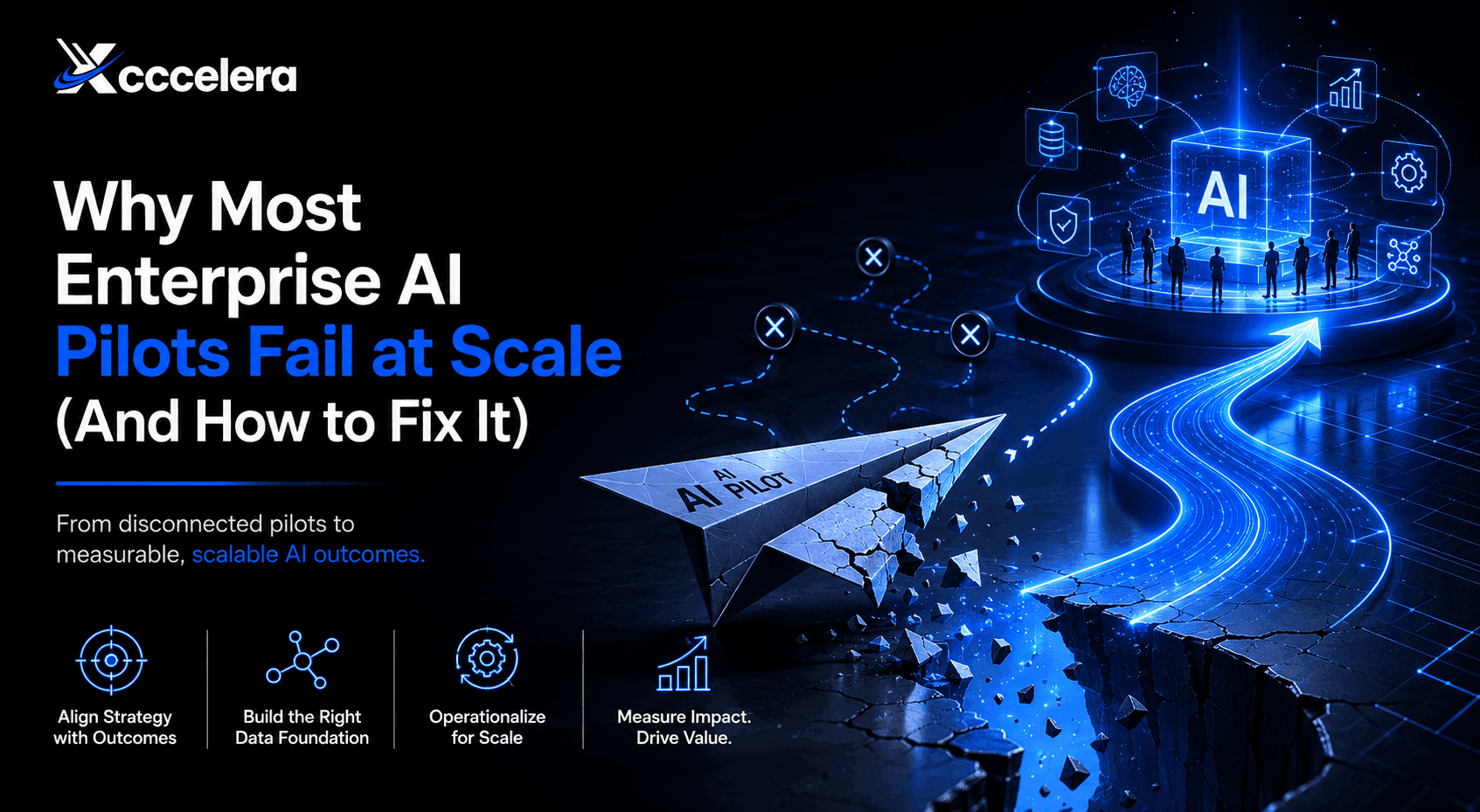
Enterprise AI pilots are failing at an alarming rate — 80% never deliver intended value. The culprit isn’t the technology. It’s data unreadiness, absent governance, and operating models built for another era. This article breaks down the five structural gaps destroying AI scale and shows exactly how to close them.
The numbers are damning. MIT’s NANDA study found that 95% of enterprise generative AI pilots produce zero measurable return on P&L. Meanwhile, RAND Corporation, after analyzing more than 2,400 enterprise AI initiatives, found that 80.3% fail to deliver their intended value — roughly twice the failure rate of non-AI technology projects. Yet, despite these sobering statistics, boards keep approving budgets, executives keep greenlighting pilots, and the cycle repeats.
2026 has become the definitive reckoning. As CIO.com put it, if 2024 was the year of experimentation and 2025 the year of proof-of-concept, then 2026 is the year of scale or fail. Boards are no longer patient with pilots that demonstrate capability but never reshape operations. Consequently, the question every senior leader should be demanding an answer to is not how many AI initiatives are running, but how many are actually moving the business.
It’s Not the Model. It’s Everything Around It.
The instinct when an AI project collapses is to blame the algorithm. That instinct, however, is almost always wrong.
A Folio3 analysis of 140 enterprise AI implementations found that only 23% of failures were caused by model performance or integration complexity. Strikingly, the remaining 77% traced back to strategy failures, governance gaps, and change management breakdowns. In other words, the model worked — the organization around it did not.
The Data Readiness Crisis
Gartner’s research sharpens this picture even further: only 12% of organizations have data of sufficient quality to support AI applications at scale. That means 88% of enterprises are effectively building on a foundation that cannot hold the weight of production AI. Public data is organized, labeled, and semantically rich. Enterprise data, by contrast, is scattered across legacy systems, inconsistently defined across business units, and stripped of the context needed to train or prompt AI reliably.
What makes this gap so damaging is that it remains entirely invisible during pilots. Controlled proof-of-concept environments use curated datasets that don’t represent what enterprise data actually looks like in production. As a result, the model succeeds in the sandbox — then it hits real operations and the outputs deteriorate fast. As analysis from Softobiz notes, pilots validate functionality while production tests whether that functionality can sustain under real enterprise conditions. Most organizations, unfortunately, are never ready for that test.
The Five Gaps That Kill AI at Scale
RAND’s breakdown of failure modes points to five structural gaps that consistently appear across failed deployments. Each one is preventable. Importantly, none of them requires better AI — they require better organizational discipline.
1. Missing Data Infrastructure
Without unified, semantically rich, AI-ready data, every new AI use case requires custom engineering from scratch. According to Gartner’s April 2026 research, organizations with the highest AI-ready data maturity are achieving up to 65% greater business outcomes than peers with weaker foundations. In practical terms, this means that building strong data and AI infrastructure is not simply a technical decision — it is a strategic imperative.
2. Absent Change Management
CIO Dive’s analysis of enterprise AI scaling identifies employee resistance, communication breakdowns, and lack of engagement as the primary barriers to adoption. Simply put, technology that no one uses delivers no value. Therefore, organizations must invest in change management with the same rigor they apply to model selection.
3. Governance Built for Pilots, Not Production
In a pilot, risks are contained and controllable. In production, however, a single hallucination in a compliance workflow or bias in a credit scoring model can trigger regulatory exposure and remediation cycles that stall entire programs. Acceldata’s 2026 research found that 42% of companies abandoned AI initiatives pre-production in 2025 — up sharply from 17% in 2024. This acceleration signals that governance failures are compounding, not stabilizing. Enterprises that invest early in AI agent consulting frameworks are significantly better positioned to close this gap before it becomes a production crisis.
4. Metrics Disconnected from Business Outcomes
AI initiatives that cannot demonstrate direct P&L contribution are the first to lose executive sponsorship. Without KPIs tied to revenue, cost reduction, or measurable productivity, even functional deployments get shut down. Accordingly, outcome alignment must be embedded into the design of every deployment — not retrofitted after the fact.
5. Executive Sponsorship That Evaporates Post-Demo
AI Assembly Lines’ analysis of enterprise pilot failures identifies this as one of the most reliably fatal gaps: senior leadership champions the pilot, attends the demo, and then redirects attention to the next priority. Without sustained executive ownership, scaling stalls and business units branch off independently, amplifying risk considerably.
Governance Is Not a Checkpoint. It’s an Operating Layer.
Stack Overflow’s January 2026 analysis of IBM’s enterprise AI scaling approach offers the clearest articulation of what governance-at-scale actually requires: stop treating governance as a review process and embed it directly into the platform. IBM’s approach automates compliance checks, connects to approved data sources, and removes the friction that makes governance feel like a bottleneck rather than an enabler.
Building Accountability Before Deployment
Acceldata’s framework for AI governance at scale identifies a RACI model as the non-negotiable starting point. Specifically, the accountability structure works as follows:
- Data Stewards own training data quality
- ML Engineers own model performance and drift monitoring
- Compliance Officers own regulatory alignment
- Business Owners own the output impact on customers
When everyone is responsible, no one is accountable — and that ambiguity is precisely where production AI systems break. Furthermore, the emerging benchmark for governance maturity is ISO/IEC 42001, an AI management framework that organizations operating in regulated industries are beginning to treat as table stakes. Cognipeer’s April 2026 agentic AI report signals the direction clearly: organizations combining AI-ready data, centralized operating models, and structured frameworks will define the separation between enterprises that scale AI and those that continue cycling through pilots.
From Pilot to Production: The Operating Model Shift
The single most significant insight from CIO.com’s December 2025 analysis of enterprise AI maturity is that the organizations successfully scaling AI are not those with the most pilots. Rather, they are those that proved AI’s impact within IT first, then federated that capability outward in a controlled and deliberate way.
Designing for Federation
That federated model looks like domain hubs staffed with platform experts, responsible AI advisors, and data engineers aligned to specific business functions. McKinsey’s data on organizational readiness is sobering: 89% of organizations still operate on industrial-age models fundamentally incompatible with the decentralized, adaptive structure that AI at scale requires. As a direct consequence, most enterprises are attempting to run next-generation AI systems on organizational structures that were never designed for them.
Deloitte’s 2026 State of AI in the Enterprise report points to the coming shift: the number of companies with 40% or more of their AI projects in active production is set to double within six months. Enterprises capturing that value share one defining trait — they stopped treating AI as a technology initiative and started treating it as an operating model.
Moreover, SS&C Blue Prism’s 2026 agentic AI trend analysis reinforces this point: agentic AI systems are no longer assistant-class tools. They are increasingly becoming autonomous workflow executors, and scaling them demands a governance and operating architecture built for that level of autonomy — not adapted from what worked for chatbots. Organizations exploring this shift will find that investing in multi-agent systems architecture early is one of the highest-leverage decisions available in 2026.
How Xccelera Operationalizes AI Beyond the Pilot Stage
Most enterprise AI vendors solve for the demo. Xccelera, by contrast, solves for production.
Xccelera’s agentic AI platform is purpose-built to eliminate the five gaps that kill AI scale: data orchestration, embedded governance, outcome-tied deployment models, organization-wide integration, and sustained operational ownership. Each accelerator and AI agent within Xccelera’s portfolio is designed to enter production — not sit in a sandbox.
Production-Ready From Day One
ApiX autonomously generates complete backend infrastructure from a single configuration file — APIs, database setup, and 100+ endpoint tests — without human supervision. FrontendX turns Figma designs into fully operational React applications with build validation and auto-corrected compile errors. LibX runs a 17-step automated security dependency pipeline that scans GitHub repositories for CVEs across OSV, NVD, and GHSA sources, patches breaking code through AI, and opens ready-to-merge pull requests — cutting vulnerability remediation from days to minutes. Critically, these are not prototype tools. They are execution systems. Together, they represent what true AI-powered software development looks like at enterprise scale.
XOra, Xccelera’s 24/7 voice AI agent, demonstrates what production-grade agentic deployment actually looks like: sub-second latency, multi-language support, CRM auto-sync, and memory-driven context that persists across interactions. It handles Tier-1 support, IT helpdesk, sales outreach, and scheduling workflows — autonomously, at volume, without the degradation that typically follows a lab-to-production transition.
The Unit Economics of Scale
Beyond functionality, Xccelera’s pay-per-run pricing model removes one of the most underappreciated barriers to enterprise AI scale: the financial risk of a failed rollout. Rather than locking organizations into seat fees or platform licenses before outcomes are proven, Xccelera charges per execution. A large ApiX run costs $3.00 to $9.00. A full freelance development project covering the same scope runs $200 to $5,000. As a result, the unit economics of scale work in the customer’s favor from day one.
As the California Management Review’s March 2026 framework for agentic enterprise governance makes clear, autonomous AI now functions as an organizational actor — not a decision-support tool. The enterprises that will lead the next five years are, therefore, those building the structural conditions to operate it responsibly. Xccelera is the partner that makes those conditions operational.
Ready to move beyond the pilot stage? Explore Xccelera’s AI automation solutions and discover how production-ready agentic AI can reshape your operations — not just your demos.


