Why Conversational AI Needs a Purpose-Built Voice Agent — Not Just a Chatbot With Audio
Deploying a chatbot with audio is not a voice strategy. Enterprise conversational AI demands purpose-built architecture: real-time ASR, LLM reasoning, Neural TTS, CRM integration, and persistent memory. The gap between a talking chatbot and a true AI voice agent is architectural, not cosmetic — and every quarter enterprises delay purpose-built deployment, the cost compounds. The…
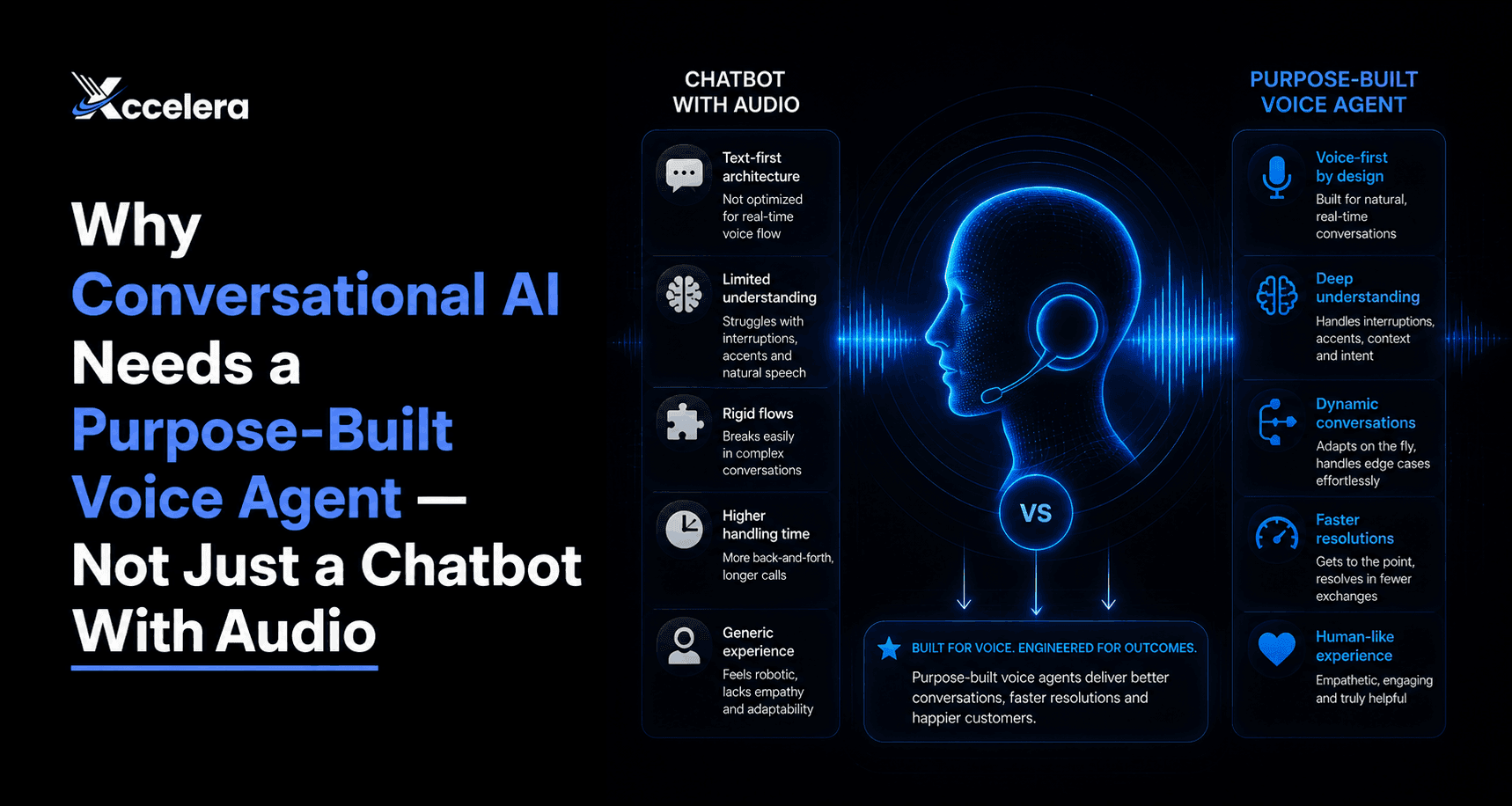
Deploying a chatbot with audio is not a voice strategy. Enterprise conversational AI demands purpose-built architecture: real-time ASR, LLM reasoning, Neural TTS, CRM integration, and persistent memory. The gap between a talking chatbot and a true AI voice agent is architectural, not cosmetic — and every quarter enterprises delay purpose-built deployment, the cost compounds.
The Difference Between Hearing and Understanding
Every enterprise that has layered speech recognition over an existing chatbot has made the same discovery: the system hears words but misses meaning. That is not an NLP problem. It is an architectural one.
Voice Interaction Operates on Different Physics
Text conversations tolerate latency. Users read, pause, rethink, and scroll back. Voice does none of that. A spoken conversation runs at human speed, meaning every delay, every misread intent, and every context failure registers immediately as friction.
The RingCentral Agentic AI Report 2026 found that 14% of organizations currently prefer interacting with digital workers via voice — a number expected to climb to 23% within two years. That trajectory reflects not just user preference but a structural shift in how enterprise AI is expected to perform.
Bolting audio onto a chatbot does not produce a voice agent. It produces a chatbot with a microphone, and the distinction is consequential.
What “Purpose-Built” Actually Means in Voice Architecture
A purpose-built voice agent is not defined by what it sounds like. It is defined by how it is built.
The Four-Layer Stack That Makes Voice Work
The foundation is a streaming pipeline running four components in tight sequence:
- Automatic Speech Recognition (ASR) converts audio to text in real time.
- Natural Language Understanding (NLU) interprets intent and extracts context.
- A large language model generates the response.
- Neural Text-to-Speech (TTS) delivers it back as natural audio.
According to AssemblyAI’s 2026 voice stack analysis, the conversational AI market is projected to reach nearly $14 billion, driven by enterprises recognizing voice as the primary interface for AI interaction.
What separates a functional voice agent from a failing one is whether those four layers are engineered together for streaming delivery or assembled as separate tools connected by patches. Streaming architecture allows the ASR model to transcribe audio in chunks while the LLM begins generating a response before transcription completes. Sequential pipelines cannot achieve that. This is the core principle behind adaptive AI development for enterprise voice systems.
Seven Ways Chatbots Fail When Given a Microphone
The failure modes of chatbot-based voice deployments are predictable. They are not edge cases.
1. Intent misread at speed. Text chatbots process one turn at a time. Voice moves faster, and intent shifts mid-sentence. Netguru’s 2025 implementation research found 61% of chatbots fail to accurately understand user queries even in text — a failure rate that accelerates in spoken interaction.
2. Context collapse. Chatbot memory structures are built for text sessions. They do not carry acoustic context, speaker tone, or mid-call intent shifts.
3. Latency spikes. Sequential processing stacks produce response delays that feel unnatural the moment they exceed 1.5 seconds.
4. Escalation failure. Chatbots route to humans via ticket or queue. Voice requires live, warm handoffs with full context transfer. This is where contact center transformation through AI conversational agents becomes critical infrastructure, not an upgrade.
5. No interruption handling. Humans interrupt each other naturally. Text-based chatbots cannot process barge-in events.
6. Rigid dialogue flows. Chatbots map to predefined paths. Spoken conversation rarely follows a script.
7. No emotional signal processing. Voice carries frustration, urgency, and hesitation. Systems built for text discard that signal entirely.
A 2025 study cited by Netguru found 67% of businesses reported their chatbot technology did not meet expectations. Devrev’s 2026 analysis adds that the gap between what is technically possible and what most enterprise deployments deliver is not a technology gap — it is a scoping and architecture gap.
The Latency Problem No Chatbot Patch Can Fix
Production Numbers Define the Problem
Introl’s January 2026 voice infrastructure analysis places the full pipeline as follows: STT at 100–500ms, LLM processing at 350ms to over one second, and TTS at 75–200ms. Stack those sequentially and even the most optimistic scenario approaches the outer edge of natural conversation. Human dialogue operates within a 300–500ms response window. Beyond that threshold, the interaction registers as mechanical.
Why Streaming Architecture Is Non-Negotiable
Hamming AI’s analysis of over four million production voice agent calls identifies sub-800ms end-to-end latency as the enterprise production target. Rasa’s enterprise voice generator benchmark confirms that anything exceeding 1.5 seconds is perceived as unnatural by callers.
That ceiling is only achievable when pipeline components run in parallel, not in sequence. No prompt optimization, no wrapper library, and no audio plugin applied to a text chatbot resolves compounding stack latency. The pipeline itself must be engineered from the ground up for real-time spoken interaction — which is precisely what purpose-built agentic AI solutions are architected to deliver.
Where Enterprise Voice AI Delivers Measurable Outcomes
Purpose-built voice agents consistently outperform chatbot deflection across four enterprise scenarios.
Outbound Qualification
AI voice agents achieve 60–75% task completion on outbound qualification calls. Chatbot deflection in equivalent workflows lands at 20–35%, based on Vocalis AI’s 2026 benchmarks. Enterprises using voice agents for outbound SDR workflows reduced cost-per-qualified-meeting by 68% compared to human-only teams, according to McKinsey’s 2025 State of AI report.
Inbound Overflow Management
Aircall customers deploying AI voice agents reduced average human response time from 29 hours in 2025 to 12 hours by January 2026 — a result driven by real-time intent routing.
Tier-1 Support Containment
Salesforce’s 2026 voice AI research confirms that enterprise platforms with native data integration outperform standalone voice tools because they access live customer records and execute workflows without external connectors. Explore how this connects to AI-powered customer support automation for Tier-1 containment at scale.
Post-Sale Customer Success
Consistent, CRM-connected voice agents eliminate human performance variability on routine follow-up calls, producing standardized interaction data and measurable improvements in first-call resolution.
Memory, CRM Integration, and the Intelligence Layer
A voice agent without live data access is a sophisticated IVR. The intelligence layer separating operational voice AI from advanced call routing is real-time CRM connectivity combined with persistent conversational memory.
What Live Integration Changes at the Call Level
When a voice agent pulls account data mid-call, hold time disappears. The caller does not wait while a system looks up records. The agent retrieves and incorporates that information into the next spoken response within milliseconds.
Callbotics’ 2026 CRM integration analysis confirms that production-grade voice automation platforms combine telephony connectivity, AI models, workflow orchestration, and enterprise integrations into a unified environment — where every interaction produces structured operational data inside the organization’s system of record. This is the same principle driving AI agent integration across enterprise tech stacks.
The Market Signal Behind Memory-Driven Voice
The conversational AI market is projected to reach $41.39 billion by 2030, up from $14.29 billion in 2025, according to Leaping AI’s enterprise implementation research. That growth is concentrated in organizations treating voice AI as a system-of-record integration layer with persistent memory, not as a standalone automation overlay.
Rasa’s enterprise analysis adds that cross-channel memory — where customers switching from chat to phone retain full conversation history — is now a baseline expectation in enterprise voice deployments.
The 2026 Business Case for Moving Beyond Chatbot Audio
The Market Has Already Decided
AssemblyAI’s 2026 voice stack analysis reports that 62% of organizations are either experimenting with or actively scaling AI agents, treating them as foundational infrastructure. The speech recognition technology market alone is projected to reach $29.28 billion by 2026. That is not an emerging demand. It is a market in active, accelerating deployment.
The Competitive Cost of Delay
Tblocks’ April 2026 conversational AI trends analysis identifies a structural shift now underway: in enterprise environments, conversation sits between people and systems, not above them. Organizations deploying voice AI as a workflow integration layer with memory and governance outperform those treating it as a customer-facing overlay.
Only 5% of custom enterprise AI tools reach production, according to Tblocks — resulting in a 95% failure rate for solutions that cannot integrate into workflows. Read more about how enterprises are turning AI hype into real systems to understand what separates deployments that scale from those that stall.
The Emotional Intelligence Dimension
Nextlevel.ai’s 2025 enterprise voice adoption analysis identifies real-time emotional intelligence as a defining capability in 2026 — with voice systems detecting frustration, urgency, and satisfaction in real time and reducing escalations by 25%.
That capability only exists in purpose-built architectures with dedicated signal processing pipelines. A chatbot converted to audio has no mechanism to process those signals.
How Xccelera’s XOra Delivers Purpose-Built Voice Intelligence
It is not a chatbot with a voice layer. It is a production-ready, agentic voice system engineered from the pipeline for enterprise-grade spoken interaction.
The XOra Architecture
XOra runs a complete voice execution stack: Whisper-class ASR for speech recognition, LLM-based intent extraction for reasoning and context, and Neural TTS for natural audio response delivery. Sub-second latency, noise cancellation, and multi-language support are built into the core pipeline as foundational capabilities, not optional modules.
Enterprise Integration and Deployment
Every XOra deployment auto-syncs conversation outcomes to CRM and ticketing systems in real time. Memory-driven context carries across sessions, so returning callers receive continuity rather than repetition.
Use cases span Tier-1 customer support automation, IT helpdesk resolution, outbound sales qualification, and intelligent scheduling across enterprise environments at scale.
Xccelera deploys XOra and goes live in under 7 weeks, delivering up to 60% improvement in customer experience and up to 35% reduction in operational cost.
For enterprise leaders moving past the chatbot era, explore Xccelera’s XOra Voice Agent — or contact us to discuss your deployment.