XOra Use Case Deep Dive: Automating Tier-1 Support Across 10,000 Daily Interactions
Enterprise Tier-1 support is collapsing under unsustainable ticket volume. XOra, Xccelera’s AI Voice Agent, autonomously resolves 10,000+ daily interactions spanning intent recognition, live system execution, and automatic CRM sync — without a human agent in the loop. Real architecture, real metrics, and the blueprint for scaling past the staffing ceiling. The Tier-1 Support Crisis Enterprises…
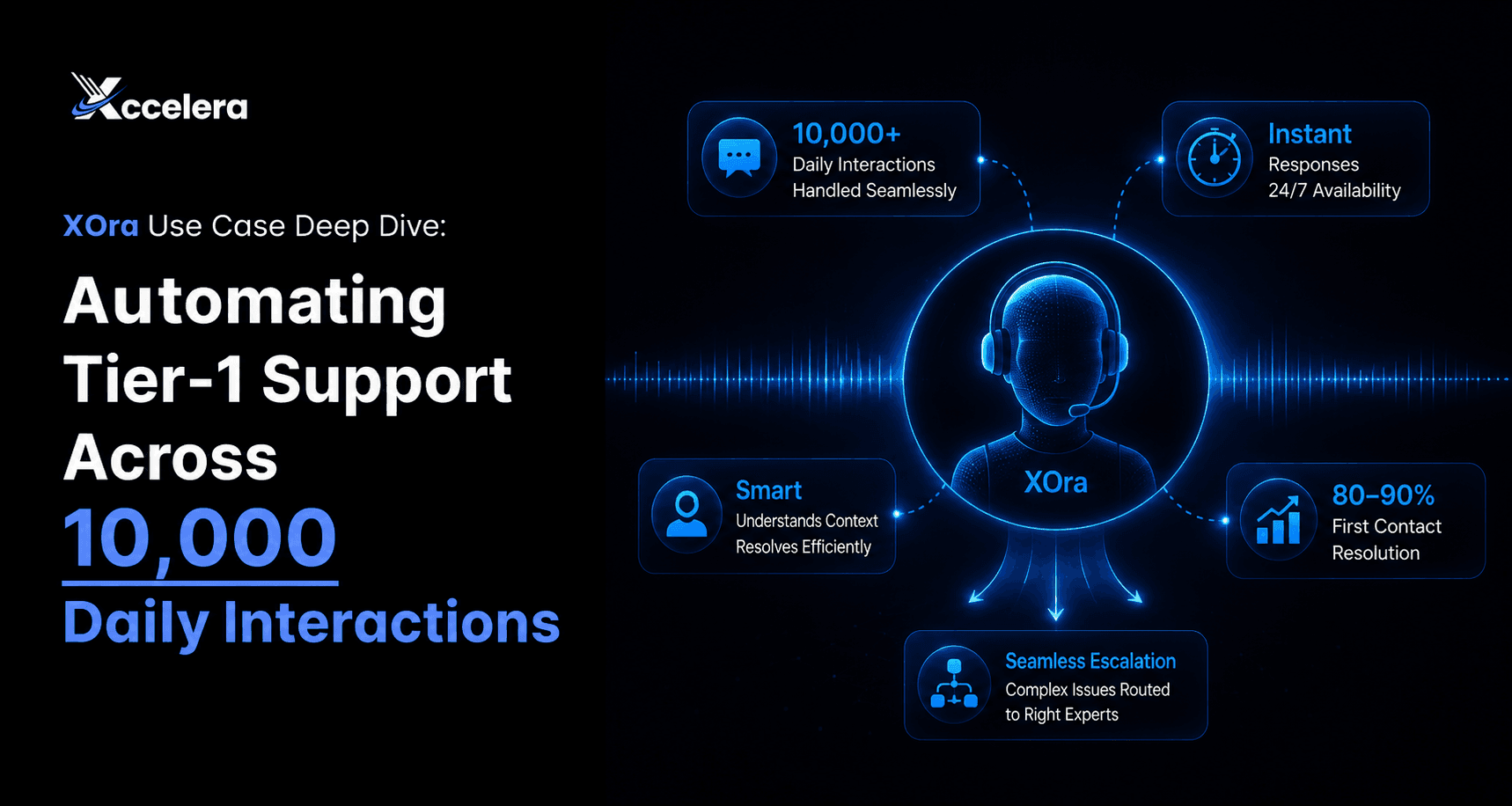
Enterprise Tier-1 support is collapsing under unsustainable ticket volume. XOra, Xccelera’s AI Voice Agent, autonomously resolves 10,000+ daily interactions spanning intent recognition, live system execution, and automatic CRM sync — without a human agent in the loop. Real architecture, real metrics, and the blueprint for scaling past the staffing ceiling.
The Tier-1 Support Crisis Enterprises Can No Longer Staff Their Way Out Of
The math stopped working. The average enterprise support organization now fields over 10,675 tickets monthly, with 34% of teams reporting year-over-year volume increases. The headcount has not kept pace. The budget has not either. Human-led Tier-1 support costs roughly $22 per ticket. AI-driven interactions bring that figure down to $1.84. At 10,000 daily interactions, that gap does not represent a savings opportunity. It represents an organizational survival decision.
The Cost Structure That Makes Linear Scaling Indefensible
Labor accounts for 60 to 80 percent of total support costs across enterprise contact centers. Every new hire adds fixed overhead without proportionally increasing throughput. Agents handling identical queries across eight-hour shifts — password resets, order status checks, account lookups, billing questions — burn out at scale. Research from Gartner in 2026 found that 56% of service agents report burnout under traditional support models.
Tier-1 support automation with AI agents addresses this at the structural level. It does not displace human judgment on complex escalations. It removes the repetitive volume that drains human capacity and makes sustainable, scalable operations possible. Enterprises that grasped this distinction early now operate with measurably lower costs, faster resolution cycles, and support teams refocused on interactions that genuinely require human reasoning.
Why Voice Is the Right Automation Layer for High-Volume Tier-1 Support
The Channel Still Carrying the Heaviest Load
Text-based bots deflect a portion of inbound volume. Voice remains the channel of choice for customers with urgent, time-sensitive, or emotionally charged concerns. Between 60 and 80 percent of inbound enterprise calls consist of FAQ-level queries, account lookups, and status updates — interactions that follow predictable resolution patterns and require no human intervention to close.
Where Legacy IVR Systems Fail
Interactive voice response systems are not automation. They are friction. Menu trees that frustrate callers, route problems to agents, and produce no resolution deliver worse outcomes than doing nothing at all. Modern AI voice agents replace this architecture entirely. They recognize intent through natural spoken conversation, hold context across multi-turn exchanges, respond in natural speech, and execute backend actions before the call ends.
The Structural Advantages That Text Cannot Replicate
Voice automation delivers two capabilities text channels cannot: real-time spoken confirmation that closes interaction loops immediately, and multi-language support without additional configuration overhead. For global enterprises handling contact center transformation across regions and time zones, this makes AI voice the most operationally complete automation layer available in 2026.
Inside XOra — How the Conversation-to-Action Pipeline Handles 10,000 Interactions Daily
Every interaction moves through a six-stage autonomous pipeline. No human touches the conversation between the moment a caller speaks and the moment the issue resolves and the system record updates.
The Six-Stage Autonomous Execution Loop
First Stage — Omnichannel Voice Capture XOra captures real-time voice input across phone and web channels with sub-second latency and active noise cancellation, maintaining audio quality regardless of the caller’s environment or device.
Second Stage — Speech-to-Text Conversion Whisper-class automatic speech recognition converts spoken input to structured text in milliseconds, handling accent variations, pacing differences, and background noise without degrading accuracy.
Third Stage — Intent and Context Extraction Large language model processing identifies caller intent, sentiment, urgency level, and all required action parameters. The system understands conversational context, not isolated trigger words. This is a core capability of adaptive AI development in enterprise deployments.
Fourth Stage — Business Logic Execution API calls fire. Database lookups run. Booking engines, CRM records, and internal knowledge bases are queried simultaneously. This is where the real separation between intelligent voice automation and legacy deflection tools becomes visible. Tier-1 support automation with AI agents at this stage moves entirely beyond conversation into verified resolution.
Fifth Stage — Natural Voice Response Neural text-to-speech generates a human-like spoken response in real time, dynamically constructed from the business logic output and shaped by the conversational context already established in Stage 3.
Sixth Stage — Automated System Synchronization CRM records, support tickets, calendar entries, and interaction logs update automatically once the call closes. No manual data entry. No follow-up work required from the support team. This end-to-end flow is what separates AI agent integration from simple chatbot deployments.
The Numbers Behind Automated Tier-1 at Scale
Production data from 2026 enterprise deployments is unambiguous. AI resolutions average $0.62 per ticket against $7.40 for human-handled interactions, according to McKinsey’s 2026 service operations analysis. At 10,000 daily interactions, that differential translates to over $67,000 in daily cost avoidance relative to a fully human-staffed contact center.
Resolution Speed Has Redefined the Support Benchmark
First response time in AI-native deployments has dropped from over six hours to under four minutes. Total resolution time has compressed from 32 hours to 32 minutes — an 87 percent improvement that reshapes what customers and executives expect from enterprise support infrastructure going forward.
Deflection Metrics and What They Actually Measure
Median Tier-1 deflection across enterprise programs sits at 41.2 percent in 2026, with the top quartile reaching 58.7 percent. High-structure intents — password resets, refund requests, account verification — deflect at 70 percent or above. Customer satisfaction scores have largely converged between AI-handled and human-handled interactions, with the gap narrowed to 0.05 CSAT points in hybrid escalation models.
According to Forrester Research on AI in customer service, organizations fully committed to autonomous support infrastructure consistently outperform those still piloting indefinitely. These are production benchmarks, not pilot projections.
Where Enterprise Support Automation Breaks Down — and How to Avoid It
Most AI support deployments that underperform do so not because of model capability failures, but because of deployment and governance gaps that create the appearance of automation without delivering resolution at any meaningful scale.
The Four Failure Modes That Stall Enterprise Deployments
1. Deflection counted as resolution. A platform that redirects callers to self-service articles and logs the interaction as deflected is not resolving anything. Deployments that do not define genuine resolution — verified end-to-end problem closure without re-contact within 72 hours — consistently overstate their actual automation performance.
2. No live backend access. AI voice agents that cannot reach CRM records, ticketing systems, databases, or booking engines stop at conversation. Resolution requires action. Systems without live backend integration deflect; they do not resolve. Real call deflection depends on live system connectivity from the moment a call begins. This is why AI agent consulting prior to deployment is essential for scoping integration requirements correctly.
3. Absent escalation logic. Hallucination rates in live AI deployments without guardrails run between 15 and 27 percent. Without clearly defined escalation thresholds tied to sentiment signals, topic boundaries, and confidence floors, autonomous agents create new support problems rather than eliminating existing ones.
4. No path from pilot to production. Sixty-four percent of enterprise customer experience teams ran an agentic AI pilot in 2026. Only 27 percent reached full production in at least one channel. The gap is architectural and organizational. Teams that do not build governance, observability, and escalation logic into the initial deployment model stall before they scale. Read more about how enterprises are turning AI hype into real systems for a detailed breakdown of what separates successful deployments.
Sustainable autonomous support requires observability from the first interaction, not as a retrospective fix after problems surface.
How Xccelera Deploys XOra for Enterprise Support Operations
From Scoping to Production in Under Seven Weeks
Xccelera’s XOra transforms enterprise Tier-1 support from a cost-heavy, headcount-dependent function into an autonomous execution layer. Deployment follows Xccelera’s Agentic AI Solution framework — moving from use-case definition to production in under seven weeks. The architecture is designed for scale from the first day of deployment, not retrofitted after a pilot reveals limitations.
Built for Configurability at Enterprise Depth
XOra supports custom voice tone, pitch, and conversational formality, enabling enterprises to align agent personality precisely with brand standards across customer-facing interactions. Workflow logic combines deterministic rule-based handling with generative AI, giving operations teams control over high-stakes interaction paths while preserving the conversational flexibility that unscripted queries demand. Role-based access controls, real-time sentiment monitoring, resolution rate tracking, and latency analytics deliver full operational visibility across every interaction volume level. Explore how this fits into AI-powered software development and broader enterprise automation strategy.
The Governance Model That Sustains Quality at Scale
Xccelera’s human-in-the-loop architecture ensures escalation paths are defined, monitored, and continuously refined as interaction patterns evolve across industries. XOra currently serves enterprise use cases across IT helpdesk automation, customer support, healthcare intake coordination, and e-commerce service management, with a deployment model built to absorb volume spikes without degrading resolution quality.
For enterprises handling 10,000 or more daily support interactions, Tier-1 support automation with AI agents is no longer an experimental budget line. It is the operational foundation that determines which organizations manage support costs and which ones structurally outpace them. XOra is how Xccelera builds and delivers that foundation at production scale.
Ready to explore autonomous Tier-1 support for your enterprise? Contact Xccelera to discuss your deployment.


