Legacy Application Modernization With AI: Analyze, Convert and Validate
Quick answer In short, legacy application modernization with AI is a three-stage process. AI first analyzes the old codebase to map its logic and dependencies. It then converts the code to a modern stack in small, reviewable batches, and finally validates that the new application behaves like the old one before cutover. First, people set…
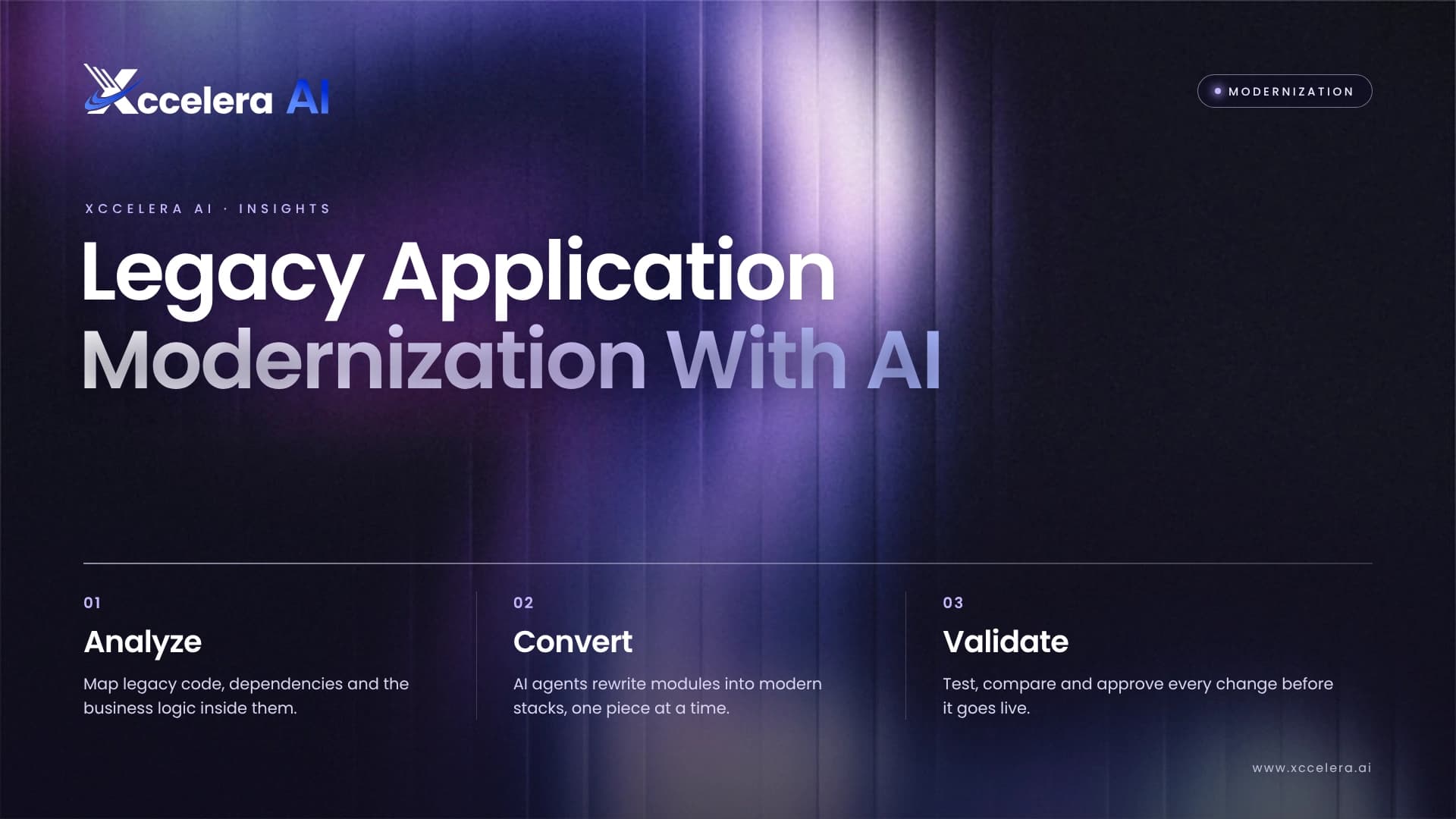
In short, legacy application modernization with AI is a three-stage process. AI first analyzes the old codebase to map its logic and dependencies. It then converts the code to a modern stack in small, reviewable batches, and finally validates that the new application behaves like the old one before cutover. First, people set the scope, own the business rules and approve go-live. Meanwhile, agents do the volume.
Most enterprises still run core operations on applications that are ten, twenty or even forty years old. They work, but they are slow to change, hard to staff and costly to keep secure. Legacy application modernization with AI offers a faster route out, because agents can read, convert and test code at a scale no manual team can match.
Modernization also needs a clean base. Also, outdated libraries are among the biggest hidden risks in an old codebase, as we explain in why AI dependency management is becoming a board-level security metric. This guide therefore covers what comes next: how AI analyzes, converts and validates legacy applications, and where people must stay in charge.
Why Legacy Application Modernization Keeps Stalling
However, traditional modernization projects stall for familiar reasons. For example, the original authors have left, documentation is thin and the code holds years of undocumented business rules. A manual rewrite means people must read every line before they can change it, so timelines stretch and budgets slip.
of organizations have exceeded their original IT modernization budgets
Ensono, 2026
of the code changes in one large Google migration were fully AI-authored
less total migration time, as estimated by the engineers involved
Sources: Ensono, State of IT Modernization Report 2026; Google, How is Google using AI for internal code migrations?
By contrast, AI changes the economics of the slow parts: reading, translating and testing. Also note that the Google figures are estimates from the engineers on the project, not controlled measurements. Even so, they show where the time goes when agents take over the repetitive work.
The Analyze, Convert and Validate Approach
In other words, think of modernization as a pipeline with three stages and a few human gates. Each stage hands a checked result to the next, so errors surface early instead of at cutover.
-
Analyze
Agents read the code, map dependencies and extract business rules into a catalog that people can review.
-
Convert
Agents translate modules into the target stack in small batches, following your architecture standards.
-
Validate
Agents generate tests, compare old and new behavior and loop failures back for repair before people approve cutover.
Stage 1: How AI Analyzes a Legacy Codebase
In fact, analysis removes most of the risk. Before anything is converted, agents build a picture of what the application actually does, which is often different from what the old documents say.
Specifically, a good analysis produces five outputs. Then a person who knows the system reviews each one.
| Output | What it contains | Reviewed by |
|---|---|---|
| Dependency map | Which modules, jobs, databases and libraries depend on each other | Architect |
| Business-rule catalog | Calculations, validations and conditions written in plain language | Domain expert |
| Dead-code report | Code that nothing calls, which is safer to retire than to convert | Senior engineer |
| Risk and complexity score | Hotspots ranked by size, coupling and change history | Engineering lead |
| Draft documentation | Readable descriptions of modules and data flows | Architect |
Then use these outputs to decide the order of work. For instance, the matrix below is a simple way to sort modules by business value and modernization risk.
Convert first
Well-understood modules with clear rules and good test coverage.
Convert with human-led design
Core engines, payments and data migrations. Here, architects lead while agents assist.
Automate in bulk
Reports, utilities and batch jobs that agents can convert quickly.
Retire or leave alone
Rarely used, fragile code is often cheaper to retire than to convert.
A single bounded module gives you real numbers on accuracy, review time and rework before you commit to a wider program.
Stage 2: AI Legacy Code Conversion in Practice
Conversion is more than line-by-line translation. Instead, good AI legacy code conversion maps old idioms to modern patterns, keeps business rules intact and produces code that your team can maintain.
For example, Google’s published workflow shows the shape of it. Engineers first found the code locations to change. A model then generated the edits in batches, and automated builds and tests checked the result. Failures went back to the model for repair, and an engineer reviewed each change before it landed.
Fewer than 100 files needed manual work. As a result, a job estimated at about 18 months finished in six weeks.
Source: InfoQ, Airbnb’s LLM-driven test migration.
A Worked Example: COBOL to Java
Here is what conversion looks like on a small example. Then open each step to compare the legacy code, the converted code and the test that proves they match.
01Legacy COBOLThe original business rule
*> WS-INTEREST is PIC 9(7)V99
COMPUTE-INTEREST.
    MOVE ACCT-BALANCE TO WS-BAL.
    IF WS-BAL > 10000
        COMPUTE WS-RATE = 0.035
    ELSE
        COMPUTE WS-RATE = 0.025
    END-IF.
    COMPUTE WS-INTEREST ROUNDED =
        WS-BAL * WS-RATE / 12.
In other words, balances above 10,000 earn a higher rate, and the system rounds the monthly result to two decimals.
02Converted JavaThe same rule in modern code
BigDecimal rate = balance.compareTo(new BigDecimal("10000")) > 0
    ? new BigDecimal("0.035")
    : new BigDecimal("0.025");

BigDecimal interest = balance.multiply(rate)
    .divide(BigDecimal.valueOf(12), 2, RoundingMode.HALF_UP);
The conversion keeps the threshold and the rounding rule, but states them in code that a modern team can read and test.
03Proof testProof that old and new outputs match
@Test
void interestMatchesLegacyOutput() {
    // Expected values come from the legacy system's real output
    assertEquals(new BigDecimal("1.04"),  interest("500.00"));
    assertEquals(new BigDecimal("20.83"), interest("10000.00"));
    assertEquals(new BigDecimal("29.17"), interest("10000.01")); // threshold edge
}
Lastly, golden cases from the real system, including one just above the threshold, show that old and new results match.
After all, a test generated from the converted code can repeat the same mistake. Instead, check tests against real outputs from the legacy system.
Compiling is not proving. A conversion is finished only when old and new behavior match.
Overall, conversion works best inside a managed lifecycle, where each agent has a defined role and a human owner. For the bigger picture, see what an agentic PDLC is and how agents work across each phase of product development.
Stage 3: Validating Behavior Before Cutover
Finally, validation answers the only question that matters: does the new application do what the old one did? Passing a compiler, however, is not enough. Instead, strong teams stack several checks, because each layer catches a different kind of failure.
| Layer | What it proves | Gate |
|---|---|---|
| Build, lint and type checks | The code is well formed and follows your standards | Automatic |
| Characterization tests | Outputs match the legacy system for known inputs | Automatic |
| Parallel run | Old and new systems return the same results on real traffic | Engineer review |
| Performance and security scans | Speed, limits and vulnerabilities are acceptable | Engineer review |
| Business-rule sign-off | Domain experts confirm that the rules were kept | Human approval |
Similarly, Airbnb’s pipeline applied the same idea at file level. In particular, each converted file had to pass the test run, the linter and the type checker. Failures went back to the model together with the error output, until the file passed or a person took over.
Before you cut over, confirm every item on this short checklist.
What a First Modernization Sprint Looks Like
For instance, here is an illustrative sprint for one bounded module. People spend their time at the decision points, while agents fill the gaps between them.
Picks one bounded module and defines the target stack and standards.
Build the dependency map, rule catalog and dead-code report.
Confirms business rules in plain language and flags gaps.
Convert code in batches and generate characterization tests.
Builds, tests and linters run, and failures go back for repair.
Reviews the highest-risk changes and the parallel-run results.
Signs off cutover for the slice, or sends it back with notes.
Illustrative sprint, not a benchmark.
Which Modernization Path Fits Your Application?
Of course, not every application needs a full conversion. Instead, open the situation closest to yours for a starting point. This is illustrative guidance, so confirm it with your architects.
AStable but datedRuns well, hard to maintain
- Best path: Replatform with light refactoring.
- AI’s role: Map dependencies, upgrade libraries and generate tests so the move is safe.
- Watch out for: Skipping tests because the app has run without issues for years.
BFragile and undocumentedFew docs, few people who know it
- Best path: Analyze first, then convert in slices.
- AI’s role: Extract business rules and write characterization tests before touching code.
- Watch out for: Converting before the rules are understood.
CSlow to changeEvery change takes too long
- Best path: Refactor into modular services.
- AI’s role: Split coupled modules, draft API contracts and convert in batches.
- Watch out for: Drawing service boundaries in the wrong places.
DPlatform near end of lifeVendor or runtime support ending
- Best path: Convert to a supported stack, for example COBOL to Java.
- AI’s role: Translate code and validate with parallel runs.
- Watch out for: Literal translation that carries old design flaws forward.
Common Mistakes in AI-Led Application Modernization
Generally, teams that struggle make one of four mistakes. Still, each has a straightforward fix.
How to Measure Modernization Progress
Track a few measures that show both speed and safety, because speed alone hides risk.
Converted modules whose outputs match the legacy system
Converted changes that land with little or no editing
Bugs found after cutover
Days from analysis to approved cutover
Expert hours per module, which should fall as agents improve
Take a baseline before you start, then compare module by module.
How We See Modernization at Xccelera AI
Modernization works when every stage has an agent doing the volume and a person holding the gate. That is why analysis, conversion and validation each get a defined job, scoped access and a named owner.
Our platform-led software development service applies this model to client applications, with human approval at the points that carry risk, such as scope, business rules and cutover.
Frequently Asked Questions
What is legacy application modernization with AI?
It is the use of AI agents to analyze an old application, convert its code to a modern stack and validate that behavior is unchanged. Meanwhile, people own the scope, the business rules and the final cutover decision.
Can AI convert legacy code accurately?
It can handle a large share of repetitive conversion work, but accuracy depends on clear rules, good tests and review. In Google’s published migration, about 80% of the code changes were fully AI-authored, and engineers still reviewed each change before it landed. Treat every conversion as a draft until tests prove it.
How do you validate AI-converted code?
First, stack several checks. Run build, lint and type checks, then characterization tests built from the legacy system’s real outputs, then a parallel run on real traffic, then performance and security scans. Then finish with sign-off from a domain expert on the business rules.
How long does AI-led application modernization take?
Generally, it depends on size, test coverage and complexity. However, AI shortens the reading, translating and testing steps, and Google engineers estimated about a 50% reduction in total migration time on one large migration. Therefore, start with one module to get a realistic estimate for your own estate.
Which legacy languages can AI convert?
AI can work with common legacy stacks such as COBOL, older Java and .NET code, and database logic such as PL/SQL. Quality varies by language and by how much context is available, so run a pilot on a small module first.
Modernizing Legacy Applications With AI, Safely
Legacy application modernization with AI works when it follows a clear order. Analyze first so you know what the system does, convert in small batches that people can review, and validate until old and new behavior match. The teams that get the best results start small, prove behavior with tests and measure outcomes instead of lines converted.
Modernization also reduces security exposure, because current code is easier to patch. For that side of the story, read how AI closes the gap between a CVE and its fix.
Which legacy application would you modernize first? Tell us on LinkedIn. For more on agentic delivery, you can subscribe to the Xccelera newsletter.
Plan Your Legacy Modernization
Map your applications, pick the first slice and set the human gates with our architects.