Performance vs Transformation: Evaluating the Business Impact of AI Solutions
AI adoption is accelerating across industries, yet the outcomes organizations achieve from these investments vary widely. While some companies report clear operational improvements, only a smaller group manage to use AI to fundamentally reshape how their businesses operate and compete. Performance vs Transformation in AI: Understanding the Two Types of Business Impact Artificial intelligence influences…

AI adoption is accelerating across industries, yet the outcomes organizations achieve from these investments vary widely. While some companies report clear operational improvements, only a smaller group manage to use AI to fundamentally reshape how their businesses operate and compete.
Performance vs Transformation in AI: Understanding the Two Types of Business Impact
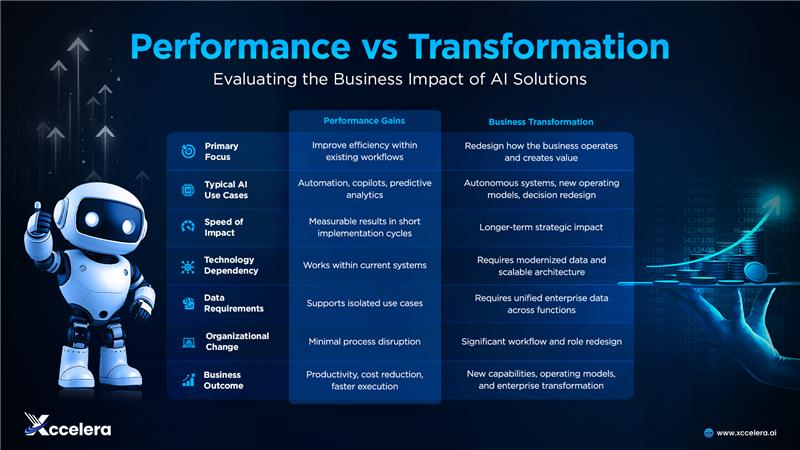
Artificial intelligence influences organizations in two primary ways: improving operational performance or enabling business transformation. Many enterprises initially deploy AI to optimize existing processes through automation, productivity improvements, and cost reduction. These initiatives enhance efficiency but largely preserve the existing structure of workflows and revenue models. Transformation impact, however, occurs when AI changes how value is created within the organization. This may involve redesigning business models, launching AI-enabled products or services, or establishing AI-native operations where data-driven systems guide decision-making across the enterprise. Distinguishing between these two outcomes helps leaders accurately evaluate whether AI initiatives are delivering incremental efficiency or long-term strategic change.
Why Most AI Deployments Deliver Performance Gains Instead of Transformation
Although enterprises widely deploy AI tools, most initiatives remain confined to efficiency improvements rather than strategic reinvention. Organizations often prioritize initiatives that deliver immediate operational value, which is why productivity metrics dominate AI deployments while large scale transformation remains rare.
AI adoption patterns across enterprises
Across industries, AI adoption typically begins with targeted applications such as workflow automation, predictive analytics, and decision support tools. These deployments improve efficiency within existing processes but rarely change how organizations create value or structure their business operations.
Why organizations prioritize quick productivity wins
Companies often start with AI use cases that generate measurable results within a short time frame. Automation tools, AI copilots, and analytics systems quickly improve operational productivity, making them attractive starting points for enterprise AI adoption.
Legacy systems as a structural barrier
Many enterprises continue to operate on legacy infrastructure that limits the integration of modern AI capabilities. Without scalable data platforms and cloud-native architectures, expanding AI solutions across multiple departments becomes difficult.
Fragmented enterprise data environments
AI systems require unified and high-quality data to operate effectively. When enterprise data remains distributed across disconnected systems and departments, organizations struggle to scale AI initiatives beyond isolated projects.
Organizational resistance to workflow redesign
Large scale transformation often requires redesigning decision-making processes, operational structures, and workforce roles. Many organizations hesitate to implement these changes, which limits AI adoption to operational improvements rather than strategic transformation.
Failure to move beyond AI pilots
As a result of these barriers, many companies remain stuck in experimentation. AI initiatives deliver localized productivity gains but fail to evolve into enterprise-wide transformation programs.
Measuring AI Performance Impact: Operational Metrics Enterprises Track
Organizations evaluating the success of AI initiatives often begin by measuring improvements in operational performance. These indicators focus on efficiency, cost optimization, and productivity gains generated through automation and data-driven decision systems. While such metrics demonstrate early value from AI adoption, they primarily capture incremental improvements rather than long-term strategic transformation.
Productivity increase
One of the most visible indicators of AI performance impact is the improvement in employee productivity. AI copilots, automation tools, and decision-support systems help employees complete tasks faster, reduce manual effort, and handle larger volumes of work without proportional increases in workforce size.
Process automation
AI systems automate repetitive and rule-based processes across departments such as customer support, finance, operations, and supply chain management. Automation improves process speed, reduces operational errors, and enables organizations to operate more efficiently at scale.
Cost reduction
Operational AI deployments often generate measurable cost savings. Predictive analytics, intelligent scheduling, and automated workflows allow organizations to reduce operational expenses by optimizing resource allocation and minimizing inefficiencies across business processes.
AI efficiency metrics in knowledge work and operations
Enterprises also evaluate AI performance using metrics such as task completion time, automation rates, error reduction, and throughput improvements. These indicators help organizations quantify how effectively AI systems improve operational performance.
Risk-adjusted ROI and operational KPIs.
Many companies use financial and operational KPIs to assess AI investments. Metrics such as return on investment, operational cost savings, and productivity gains provide early evidence that AI deployments are generating measurable business value.
Time horizons for measurable operational impact
Performance improvements from AI typically appear within shorter implementation cycles. Organizations often observe operational gains within months of deployment, which explains why performance-oriented AI initiatives are usually the first stage of enterprise AI adoption.
Measuring AI Transformation Impact: Strategic and Long-Term Business Metrics Unlike performance improvements, transformation impact evaluates how AI changes the strategic capabilities of an organization. Instead of focusing only on efficiency gains, enterprises measure transformation through indicators that reflect new revenue opportunities, improved customer value, and redesigned operating models.
Revenue growth from AI products
Organizations often assess transformation by tracking revenue generated through AI-enabled products and services. Examples include predictive platforms, intelligent recommendation systems, and AI-powered digital services that create new market opportunities.
AI-enabled services
AI allows companies to introduce services that were previously difficult to scale, such as personalized customer experiences, predictive maintenance solutions, and intelligent advisory tools.
Customer experience improvements
Transformation also appears in how organizations enhance customer interactions. AI-driven insights help businesses deliver faster responses, personalized recommendations, and more adaptive service models.
AI-native workflows and workforce redesign
Long-term transformation occurs when companies restructure workflows around AI-driven decision systems. In such environments, AI becomes embedded in daily operations, enabling faster decisions and new forms of collaboration between human teams and intelligent systems.
The Enterprise AI Impact Gap: Why Only a Few Companies Achieve Transformation
Despite significant investments in artificial intelligence, only a small number of organizations manage to achieve transformation-level impact. While many enterprises successfully deploy AI to improve operational efficiency, fewer are able to redesign their business models, workflows, and decision systems around AI capabilities.
Statistics showing low enterprise AI ROI rates
Industry reports consistently indicate that a large share of AI initiatives struggle to deliver measurable business returns. Many organizations report productivity improvements, but only a limited percentage convert AI experiments into large-scale transformation programs.
Organizational capabilities separating leaders from laggards
Companies that achieve transformation typically develop stronger data infrastructure, cross-functional AI teams, and clear leadership ownership of AI strategy. These capabilities allow them to scale AI initiatives beyond isolated operational projects.
Importance of workflow redesign and AI-native operations
Transformation requires more than deploying AI tools. Organizations must redesign operational processes, integrate AI into decision-making systems, and align workflows around data-driven intelligence.
Strategic alignment between AI initiatives and business goals
Enterprises that realize transformational impact ensure that AI initiatives directly support broader business objectives. Instead of isolated technology deployments, AI becomes embedded within strategic planning, product development, and long-term growth initiatives.
Moving from AI Performance to AI Transformation: Strategic Path Forward
Organizations that achieve meaningful AI impact move beyond isolated productivity improvements and adopt a structured approach to enterprise-wide transformation. This transition requires aligning technology capabilities with long-term business strategy and redesigning operations around data-driven decision systems.
Enterprise roadmap from performance to transformation
Companies typically begin with operational AI use cases such as automation and analytics. Over time, successful organizations expand these capabilities into integrated AI platforms that support multiple business functions and strategic initiatives.
Key stages in scaling AI across organizations
Scaling AI involves strengthening data infrastructure, establishing governance frameworks, and building cross-functional teams that combine technical expertise with domain knowledge.
Importance of leadership ownership and governance
Executive leadership plays a central role in driving AI transformation. Clear governance structures and strategic oversight help organizations prioritize initiatives that deliver long-term value.
Converting AI pilots into enterprise platforms
Enterprises that successfully transform their operations move beyond experimentation by integrating AI systems into core workflows, enabling continuous innovation and sustained competitive advantage.
Conclusion
Artificial intelligence is generating measurable value across industries, but the depth of that impact varies. Performance-focused AI deployments typically improve efficiency through automation, productivity gains, and cost optimization. Transformation impact emerges when organizations redesign products, services, and decision systems around AI capabilities.
Companies that achieve lasting impact move beyond isolated AI tools and integrate intelligence into core business operations. Strong data infrastructure, leadership ownership, and strategic alignment play a critical role in this transition. As AI adoption expands, organizations that treat AI as a foundation for long-term innovation rather than only operational improvement will be better positioned to achieve sustainable competitive advantage.