Agentic AI for Enterprises: How It Works, Use Cases and What It Takes to Scale
Quick answer Enterprises are moving to agentic AI because assistants speed up single tasks but leave the handoffs between people, tools and teams untouched, which is where most delivery time goes. Agentic AI gives specialized agents a goal, connected systems and a way to check their own work, with people approving risky decisions. Most enterprises…
Enterprises are moving to agentic AI because assistants speed up single tasks but leave the handoffs between people, tools and teams untouched, which is where most delivery time goes. Agentic AI gives specialized agents a goal, connected systems and a way to check their own work, with people approving risky decisions.
Most enterprises already have AI on every desk. Developers use coding assistants, analysts ask chatbots to summarize reports and support teams draft replies with generative tools. Yet when leadership asks whether products ship faster or operations cost less, the answers get vague.
The survey data shows the same gap. McKinsey’s State of AI in 2026 found that 89% of organizations use AI, yet only 44% are scaling it across the enterprise and just 37% report a positive impact on EBIT.
An assistant makes one person faster at one task. Most of the time in an enterprise workflow is lost between tasks: waiting for review, re-explaining context to the next team, checking output by hand. If you need a refresher on the terms, our guide to how AI agents differ from AI assistants covers the definitions in detail.
Agentic AI for enterprises means AI agents that plan, reason and carry out multi-step business workflows across connected enterprise systems. People set the goal and the acceptance criteria, and the agents pause for human approval on decisions that carry risk. The rest of this article covers what changes when agents take on a whole workflow, and what needs to be in place before that pays off.
Here is the shift at a glance.
Who starts the work
From one prompt at a time
To a goal with acceptance criteria
Scope
From a single task
To a multi-step workflow
Context
From whatever the user pastes in
To shared memory across projects
Systems
From the chat window or IDE
To connected tools such as Git, Jira, ERP and CRM
Checking the output
From done by hand
To automated checks plus human approval
Measure of success
From time saved per task
To cycle time, cost and quality of the workflow
And here is what that does to the flow of work.
With AI assistance
The assistant speeds up coding, while review, testing, documentation and release still wait on manual handoffs.
With agentic AI
Specialized agents work in parallel under one orchestration layer, reach enterprise systems through connectors and pass a human approval gate before release.
Agentic AI vs Generative AI in the Enterprise
Generative AI and agentic AI often run on the same models, but they do different jobs. Generative AI produces content when a person asks for it. Agentic AI takes a goal and carries the work through to a result, using tools and systems along the way.
Primary job
Generative AI Produces text, code, images or summaries
Agentic AI Completes multi-step workflows toward a goal
Who drives the work
Generative AI A person prompts, reviews and decides every step
Agentic AI A person sets the goal and approves risky actions
Tool use
Generative AI Usually none, or read-only search
Agentic AI Calls APIs, enterprise apps, MCP tools and other agents
Memory
Generative AI Limited to the current session
Agentic AI Shared context across tasks and projects
Enterprise value
Generative AI Faster drafting, search and analysis for one person
Agentic AI Shorter cycle times and lower cost per process
Governance need
Generative AI Output quality, data privacy and IP
Agentic AI Action permissions, runtime guardrails, audit trails and rollback
In practice most enterprises run both. Generative AI helps inside individual work, while agentic AI runs the workflows that connect that work.
Where Does AI Assistance Stop Paying Off?
An AI assistant waits for a prompt, produces an answer and hands control back to the user. That works well for drafting, searching and summarizing. It works less well when a piece of work passes through several people, tools and approvals, which describes most of what large organizations do every day.
Software delivery shows the problem clearly. A developer with a coding assistant can write a feature in an afternoon. The pull request then waits for review, tests are written after development finishes, documentation is updated by hand and a release manager validates the build before deployment. The assistant sped up one step, and cycle time barely moved, because typing was never the bottleneck.
Three problems usually survive an assistant rollout:
- Requirements, code, tests and documentation live in separate systems, so every handoff is manual and rework is common.
- Each AI tool supports one task. People still carry context between tools, coordinate the next step and check what the tools produced.
- AI spend is hard to tie to business results, and it is often unclear who approves AI output or where problems get escalated.
Gartner analyst Anushree Verma made a related point in 2025, saying that organizations get real value from agentic AI when they focus on enterprise productivity and look past individual task augmentation.
What Changes When Agentic AI Owns the Outcome?
With agentic AI, a person sets a goal and the acceptance criteria. The agents work out the steps, call the tools they need, check their results and report back. People still decide what good looks like and approve actions that carry real risk, while most of the execution in between moves to the agents.
In an enterprise this usually means several specialized agents working together. A requirements agent turns business input into user stories. Development agents build backend, frontend and integration code in parallel. A testing agent generates and runs tests while the code is being written, and a DevOps agent prepares the release. An orchestration layer assigns the work, passes context from one agent to the next and decides when a person needs to step in.
The unit of work becomes a goal with a definition of done, which is what lets agents take handoffs out of the process.
How Agentic AI Works in an Enterprise
Whatever the use case, an enterprise agent runs the same basic loop. The loop, plus the platform around it, is what separates a governed agent from a chatbot with API keys.
-
Goal
A person or system sets an objective with acceptance criteria.
-
Plan
The agent breaks the goal into steps and picks the tools and models it needs.
-
Act
It calls APIs, queries data and works inside connected enterprise systems.
-
Check
Automated tests and policies verify the result, and risky actions wait for human approval.
-
Learn
Outcomes and decisions are stored, so the next task starts with that context.
The Architecture Behind Enterprise Agents
Around that loop, enterprise agent platforms tend to settle on the same layers. Bain describes a core of orchestration, observability and governed data access, and production systems usually add channels and tools around that core.
Channels
Where work arrives
Teams, Slack, portals and APIs, where people and systems hand goals to agents.
Orchestration
The command center
Plans and routes work, manages context handoffs, retries, parallel agents and model choice.
Agents and tools
Where work gets done
Specialized agents with scoped permissions, reaching systems through connectors and MCP.
Governance and observability
How work stays safe
Identity for agents, policy enforcement, traces of every step, audit trails and approval gates.
Data and knowledge
What agents act on
Governed access to structured and unstructured data, vector and graph indexes, and enterprise RAG.
Memory
What agents remember
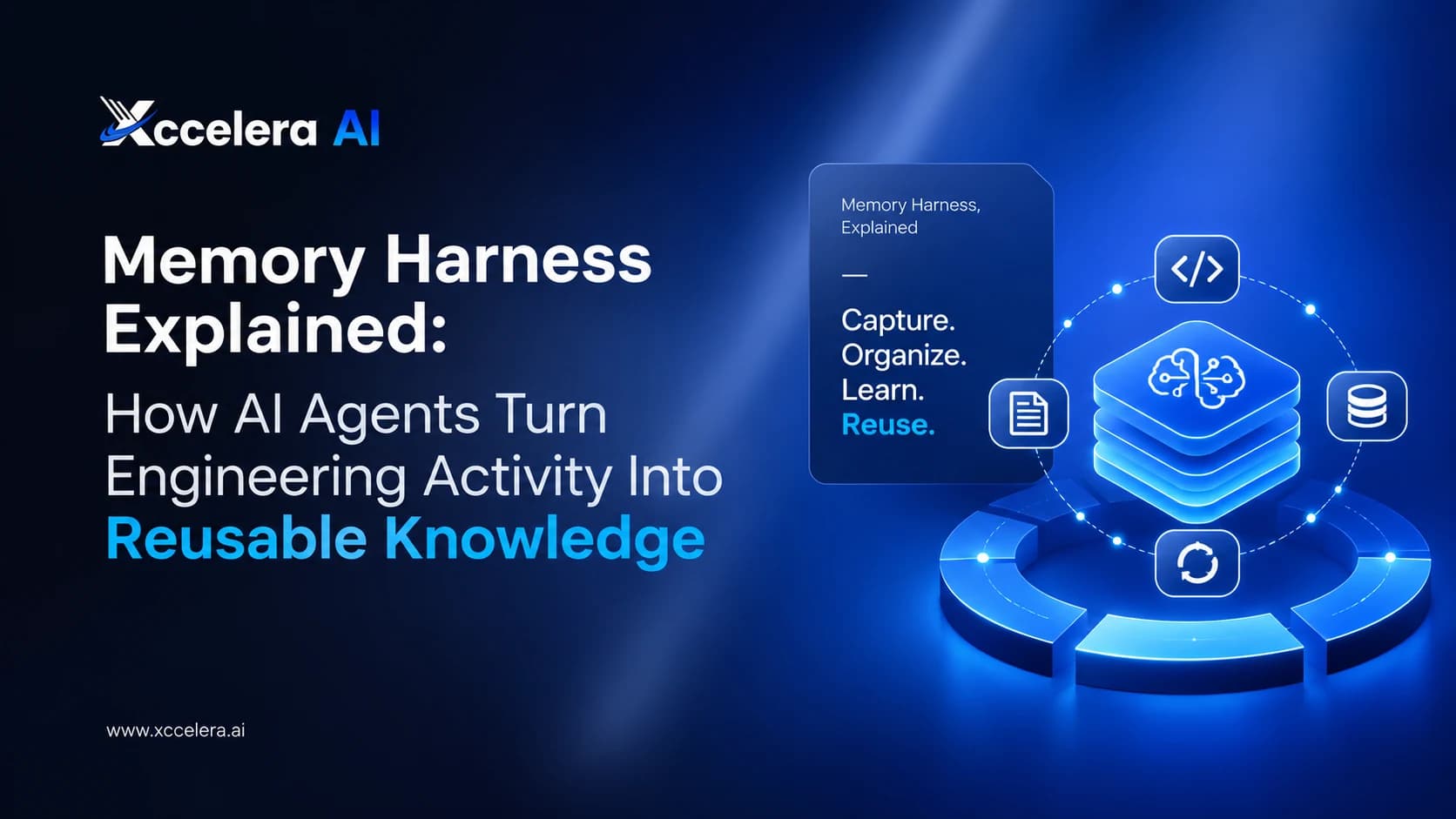
Requirements, decisions, code history and past fixes, captured so each task builds on the last.
The orchestration layer does the most work and gets the least attention in early pilots. We cover it in depth in why enterprise AI needs an orchestration layer, and the knowledge layer in our guide to the memory harness behind AI agents.
Why Are Enterprises Moving to Agentic AI Now?
Interest in agents keeps growing, but unevenly. McKinsey’s 2026 survey, fielded in May and June 2026 with 1,719 respondents across 97 countries, found that 40% of companies with $1 billion or more in revenue are scaling AI agents, up from 27% a year earlier. Smaller organizations stayed flat at 22%. Even in IT, the function where scaled agents are most common, only 12% of respondents report scaling them. Large companies are pulling ahead, and most organizations still run agents in only a few places.
Source: McKinsey, The State of AI in 2026: On the Road to ROI.
Gartner’s outlook shows both the demand and the risk. It expects at least 15% of day-to-day work decisions to be made autonomously through agentic AI by 2028, up from none in 2024, and a third of enterprise software applications to include agentic AI by the same year. In the same research, Gartner predicts that more than 40% of agentic AI projects will be canceled by the end of 2027 because of rising costs, unclear business value or weak risk controls.
Cost, value and control are operating problems more than model problems.
That is why the teams getting agents into production spend as much effort on integration and governance as on the agents themselves.
Agentic AI Use Cases Across the Enterprise
Agentic AI pays off wherever work runs through several steps and systems. When Bain surveyed 200 B2B IT decision makers in March 2025, these were among the most cited opportunities.
Source: Bain & Company survey of B2B IT decision makers, March 2025.
Here is how those opportunities look function by function, and where a person should stay in the loop.
IT operations and service management
Agents triage tickets, group related alerts, find the likely root cause and run approved runbooks, which cuts mean time to resolution. See AI agents for IT service management.
Human approves production changes and privileged access
Software delivery
Requirements, development, testing and release agents work in parallel under one orchestrator, as described in the agentic PDLC.
Human approves architecture, merges and releases
Customer service and sales
Agents resolve routine requests end to end, qualify leads and keep CRM records current, then pass complex cases to people with the full history attached.
Human approves refunds, exceptions and contract terms
Finance and procurement
Agents match invoices, chase approvals in procure-to-pay and prepare reconciliations. Bain found 78% of IT leaders expect agentic AI to replace or augment some ERP functionality by 2028.
Human approves payments and vendor changes
HR and employee services
Agents run onboarding checklists, provision accounts across HR and IT systems and answer policy questions with links to the source.
Human approves access to sensitive data and pay changes
Marketing and campaigns
Agents segment audiences, assemble campaign variants, coordinate launches across channels and report results against targets.
Human approves brand-sensitive content and budget shifts
The Four Levels of Agentic AI Maturity
Enterprises rarely jump straight to fully autonomous agents. Most move through four levels, a progression Bain also uses to describe the market.
-
Level 1: Assistants and copilots
Answer questions and draft content inside one tool, while a person does every step.
-
Level 2: Single-task agents
Complete one bounded task with tool access, such as resetting a password or filing a ticket.
-
Level 3: Orchestrated workflows
Several agents coordinate a multi-step process across systems, with human approval gates. This is where most enterprises are heading now.
-
Level 4: Multi-agent operations
Many agents collaborate across domains with shared memory and central governance.
Level 4 is still early. Data readiness, missing interoperability standards and errors that compound across long chains of steps hold most organizations at level 3 for now, which is why the foundations in the next section matter.
What Do Enterprises Need Before Agentic AI Can Deliver?
Teams that move agents past the pilot stage tend to put the same five things around them. Skipping one is a common reason pilots stall.
1. Connected Systems and Shared Context
An agent can only act on what it can reach. That means connectors into the systems where work already happens, such as GitHub, GitLab, Jira, Azure DevOps, Salesforce, SAP and the major cloud platforms. An open standard such as the Model Context Protocol (MCP) helps here, because a tool connected once becomes available to every agent.
Agents also need memory. When requirements, architecture decisions, code history, test results and past fixes are captured in one knowledge layer, each new task starts with the context of the last one.
Data readiness matters as much as connectivity. Agents act on what they retrieve, so duplicated, stale or unlabeled data turns into wrong actions at machine speed. Clean, permissioned sources with good metadata, plus vector or graph indexes for retrieval, need to come before autonomy.
2. Orchestration Across Specialized Agents
Several agents working in parallel need a coordinator. The orchestration layer breaks a goal into tasks, gives each task to the right agent, picks a suitable model for each job and keeps track of what is finished. Without it, a company ends up with the same disconnected tools it had before, only with more autonomy and less visibility. We covered this in more depth in why enterprise AI needs an orchestration layer.
3. Verification Inside the Workflow
In Google’s 2025 DORA research, 30% of technology professionals said they trust AI output only a little or not at all, and that caution is reasonable until there is a reliable way to check the work. Define acceptance criteria before the work starts, run automated checks as agents produce output, and keep a named person accountable for approval. When tests are generated alongside the code and every output is compared with the original requirement, human review becomes a short confirmation step.
Write acceptance criteria in plain language before an agent starts. The same criteria can drive the automated checks and the human review, so everyone tests against one definition of done.
4. Governance That Decides Where People Approve
Agents need written limits: which data they can access, which actions they can take on their own and which actions wait for approval. Every action should leave an audit trail showing what the agent did, with which inputs, and who signed off. A sensible starting point is to place approval gates at these points:
- Scope and architecture sign-off before agents start.
- Any action that touches production, customer data or payments.
- Final approval before a release goes live.
Gates can loosen as an agent builds a track record. Our piece on choosing between human-in-the-loop and fully autonomous workflows lays out a risk framework for deciding how far.
5. Outcome Measures From the First Week
Before a pilot starts, record the current numbers for the workflow, such as cycle time, engineering effort, defect rates and cost per change. Without a baseline, a successful pilot is hard to tell apart from a good demo, and the budget conversation at renewal gets much harder to win.
How the Operating Model Changes for Engineering Teams
Agentic AI changes who does which part of the work. In a human and agent hybrid model, architects and senior engineers set direction, design the system and review what agents produce. Supervisors watch the flow of work and step in on exceptions. Agents handle repeatable execution such as scaffolding services, writing integration code, generating tests, updating documentation and preparing releases.
Over time the platform also learns from the work. If every commit, pull request, incident and fix is captured, recurring patterns become reusable recipes and later projects start with what earlier ones figured out. A standalone assistant keeps no such history, so each session starts from zero. For a closer look at team design, see how engineering teams are restructuring around agentic workflows.
Skills and Roles Leaders Need for Agentic AI
Agentic AI is an organizational change as much as a technical one. People move from doing every step to supervising agents that do them, so the roles around each workflow shift.
Executive sponsor
Picks the workflows tied to business outcomes and owns the risk appetite for agent autonomy.
AI or agent architect
Designs orchestration, tool access, model routing and how agents share context.
Process owner
Writes the goals, acceptance criteria and approval rules for each workflow.
Platform and data engineers
Build connectors, data pipelines and the observability that shows what agents did.
Risk, security and compliance
Set agent permissions, review audit trails and test agents against misuse such as prompt injection.
Agent supervisors
Watch the flow of work, handle exceptions and feed corrections back into the system.
The skills that matter most across these roles:
- Redesigning workflows end to end, not just single tasks.
- Writing clear specs and acceptance criteria that agents can work to.
- Evaluating agent output and setting quality thresholds.
- AI governance, security and risk management.
- Systems integration, including connectors and MCP.
- Change management, so teams trust and adopt the new way of working.
For a structured way to build these capabilities, see our enterprise AI transformation approach.
Benefits and Risks of Agentic AI for Enterprises
The upside is real, and so are the failure modes. Teams that plan for both from the start are the ones that get past the pilot.
Benefits
- Shorter cycle times, because agents remove the waiting between handoffs.
- Lower cost per process, as repeatable execution moves from people to agents.
- Work that runs around the clock without adding headcount.
- Policies applied the same way every time, with a full audit trail.
- Knowledge that compounds, as each finished task improves the next one.
Risks and How to Contain Them
Check output at every step, not only at the end. Set a budget per workflow and route simple steps to smaller models.
Give agents least-privilege access, add runtime guardrails against prompt injection and log every action.
Record baseline metrics before the pilot and pick workflows that genuinely need agents.
A Practical Path From Pilot to Production
A phased approach keeps risk contained and gives leadership evidence at each stage. This is the phased approach Xccelera recommends.
-
Assess (2 to 4 weeks)
Choose candidate applications or workflows, record baseline metrics, check governance readiness and agree on the KPIs that will define success.
-
Pilot (6 to 8 weeks)
Deploy agents on a few selected scenarios. Measure productivity and quality against the baseline, test governance controls under real conditions and write down what you learn.
-
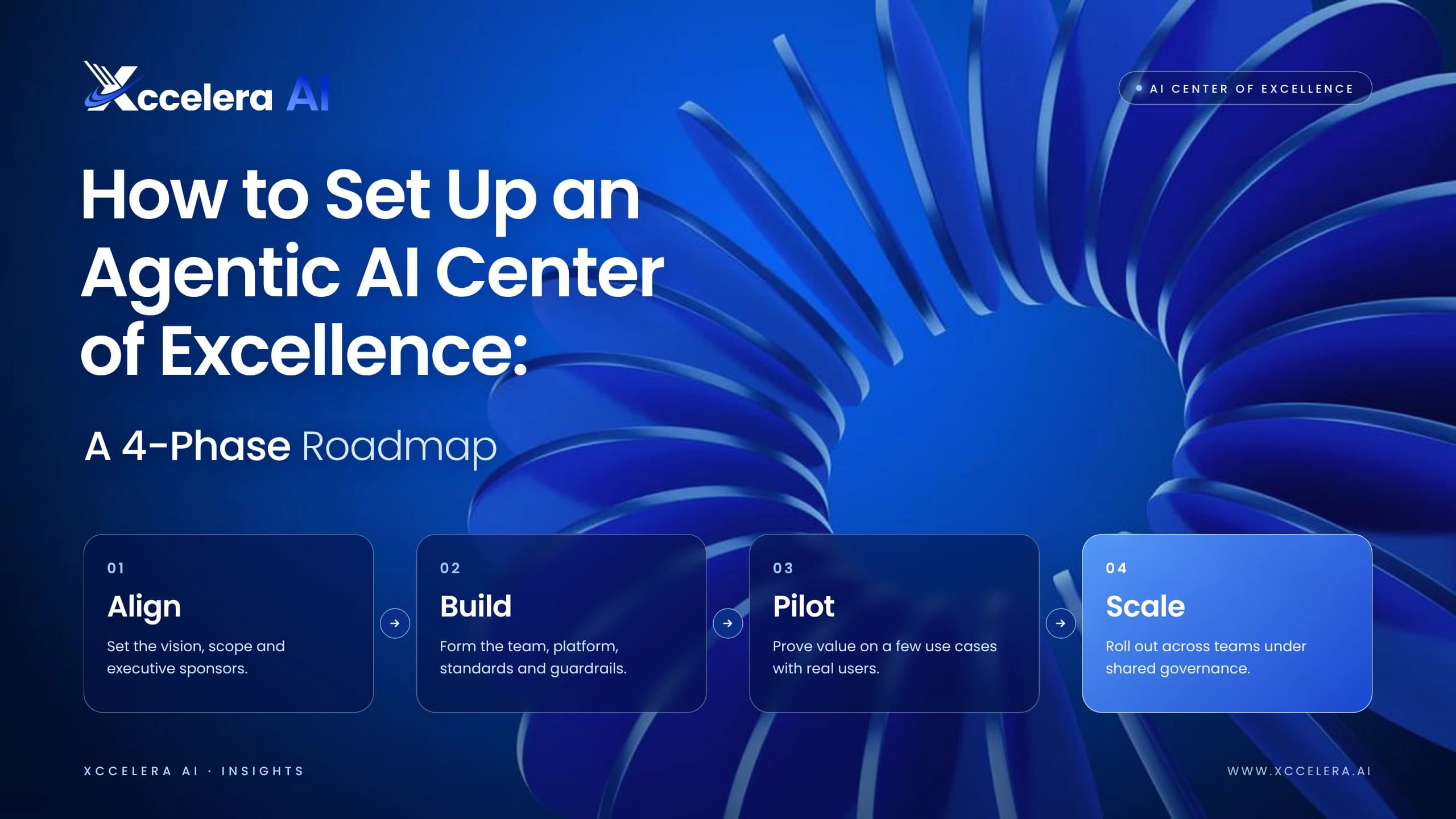
Establish a center of excellence
Set an enterprise LLM strategy, build a catalog of approved agents, standardize the MCP and connector framework, define the governance operating model and train the teams who will work with agents.
-
Scale across the portfolio
Extend to more teams, standardize the workflows that worked, reuse agents and assets across projects and keep tuning against the metrics.
For the ROI side of that move, our blueprint for maximizing ROI from pilot to production goes further.
Not every workflow needs agents. A quick way to sort candidates before the assessment:
Several steps, more than one system, a measurable outcome and a clear owner for approvals.
Work that touches regulated data, payments or irreversible actions. Start with tight approval gates.
A single step with fixed rules. A script or a standard workflow tool will cost less.
Gartner estimates that only about 130 of the thousands of vendors selling agentic AI offer genuine agentic capabilities, and notes that many use cases sold as agentic don’t need agents at all. Check what a product does on its own before you build a pilot around it.
The move from assistance to outcomes works when agents, connectors, checks and approvals are designed as one system. Adding agents as isolated tools adds speed in one place and risk in another.
The Xccelera AI platform runs specialized agents in parallel across backend development, frontend development, integration, validation, unit testing and deployment, with Xccelera Orchestrator coordinating the agents, integrations and delivery workflows. More than 100 connectors and an MCP framework link them to the existing enterprise toolchain, every agent and deliverable is monitored at each step, and critical actions wait for human approval. The team has more than 50 agents in production across SaaS, FinTech, healthcare and retail.
Frequently Asked Questions
What is agentic AI for enterprises?
It is the use of AI agents that plan, reason and carry out multi-step business workflows across enterprise systems, with access controls, audit trails and human approval for important decisions.
What is the difference between agentic AI and generative AI?
Generative AI produces content such as text, code or images when a person prompts it. Agentic AI takes a goal, plans the steps, uses tools and enterprise systems to complete a workflow and checks its own results, with people approving risky actions.
What are examples of agentic AI in enterprises?
Common examples include IT ticket triage and incident remediation, software delivery with parallel coding and testing agents, customer service resolution, invoice matching in procure-to-pay, employee onboarding and multi-channel campaign coordination.
What architecture does enterprise agentic AI need?
Most enterprise platforms use an orchestration layer to plan and route work, specialized agents that reach systems through connectors and MCP, a governance and observability layer for permissions, traces and approvals, and a governed data and knowledge layer.
What skills do enterprises need for agentic AI?
Teams need workflow redesign, clear specs and acceptance criteria, evaluation of agent output, AI governance and risk management, systems integration and change management, spread across sponsors, architects, process owners, engineers and risk teams.
What should an enterprise have in place before piloting agentic AI?
Connectors into the systems the workflow touches, an orchestration layer to coordinate agents, acceptance criteria with automated checks, written approval rules with an audit trail, and baseline metrics so the results can be measured.
Will AI agents replace software engineers?
No. Agents take on repeatable execution such as scaffolding, test generation and documentation. Engineers keep ownership of architecture, code review and any decision with business or security impact.
How long does an agentic AI pilot take?
In a phased approach, an assessment of 2 to 4 weeks is followed by a pilot of 6 to 8 weeks on a few selected scenarios. The exact timeline depends on the workflow and on how many systems the agents need to reach.
Why do agentic AI projects fail?
Gartner points to rising costs, unclear business value and weak risk controls. Setting baseline metrics before the pilot, choosing workflows that need agents and building governance in from the start address all three.
Moving From Assistance to Outcomes
AI assistants made individual people faster, and that was worth doing. The larger gains sit in the handoffs between people, tools and teams, and reaching them takes agents that can carry a workflow from start to finish inside clear limits. The enterprises moving agents out of pilots connect their systems, put verification and governance inside the workflow and measure outcomes from the first week.
If your organization has run pilots that never went further, our analysis of why most enterprise AI pilots fail at scale looks at the structural gaps behind that pattern.
Which workflow in your organization loses the most time to handoffs today, and what would need to be true before you let an agent run it? Tell us on LinkedIn. For more on agentic delivery, you can subscribe to the Xccelera newsletter.
Xccelera AI is an agentic AI company that helps enterprises transform operations and accelerate engineering through its proprietary Xccelera AI Platform, a multi-agent system that spans the full software delivery lifecycle.