Memory Harness Explained: How AI Agents Turn Engineering Activity Into Reusable Knowledge
Quick answer AI memory for software engineering is the layer that lets AI agents remember a codebase, its decisions and its history across sessions, instead of starting from zero each time. A memory harness goes further: it captures engineering activity such as requirements, commits, tests, defects and incidents, links it in a knowledge graph, and…
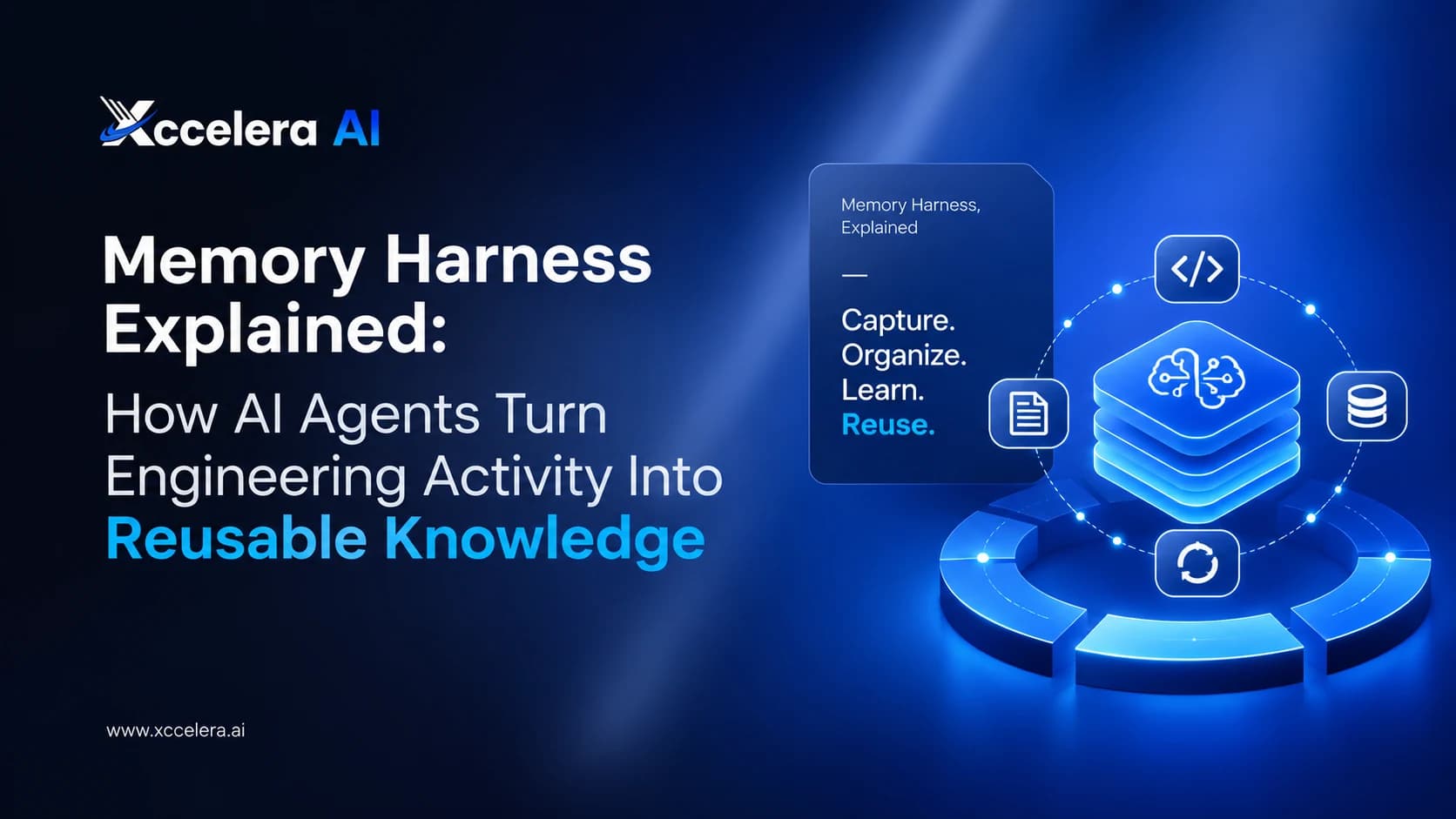
AI memory for software engineering is the layer that lets AI agents remember a codebase, its decisions and its history across sessions, instead of starting from zero each time. A memory harness goes further: it captures engineering activity such as requirements, commits, tests, defects and incidents, links it in a knowledge graph, and serves the right context to every agent on future work.
Every engineering team pays a quiet tax: knowledge that lives in people’s heads, old tickets and closed pull requests. AI coding agents make that tax more visible, because most of them forget everything when a session ends. As a result, engineers keep re-explaining architecture, constraints and past decisions to tools that should already know them.
This guide explains how AI memory works for engineering teams, which types of memory matter, where memory lives, and how a memory harness turns everyday engineering work into knowledge that agents reuse. If you are new to agent-driven delivery, start with our overview of what an agentic PDLC is.
What Is AI Memory for Software Engineering?
A language model on its own carries nothing from one call to the next. AI memory is everything around the model that keeps context alive: the active session, project instruction files, searchable stores of code and documents, and records of past work. JetBrains puts it simply in its guide to AI agent memory: memory is what keeps a task from starting over every time.
For software teams, memory matters more each year, because agents now do a large share of the work. In JetBrains’ preliminary 2026 Developer Ecosystem Survey of more than 15,000 developers, 57% said they write less than 20% of their code entirely by hand. When agents write most of the code, what those agents remember shapes quality.
The Cost of Forgetting in Engineering Teams
Knowledge loss was a problem long before AI. However, agents without memory make it worse, since every new session repeats the same discovery work.
of developers spend 30 minutes or more a day searching for answers
developers answer questions they have already answered before
of developers write less than 20% of their code fully by hand
Sources: Stack Overflow 2024 Developer Survey; JetBrains Developer Ecosystem Survey 2026 (preliminary).
Overall, the pattern is clear. Teams lose time finding knowledge, repeat answers they already gave, and now rely on agents that forget just as fast. Memory turns that repeated effort into an asset.
Five Types of Engineering Memory
Memory is easier to design when you split it by what it holds. Five types cover almost every engineering need.
Working memory
The desk in front of you
The active prompt, open files, recent tool output and chat history, so it changes with every task.
Lives in: the context window. It resets when the session ends.
Semantic memory
Facts about the system
Data schemas, library versions, service dependencies and business rules.
Lives in: searchable stores and the knowledge graph.
Episodic memory
What happened before
Past debugging sessions, incidents and failed approaches, so agents do not repeat old mistakes.
Lives in: timestamped records with metadata.
Procedural memory
How the team works
Test commands, deployment steps, code style rules and review checklists.
Lives in: repository instruction files and reusable workflows.
Decision memory
Why things are the way they are
Architecture and design trade-offs, the options rejected and the reasons behind each choice.
Lives in: structured decision records linked to code and requirements.
Where AI Memory Lives: Storage Layers Compared
Most teams, therefore, combine several storage layers. Each one trades speed, cost and how long knowledge survives.
Plain-text files such as CLAUDE.md or AGENTS.md in the repository guide agents on style, setup and tests.
Databases that retrieve relevant code chunks, documents or past notes for each query.
Reuses work across repeated calls to cut latency and cost on long inputs. JetBrains cites reported reductions of up to 85 to 90% on long, repeated inputs.
Stores entities and the relationships between them, such as which requirement a test covers.
A central service that gives every engineer and agent the same context across tools and models.
Most teams start with instruction files, then add retrieval as the codebase grows. However, files and vector search alone struggle with one thing engineering depends on: relationships. That is where a memory harness comes in.
Memory Harness Explained
A memory harness is the system that organizes and validates engineering knowledge so agents can trust it. Rather than storing raw text, it ingests activity from across the lifecycle, structures it, links it and ranks it before any agent sees it.
From Engineering Activity to a Knowledge Graph
1 · Knowledge sources
2 · Ingestion layer
3 · Memory harness
4 · Knowledge graph
5 · Used by AI agents
Validation and ranking are the steps most memory setups skip. Yet they decide whether an agent gets the current truth or a stale note. As JetBrains warns, returning results that are only similar instead of truly relevant is where most retrieval problems live.
Why a Knowledge Graph, Not Just a Vector Store
Vector search finds text that looks similar. By contrast, a knowledge graph also knows how things connect, so an agent can follow the trail from a business rule to the code and tests that enforce it.
With that chain in memory, a testing agent then knows which rule a failing test protects, and an impact analysis can show what a change will break. Our guide to legacy application modernization with AI shows how the same idea helps when rebuilding old systems.
Decision Memory: Keeping the Why
Teams usually remember what they chose but forget why. An AWS Builder Center article on decision memory makes the case for structured records that capture the problem, the choice, the reasoning and the alternatives. For example, here is what one looks like in a memory harness:
id: ADR-042
title: Use Redis for session caching
status: accepted
problem: Session reads slow down checkout at peak traffic
decision: Redis with a 30-minute expiry
alternatives:
  - MongoDB (slower reads for this access pattern)
  - In-process cache (lost on every deploy)
linked_to: [REQ-118, PR-2291, INC-77]
review_by: 2027-06-30
When someone later asks why the team chose Redis over MongoDB, an agent can answer from the record itself. The review_by date also stops agents from treating old decisions as current forever.
How Engineering Knowledge Compounds Over Time
Still, a memory harness is worth little on day one. Its value grows as every project adds to it, which is why the curve below bends upward.
Three steps drive that growth, and together they form a loop of continuous organizational learning.
The harness automatically records every commit, pull request, bug fix, deployment, incident and AI interaction.
The system spots recurring patterns, root causes, best practices and reusable workflows.
Future projects receive recommendations, reusable recipes and agents that know the organization.
Governance: What to Remember and What to Forget
Even so, memory that nobody governs turns into a liability. Stale entries, conflicting facts and leaked secrets are the common failure modes. Therefore, set rules for what enters memory before you scale it.
Remember
Never store
Every stored entry also needs an audit trail, so teams can see where a fact came from and who approved it. Our article on creating an immutable audit trail for every AI action covers that layer in depth.
Choosing the Best AI Memory Approach
There is no single best AI memory for software engineering. Instead, the right setup depends on team size, codebase complexity and how many agents share context. Open each option to see when it fits.
01Instruction files only
Best for small teams and single repositories. A file such as AGENTS.md or CLAUDE.md costs nothing to start, but someone has to keep it current by hand.
02Add retrieval with a vector store
Fits growing codebases and large document sets. Open-source options such as pgvector, Qdrant and Weaviate are common, and ranking quality matters as much as the store.
03Add a dedicated memory layer
Fits teams that use several AI tools. Open-source projects on GitHub such as Mem0, Letta and Graphiti add persistent, cross-session memory to existing agents.
04Build a full memory harness
Fits enterprises running agents across the whole lifecycle. It adds ingestion from delivery tools, a knowledge graph, validation and governance, so many agents share one trusted memory.
Measuring Memory Quality
Like any system, memory should also earn its place. Track a few signals from day one, so you can prove it helps rather than adds noise.
Share of queries that return relevant context
Share of retrieved entries the agent uses
Entries past their review or expiry date
Known problems that happen again
Days until a new engineer ships safely
Time spent re-explaining context to agents
How Xccelera AI Builds Engineering Memory
In the Xccelera AI platform, the memory harness sits beside the agents and the orchestration layer. It ingests knowledge from requirements, architecture, code, tests, defects, documentation and connected tools such as Jira, GitHub and Confluence. It then extracts, classifies, enriches and links that knowledge into a knowledge graph.
Requirements, architecture, development, testing, code review, deployment and documentation agents all draw on the same graph, while Xccelera Orchestrator coordinates their work. As a result, each completed task improves the next one, which is how our platform-led software development service compounds value for clients over time.
Frequently Asked Questions
What is AI memory for software engineering?
It is the layer that lets AI agents keep context about a codebase, its decisions and its history across sessions, so engineers do not have to re-explain architecture and constraints every time.
What is a memory harness?
A memory harness captures engineering activity such as requirements, commits, tests, defects and incidents, then organizes, links and validates it in a knowledge graph that AI agents reuse on future work.
What types of memory do AI agents use?
Most engineering setups combine working memory, semantic memory, episodic memory, procedural memory and decision memory. Each holds a different kind of knowledge and lives in a different storage layer.
How is a knowledge graph different from a vector database?
A vector database finds content that is similar to a query. A knowledge graph also stores how items relate, such as which requirement a test covers or which decision led to a code change.
Is a CLAUDE.md or AGENTS.md file enough?
For small projects, often yes. As teams, repositories and agents grow, a single hand-maintained file cannot hold decisions, history and relationships, so teams add retrieval and a shared memory layer.
Are there open-source AI memory tools on GitHub?
Yes. Projects such as Mem0, Letta and Graphiti provide persistent memory for AI agents, and many teams use vector stores such as pgvector and Qdrant for retrieval.
Will AI replace software engineers?
Not on current evidence. Agents take on more of the writing, while engineers own design, review and decisions. Good memory makes that partnership work, because agents can reuse what the team already knows.
Turning Every Project Into Reusable Knowledge
AI memory for software engineering decides whether agents keep relearning a codebase or build on what the team already knows. Start simple with instruction files, add retrieval as you grow, and move to a governed memory harness when many agents share the same work. Above all, capture the why, not only the what.
For a wider view of how agents coordinate, see why enterprise AI needs an orchestration layer. What knowledge does your team lose most often today? Tell us on LinkedIn, and subscribe to the Xccelera newsletter for more on agentic delivery.
Give Your Agents a Memory
See how a memory harness can capture your team’s knowledge and make every new project faster.