How to Set Up an Agentic AI Center of Excellence: A 4-Phase Roadmap
Quick answer An agentic AI center of excellence (CoE) is a cross-functional team that sets the standards, guardrails and shared platform for building, running and scaling AI agents across an enterprise. You can set one up in four phases: assess readiness, prove value with a pilot, establish the CoE operating model, then scale agents across…
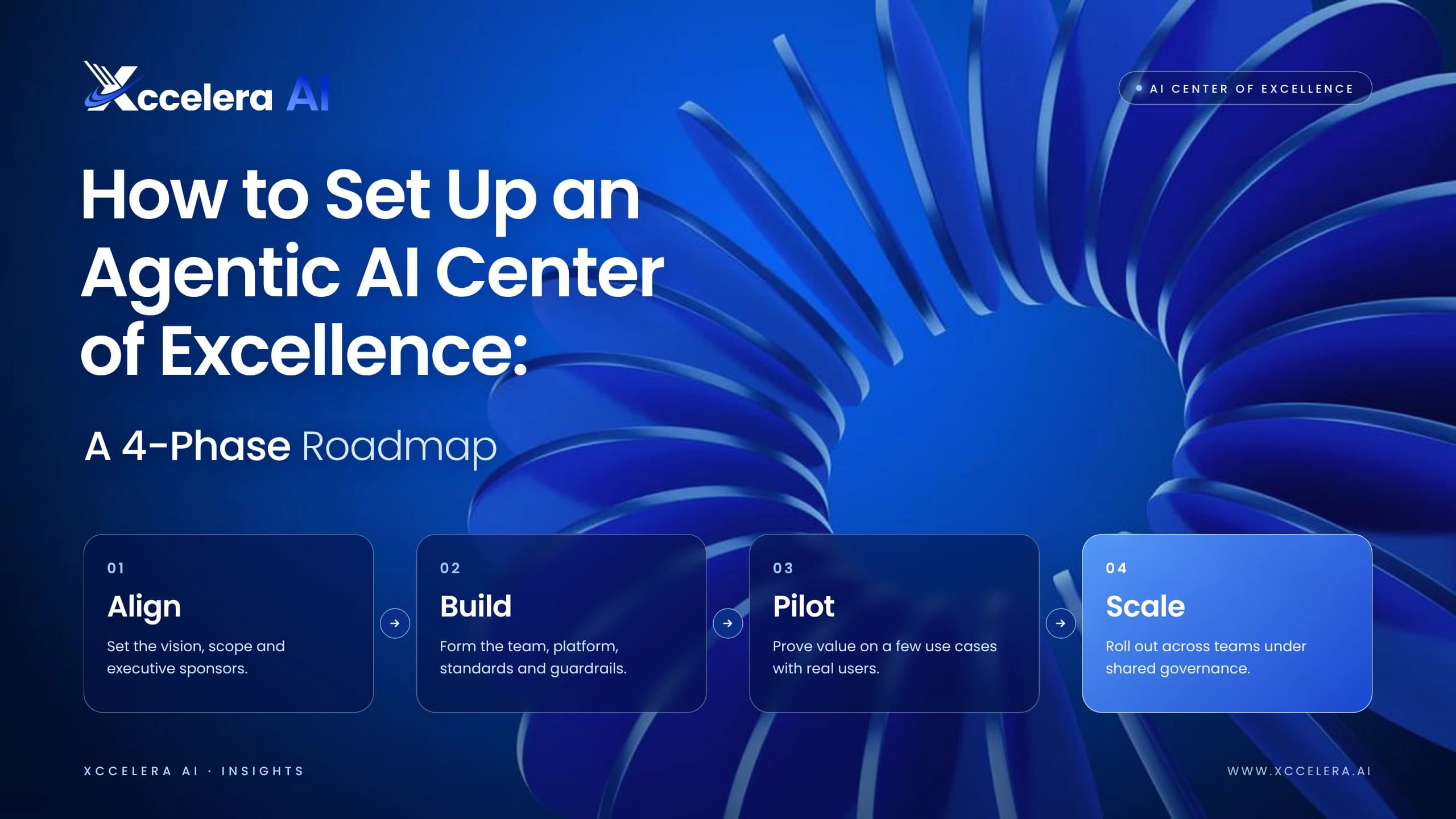
An agentic AI center of excellence (CoE) is a cross-functional team that sets the standards, guardrails and shared platform for building, running and scaling AI agents across an enterprise. You can set one up in four phases: assess readiness, prove value with a pilot, establish the CoE operating model, then scale agents across the portfolio. Xccelera AI designs, builds and runs each phase with your teams.
Most enterprises do not struggle to build their first AI agent. Instead, they struggle with the fiftieth. Microsoft’s guidance on building an agentic CoE puts it bluntly: when every team builds agents its own way, the early agents work, but by the time there are dozens, governance turns into a crisis.
This roadmap shows how Xccelera AI helps enterprises avoid that outcome. It covers what to do in each phase, who to involve, which guardrails to set and how to measure progress. For the wider business case, start with our guide to agentic AI for enterprises.
of agentic AI projects will face cancellation by the end of 2027, Gartner predicts, because of cost, unclear value or weak risk controls
core CoE functions in Microsoft’s framework: govern, enable, optimize and scale
faster time-to-market that Xccelera reports across its agentic delivery programs
Sources: Gartner; Microsoft Learn; Xccelera AI delivery data.
Why Agentic AI Needs Its Own Center of Excellence
Many companies already run an analytics or AI CoE. However, agents change the job. Agents act inside business systems, so the CoE has to govern actions, not only models.
| Area | Traditional AI CoE | Agentic AI CoE |
|---|---|---|
| Main asset | Models and dashboards | Agents that plan, act and coordinate |
| Key risk | Biased or inaccurate predictions | Wrong actions in live systems |
| Controls | Model review before release | Autonomy limits, approval gates and runtime monitoring |
| Integration | Data pipelines | ERP, CRM, ITSM and HR systems through connectors and MCP |
| Delivery model | One-off projects | Agents managed as products with a lifecycle |
That is why Xccelera treats an agentic AI center of excellence as a governed transformation program rather than a tooling initiative.
The 4-Phase Roadmap at a Glance
Use cases, baselines, governance readiness and success KPIs.
Agents in production for selected scenarios, with measured results.
Operating model, agent catalog, MCP framework and enablement.
More teams, standard workflows, reused assets and steady optimization.
Phase 1: Assess Readiness and Pick the Right Use Cases
The first phase answers one question: where will agents create measurable value with acceptable risk? Above all, it sets the baseline for measuring every later phase.
Key activities
Exit criteria
How Xccelera helps
Phase 2: Prove Value With a Governed Pilot
Next, the pilot puts real agents into real workflows. Because the CoE does not fully exist yet, the pilot also tests the governance you plan to scale, such as approval gates and audit trails.
Key activities
Exit criteria
How Xccelera helps
Most pilots fail for predictable reasons, which we cover in why most enterprise AI pilots fail at scale.
Planning your first agentic pilot? We can help you pick the use case and set the baseline in two to four weeks.
Phase 3: Establish the CoE Operating Model
With proof in hand, the CoE becomes permanent. This phase turns what worked in the pilot into standards, shared assets and clear decision rights.
Key activities
Exit criteria
How Xccelera helps
The Four Pillars of an Agentic AI CoE
Central standards, federated execution
A lean central team sets guardrails, evaluation and LLMOps and FinOps standards, while business units build their own agents.
Xccelera Orchestrator
Agentic process automation
Agents work through APIs, connectors and existing automation, so they take real action in business systems.
Connectors and MCP
Risk and governance controls
Release gates, autonomy limits, least-privilege access and audit trails, so controls match each agent’s risk.
Xccelera Guard
Intake and lifecycle
One front door captures agent ideas, ranks them and then manages each agent as a product until retirement.
Agent catalog
Phase 4: Scale Agents Across the Portfolio
Finally, the CoE shifts from building to multiplying. More teams adopt the golden paths, while the CoE keeps optimizing cost, quality and value.
Key activities
Exit criteria
How Xccelera helps
Choosing Your CoE Operating Model
There are three common structures. Most enterprises start centralized or hub-and-spoke, then federate as maturity grows.
One team builds and governs every agent, so control stays tight.
Best when: you are early and need tight control.
A central hub sets standards, while business-unit spokes build within them.
Best when: several units want agents and need shared guardrails.
Business units own delivery, while a thin core owns policy and platform.
Best when: maturity is high and golden paths are proven.
Who Belongs on the CoE Team
A CoE needs few people at the start, but the right mix. The chips show when each role becomes active.
Funds the CoE and removes blockers when teams get stuck.
P1P2P3P4
Runs the operating rhythm and roadmap.
P1P2P3P4
Owns the platform, models and integration patterns.
P1P2P3P4
Build and test agents, then maintain them.
P1P2P3P4
Sets release gates, autonomy limits and audits.
P1P2P3P4
Monitors quality and cost, so spending stays predictable.
P1P2P3P4
Runs training, champions and the maker community.
P1P2P3P4
Own outcomes, so they approve agents in their area.
P1P2P3P4
Governance That Speeds Teams Up
Good governance makes the safe path the fast path. Therefore, Xccelera sets controls by risk tier, so low-risk agents ship quickly while high-risk agents get deeper review.
Automated checks and a light review, then release.
Owner approval first, then scoped access and runtime monitoring.
Human approval for each critical action, because mistakes cost more here.
For a board-ready version of these rules, see building an AI governance framework your board will approve.
The Agent Lifecycle the CoE Manages
Four Ways a CoE Fails, and the Fix
Reviews everything, so teams route around it. Fix: risk tiers and golden paths.
Launched with fanfare, then no rhythm or authority. Fix: a funded sponsor and weekly cadence.
Waits for complete governance before anything ships. Fix: govern the pilot, then improve.
Every team picks its own agent stack, so costs and risks multiply. Fix: one platform and a shared catalog.
The first three failure modes follow Microsoft’s agentic CoE guidance.
Measuring CoE Success
A CoE earns its budget by showing value. As a result, Xccelera reports on four groups of metrics every quarter.
And teams actively building
Agents with owners, tiers and audits
Against the Phase 1 baseline
Plus escalations to humans
Why Enterprises Build Their CoE With Xccelera AI
Xccelera’s role is to design, implement and operationalize the CoE through measurable pilots and scalable adoption. Our enterprise AI transformation team brings the platform, the agents and the delivery experience in one engagement.
Ranges Xccelera reports across its agentic delivery programs. Results vary by scope, systems and team setup.
In addition, the CoE runs on proven building blocks: Xccelera Orchestrator for coordination, Xccelera Guard for governance and 100+ connectors for enterprise systems. You can engage us in the way that fits your budget:
Frequently Asked Questions
What is an agentic AI center of excellence?
It is a cross-functional team that sets standards, guardrails and a shared platform for building, running and scaling AI agents, so teams across the enterprise can deploy agents safely and consistently.
How long does it take to set up an agentic AI CoE?
With Xccelera, assessment takes 2 to 4 weeks and a governed pilot takes 6 to 8 weeks. After a successful pilot, we establish the CoE operating model and then scale it continuously across the portfolio.
How is an agentic AI CoE different from an AI CoE?
A traditional AI CoE governs models and analytics. An agentic AI CoE also governs actions, so it adds autonomy limits, approval gates, connector standards and lifecycle management for agents.
Should the CoE be centralized or federated?
Most enterprises start centralized or hub-and-spoke for control, then move toward a federated model once golden paths and governance are proven.
Who should lead an agentic AI CoE?
A named executive sponsor funds it, while a CoE lead runs it day to day with an AI architect, a governance lead and business domain owners.
How do you measure CoE success?
Track adoption, governance coverage, business value against the baseline, and quality measures such as accuracy, rework and escalations.
What does Xccelera AI deliver in a CoE engagement?
Xccelera delivers the readiness assessment, a governed pilot, the CoE operating model, the agent platform and ongoing scaling, with flexible engagement and outcome-based options.
From First Agent to Enterprise Scale
An agentic AI center of excellence is how enterprises turn scattered agent experiments into a governed, repeatable capability. Start with a sharp assessment, prove value in a governed pilot, formalize the operating model, and then scale with shared assets. For a sense of the delivery problems a CoE solves, read why AI tools alone don’t scale in enterprise delivery.
Start Your Agentic AI CoE
Get a readiness assessment, a ranked use case list and a pilot plan from our AI architects.