COBOL to Java Migration Tools Compared: AI Agents vs Rule-Based Converters (2026)
Last updated: November 2026 READYCOBOL ▸ JAVA 21 COBOL to Java migration tools fall into four groups: rule-based converters, AI coding assistants, general-purpose LLMs and agentic hybrid platforms. Rule-based tools give the strongest equivalence on large mainframe estates, while AI tools give more readable Java. For enterprise portfolios, an agentic hybrid that combines AI analysis,…
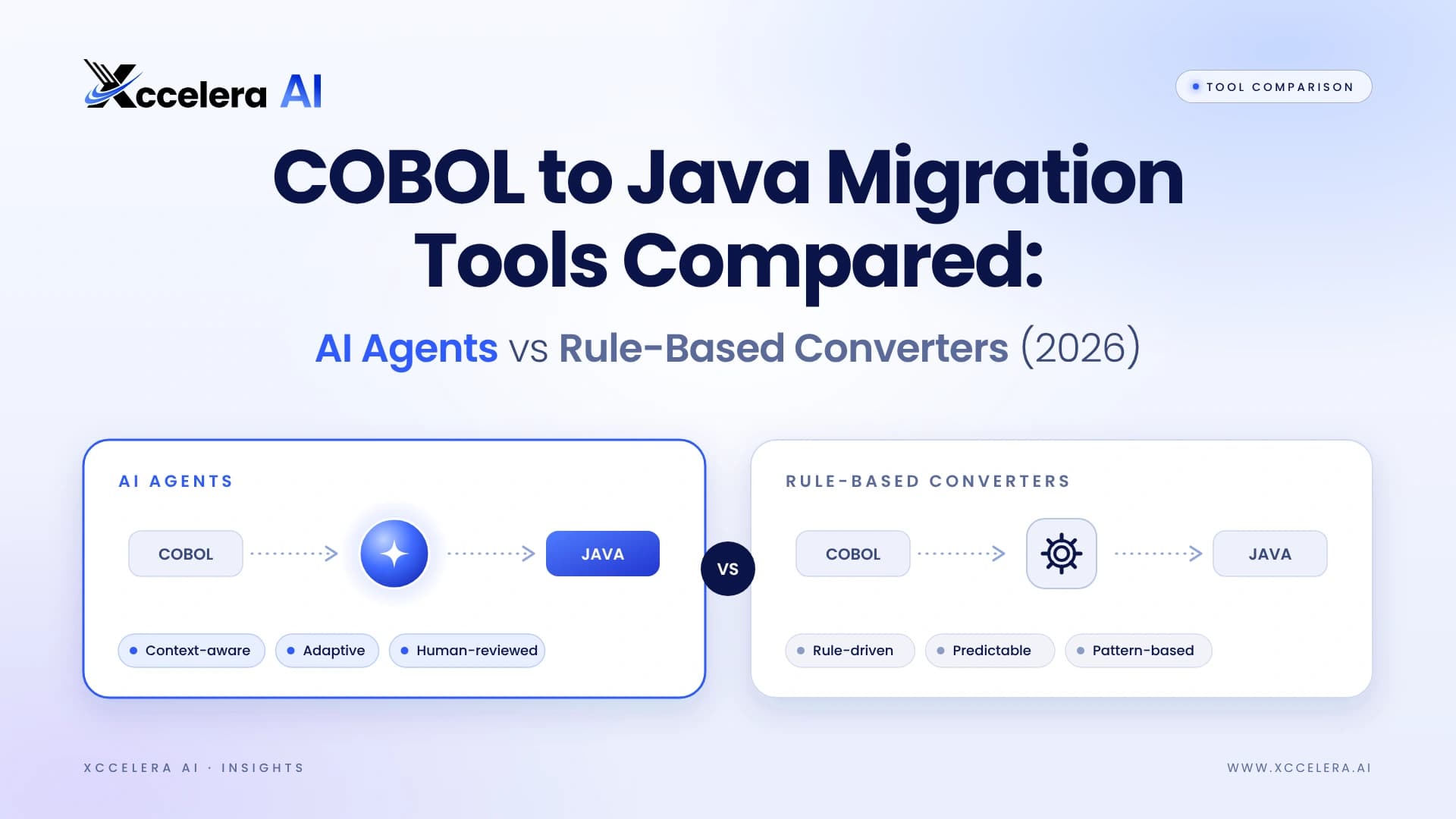
COBOL to Java migration tools fall into four groups: rule-based converters, AI coding assistants, general-purpose LLMs and agentic hybrid platforms. Rule-based tools give the strongest equivalence on large mainframe estates, while AI tools give more readable Java. For enterprise portfolios, an agentic hybrid that combines AI analysis, deterministic conversion and automated equivalence testing usually gives the best balance.
Choosing between COBOL to Java migration tools used to be simple, because there was only one serious option: a rule-based converter. Generative AI changed that. Now teams must weigh accuracy against readability, and speed against proof that the new system behaves exactly like the old one.
This comparison explains each type of tool, shows the difference in real code, and gives you criteria and a decision path for your own estate. If you are still planning the wider program, start with our guide to legacy application modernization with AI.
The Four Types of COBOL to Java Migration Tools
Every tool on the market fits one of four categories. In addition, they sit on a spectrum, from fully deterministic to fully generative.
Rule-based conversion platforms
Compiler-style parsers apply fixed transformation rules across the whole estate, so they also cover CICS, JCL, VSAM and DB2.
Best for: very large, tightly coupled mainframe systems
AI coding assistants
IDE tools use generative AI to explain COBOL modules and then refactor them into object-oriented Java.
Best for: modular code where readability matters most
General-purpose LLMs
Chat models and open-source wrappers translate snippets on request, so heavy manual cleanup usually follows.
Best for: prototypes and small, isolated programs
Agentic hybrid platforms
AI agents analyze and convert code, while deterministic checks and automated equivalence tests prove the result before release.
Best for: enterprise portfolios that need speed and proof
DeterministicGenerative
Jobol vs Idiomatic Java: The Same Rule, Three Ways
The fastest way to compare tools is to look at their output. Below, we convert a COBOL interest calculation three ways. The business rule is simple: charge monthly interest at 3.5% a year and round to two decimals.
01 WS-BALANCE   PIC S9(7)V99 COMP-3.
01 WS-RATE      PIC V9(4) VALUE .0350.
01 WS-INTEREST  PIC S9(7)V99 COMP-3.

    COMPUTE WS-INTEREST ROUNDED =
WS-BALANCE * WS-RATE / 12.double interest = balance * 0.035 / 12;
interest = Math.round(interest * 100) / 100.0;
// binary floating point can drift on moneyIt compiles and looks right, yet double cannot represent decimal money exactly. As a result, cent-level differences appear over millions of accounts.
public class PROG0042 {
  BigDecimal wsBalance = BigDecimal.ZERO;
  BigDecimal wsRate = new BigDecimal("0.0350");
  BigDecimal wsInterest = BigDecimal.ZERO;

  void para1000Compute() {
    wsInterest = wsBalance.multiply(wsRate)
      .divide(new BigDecimal("12"), 2, RoundingMode.HALF_UP);
    perform("PARA-2000");
  }
}
The arithmetic is exact, but the structure is still COBOL: paragraph names, global fields and procedural flow.
public record Account(String id, BigDecimal balance) {}

public final class InterestService {
  private static final BigDecimal ANNUAL_RATE = new BigDecimal("0.0350");
  private static final BigDecimal MONTHS = BigDecimal.valueOf(12);

  public BigDecimal monthlyInterest(Account account) {
    return account.balance()
      .multiply(ANNUAL_RATE)
      .divide(MONTHS, 2, RoundingMode.HALF_UP);
  }
}
Exact decimal math in idiomatic Java 21, then proven against the original with equivalence tests using real production values.
Illustrative example. Always confirm rounding and intermediate precision against real COBOL runs.
How COBOL Constructs Map to Java
Good tools handle more than syntax. They also map mainframe constructs to modern Java equivalents, so check how each candidate handles the items below.
| COBOL or mainframe | Typical Java 21 target | What to check |
|---|---|---|
| COMP-3 and PIC 9V99 fields | BigDecimal with fixed scale | Rounding mode and intermediate precision |
| Copybooks | Records or shared classes | One source of truth, not copies |
| REDEFINES | Accessor methods or sealed types | Byte-level behavior stays the same |
| EXEC SQL on DB2 | JDBC or JPA repositories | Null indicators and transactions |
| VSAM files | Relational tables | Keys, ordering and EBCDIC conversion |
| JCL batch jobs | Spring Batch or scheduler jobs | Step order and return codes |
| CICS transactions | Spring Boot services and APIs | Commit and rollback boundaries |
| PERFORM and GO TO | Methods and structured control flow | No hidden fall-through logic |
Rule-based tools usually cover the widest range of these constructs. However, AI-based tools often produce cleaner Java for the ones they support, which is why many enterprises now combine both.
COBOL to Java Migration Tools Compared
In short, here is how the four categories compare on the factors that decide enterprise projects.
| Factor | Rule-based | AI assistant | General LLM | Agentic hybrid |
|---|---|---|---|---|
| Best for | Huge, coupled estates | Single modules | Prototypes | Portfolios that need speed and proof |
| Java readability | Often “Jobol” | Idiomatic | Varies by prompt | Idiomatic, reviewed |
| Subsystems | Broad built-in support | Often manual wiring | Mostly manual | Mapped by analysis agents |
| Testing | Often bundled | Standard unit tests | None | Automated equivalence tests |
| Main risk | Hard-to-maintain code | Subtle logic drift | Silent precision errors | Needs a governed process |
Eight Criteria for Evaluating COBOL Conversion Tools
Use these criteria to score any tool or vendor. The bars, however, show typical strengths of each category, not scores for specific products.
Two criteria deserve extra weight. First, decimal precision, because COBOL fixed-point arithmetic does not behave like floating point. Second, built-in testing, because a converter that cannot prove equivalence leaves the hardest work to you. Our guide on verifying AI-generated code covers the review side in detail.
Which Tool Should You Choose?
Answer these questions in order, because each one narrows the choice. Open each one to see where it points.
01Is the codebase very large and tightly coupled to CICS, IMS or batch JCL?
Yes: you need deterministic coverage of every subsystem. Choose a rule-based platform, or an agentic hybrid that adds equivalence testing and readable output on top.
02Will Java developers maintain the code for the next ten years?
Yes: readability matters as much as accuracy, so avoid tools that only produce Jobol. Prefer an agentic hybrid or an AI assistant with strong review.
03Does the system handle money, interest or regulated calculations?
Yes: rule out tools without exact decimal handling and automated equivalence testing, because small rounding errors become audit findings.
04Is this a small, isolated program or a prototype?
Yes: an AI assistant or general LLM can work, provided an engineer reviews the output and tests it against real data.
Run a Proof of Concept Before You Commit
Every vendor claims high accuracy, so test the claim on your own code. A short proof of concept usually reveals more than any demo.
First, choose one transaction or batch chain that uses shared copybooks and real business data.
Then record real inputs and outputs from production, including edge cases around rounding and limits.
Then ask your Java developers to read, debug and change the output.
Check numbers, database updates, files and batch outputs against the original, because compilation alone proves nothing.
Finally, weigh accuracy, readability and effort to fix, using the eight criteria above.
What Drives Cost and Timeline
Tool licenses are rarely the biggest cost. Instead, these factors decide how long a migration takes and what it costs.
Lines of code, programs and copybooks
CICS, IMS, VSAM, DB2 and JCL in use
EBCDIC, packed decimals and file to SQL
How much proof the business needs
The share of code a tool cannot finish
Undocumented rules only a few people know
However, manual rework is the hidden cost. Some rule-based vendors report automating 70 to 80% of a migration, which still leaves a large share for engineers. For the timeline side, see the legacy rewrite timeline problem.
How Xccelera ReForge Converts COBOL to Java 21
Xccelera ReForge converts COBOL to Java 21 or later versions using the agentic hybrid approach. It follows the analyze, convert and validate method, so speed never comes at the cost of proof.
To see the engine in action, read inside an AI code modernization engine, or explore eight legacy systems you can modernize without a manual rewrite.
Frequently Asked Questions
What are the main types of COBOL to Java migration tools?
There are four: rule-based conversion platforms, AI coding assistants, general-purpose LLMs and agentic hybrid platforms that combine AI with deterministic checks and automated testing.
Is AI better than rule-based COBOL conversion?
Neither wins alone. Rule-based tools give stronger equivalence at scale, while AI gives more readable Java. A hybrid that pairs AI with automated equivalence testing usually gives the best result.
What is Jobol?
Jobol is Java that still follows COBOL structure, with paragraph-style methods, global fields and procedural flow. It runs correctly but is hard for Java developers to maintain.
Can ChatGPT or other LLMs convert COBOL to Java?
They can translate small snippets, but output often needs manual refactoring and can introduce precision errors, for example by using double instead of BigDecimal for money.
Which Java version should you target when migrating COBOL?
Most teams target a long-term support release such as Java 21 or later, so the new system receives updates for years. Xccelera ReForge converts COBOL to Java 21 or later versions.
How do you prove the Java code behaves like the COBOL?
Run the original and converted programs with the same real inputs, then compare outputs, database changes and batch results, including rounding edge cases.
Choosing the Right COBOL to Java Migration Tool
The best COBOL to Java migration tools balance three things: exact behavior, readable Java and proof before release. Rule-based tools win on scale, AI tools win on readability, and an agentic hybrid brings both together with testing. Above all, test any tool on your own code before you commit. For common pitfalls, read what enterprises still get wrong about legacy code modernization.
See Your COBOL in Java 21
Send us a representative program, and we will show you the converted Java and the equivalence test results.